Mandy Bourne is sweating. Again.
She lives on the top floor of a social housing flat in the West Midlands with her 80-year-old mother. Both have health conditions made worse by the heat. Mandy has COPD. When the temperature spikes, her lungs rebel. She can’t breathe.
“The flat is red hot,” she says. “The sun is just beaming in.”
Her inhaler is within arm’s reach. Always.
This isn’t a niche problem. It’s the new normal. Across the UK, solid brick homes are absorbing solar radiation all day like thermal batteries. They hold that heat long after the sun sets. At night, when the body needs to cool down to recover, the walls radiate warmth back into the room.
It’s called the urban heat island effect. In cities, night-time temps can be 7°C higher than in the countryside. It’s deadly. Modelling from a previous heatwave in the West Midlands showed that this effect alone accounted for half the 130 deaths.
Now, the conversation is shifting. The question isn’t just about saving the planet anymore. It’s about survival.
The adaptation gap
For decades, wealthy nations have prioritized mitigation—cutting carbon emissions. It felt morally right. Rich countries made the mess; they should fix it. Adaptation? That was left to the back burner.
In 2023, mitigation got $1.8 trillion. Adaptation got $65 billion. Less than 5%.
Why the skew? Money talks. Heat pumps and electric vehicles can be sold for profit. Painting roofs white? Installing ventilation? Better insulation? These are public goods. They don’t offer easy bankable returns for private investors.
But the doomsday narrative is cracking. Bill Gates recently argued that the obsession with strict temperature targets has diverted funding from interventions that actually save lives now. Climate change won’t end humanity. But heat kills. Today.
Jo Shields knows this firsthand. She heads sustainability for Walsall Housing Group (whg). They manage 23,000 homes. Last summer, residents in Ellum Pointe—a scheme for over-55s—couldn’t cope. So Shields did something improvised.
“We took the community room,” she explains. “Closed all the windows. Put a mobile air-conditioning unit in. We made an internal cool room.”
It was the winter of 2020 all over again, but hot.
Now Shields has to balance decarbonization with heat resilience. It’s a tightrope. And landlords across the UK are walking it.
Is air conditioning the answer?
Britain has historically hated mechanical cooling. We prefer shade. Ventilation. Thick curtains. Passive design.
But is that stance becoming masochistic?
David Lawrence, from the Centre for British Progress, puts it bluntly: we tell people to insulate in winter. We install radiators. Why do we expect them to suffer in summer because of a cultural preference for fresh air?
Air conditioning is standard in offices, hotels, and shops. Yet, we don’t expect it in schools or hospitals. Places where millions of people spend their days. Where heat measurably reduces concentration and endangers health.
Right now, only 5% of English homes have cooling units.
The government’s Climate Change Committee, led by Baroness Brown (engineer Julia King), says we need to change course. Her committee has spent years pushing for hard targets. This year, they delivered a report just as the May heatwave hit.
The findings?
Providing cooling support for the 30% most vulnerable homes, plus cooling in hospitals, would reduce 40% of predicted heat-related deaths by 2050.
They’re recommending air conditioning in hospitals and care homes within 10 year. Schools within 25.
This clashes with years of government advice favoring passive measures.
Professor Mat Santamouris, a leading expert on urban overheating, agrees. Machines should be the last line of defence.
“Reflective roofing alone can drop indoor temperatures from 43°C to 30°C,” he notes. “Ceiling fans cost pennies.”
Building glass towers without shade? “Crazy.”
“We cannot air-condition our way out of climate,” Santamouris says. The industry is powerful, yes. But passive cooling creates jobs for plumbers and builders, too.
The political split
The debate is getting ugly. Some London councils are using a “cooling hierarchy” that prioritizes low-energy methods. They’ve even ordered owners to remove AC units.
Conservatives call this “dark ages miserabilism.” Others are calling for an air-con revolution.
Then there’s the subsidy issue.
Since April, England and Wales have offered a £2,500 grant for reversible air-air heat pumps. It’s effectively Britain’s first air-conditioning subsidy.
Silence.
In the first month, only 45 households applied. Thousands claimed the heating-only version instead.
In Scotland, homeowners can get £7,500 via the Home Energy Scheme. But no funding for air-air cooling. Northern Ireland? No universal grant.
And here’s the catch: the England and Wales scheme excludes social housing and new builds.
That shut out people like Keisha in Woolwich, south-east London.
Her top-floor flat hit 43°C in the heatwave. She calls it “inhumane.” She and about twenty neighbours are suing their landlord, PA Housing.
The landlord’s CEO admits residents face “uncomfortably warm temperatures… in homes designed to keep heat in, not keep them cool.”
Keisha is exactly who the new grant was meant to help. But because she’s a social tenant, she’s barred.
The most deprived neighborhoods are seven times more likely to be badly exposed to heat. Yet they are systematically excluded from the funding.
The grid problem
Even if we installed AC in every home, could the grid handle it?
Probably not.
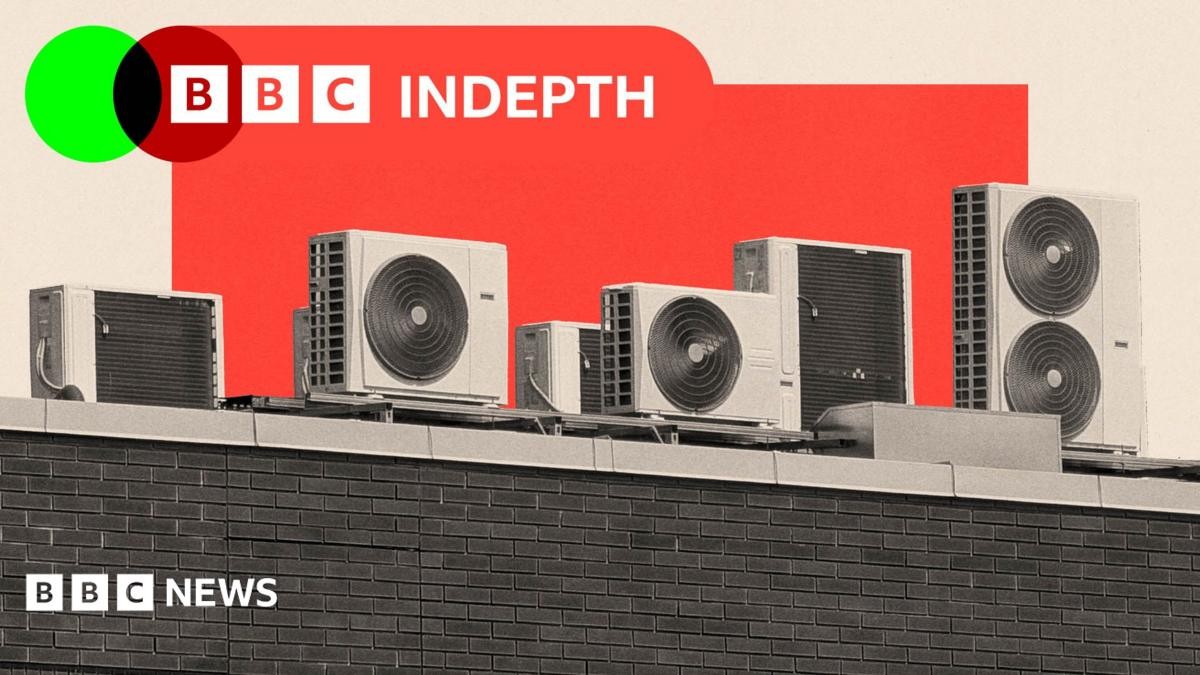
Santamouris points to Tokyo. So many air conditioners are running that the waste heat they pump out creates a secondary heat island. The exhaust adds nearly 1,000 watts of warming per square meter.
“It’s another sun,” he says.
London isn’t there yet. But if we follow the same path, we will be.
Cooling everything mechanically strains the grid and warms the streets, which makes the outside air hotter, which makes people need more AC. It’s a feedback loop.
Santamouris and Baroness Brown agree on the path forward: passive cooling first. Machines only where necessary. Powered by clean energy. And crucially, protect the vulnerable.
France learned this the hard way in the deadly heatwave of 21003. Thousands died because no one had a plan. We are not improvising.
For Jo Shields, the fear is real.
“It’s our survival,” she says. She tries not to think about it most days. “Otherwise it terrifies me.”
Mandy is grateful for the community room. The AC unit runs all day.
“We sit there… it helps so much,” she says. “I want one in my flat.”
Maybe one day, she’ll get it. Or maybe she’ll just keep reaching for her inhaler, waiting for the walls to stop glowing.