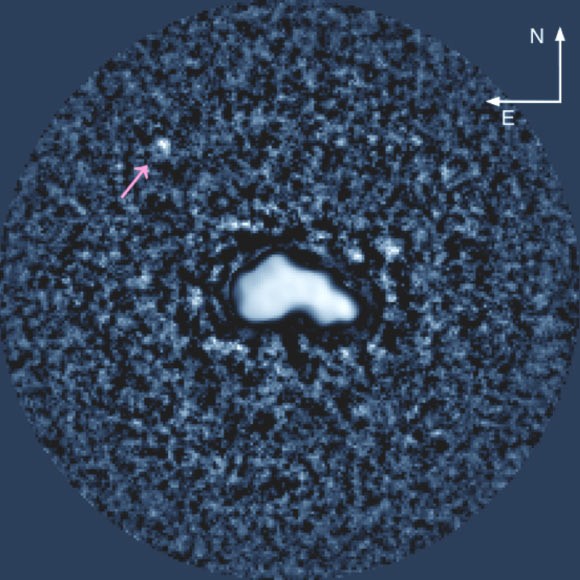
Most asteroids are either lumpy potatoes or spinning tops. This one? It’s something else entirely.
The main belt has long harbored (44) Nysa. It’s big. It’s bright. And up until now, it was just another bright pixel in a crowded sky. That changed today.
New high-resolution imaging has shattered our understanding of this E-type asteroid. We’re looking at a trilobate structure. Three distinct lobes connected by narrow necks. It’s not a bilobate. It’s a trinary.
Why Nysa’s Shape Matters for Solar System Formation
Why does this specific shape matter? Because Nysa is an enstatite-rich body.
Enstatite. You might not know the word, but you’ve felt the result. This material is rare. It’s linked to aubrite and enstatite chondrite meteorites. It’s thought to be the same feedstock that built terrestrial planets. Earth. Venus. Mars. They likely formed from similar stuff.
Nysa sits in the main asteroid belt, but its composition tells a story of early solar system dynamics that few objects can claim. It’s one of the brightest E-type asteroids around. Until recently, we assumed its odd brightness and spectral properties were just surface quirks.
Dr. Kate Minker at Lowell Observatory put it bluntly.
“The most likely explanation is that Nysa is a contact trinary… or an extremely irregular coherent body unlike anything else we’ve seen.”
This isn’t just a fun fact. If Nysa formed from three distinct objects that merged, it challenges simple models of asteroid evolution. Collisions don’t usually result in clean, stable three-lobed structures. They usually result in debris.
Ground-Based Imaging That Rivals Spacecraft
How did they see it? Usually, you need a spacecraft to get this close. Voyager. New Horizons. OSIRIS-REx.
These astronomers used the Very Large Telescope (VLT) and the Large Binocular Telescope (LBT) instead.
They employed adaptive optics. This technology fights the atmospheric blur that plagues ground-based observation. By correcting for the turbulence of our own atmosphere in real-time, they got crisp data.
Dr. Anthony Berdeu from ESO described the technical hurdle. You have to strip away the halo. Asteroids scatter light. That bright halo often hides faint companions or subtle surface features.
“These observations likely represent the closest competition to spacecraft quality imaging ever achieved from the ground.”
They combined SPHERE on the VLT with SHARK-VIS on the LBT. Then they ran sophisticated image processing techniques. The result? A clear view of an 80-kilometer-wide object with three blobs joined by two necks.
It’s not subtle. The data shows distinct separation. The “necks” connecting the lobes are visible. Previous identifications of “necked” asteroids assumed they were bilobate. Two-lobed. Double-lobed. Nysa breaks that mold.
Trinary Contact vs. Deformed Monolith
So, how did it get this way? Two main theories are on the table.
First: It’s a contact trinary. Three separate bodies collided at low speeds and stuck together. The necks are the scars of that merger.
Second: It’s a single monolith that was heavily deformed. A massive impact scrambled it, reshaping a once-coherent body into a three-lobed shape.
Both require violence. But they imply very different histories for the early solar system.
If it’s a trinary, we’re looking at a rare preservation of accretion dynamics. If it’s a deformed monolith, our models of impact physics need serious tweaking.
Dr. Al Conrad from the Large Binocular Telescope Observatory noted that previous clues pointed toward uniqueness.
“For the first time, we can directly investigate… whether those clues point to a deeply indented monolith or a true multi-lobed structure. The new images appear consistent with Nysa being a unique object.”
The discovery of a satellite around Nysa adds another layer. The new moon might hold the key. Orbital mechanics around a three-lobed object are chaotic. A satellite’s orbit could help researchers triangulate the mass distribution. That would settle the monolith vs. trinary debate faster than any other method.
What This Means for Future Searches
We’ve spent decades cataloging asteroids based on brightness and spectral type. We assumed most were simple rocks.
Nysa proves that assumption is wrong.
The paper, led by Kate Minker, is set for publication in Astronomy & Astrophysics. The findings, detailed in the preprint arXiv:2607.257, suggest that trilobate structures might be more common than we thought, just harder to see without advanced adaptive optics.
There’s a satellite out there too. A new companion. Its role in the system’s stability is still being calculated. But one thing is clear: Nysa is not what it seemed.
It’s a three-headed beast of rock and ice, hiding in plain sight in the main belt.
What other anomalies are we missing because our instruments weren’t good enough to strip the halo? There are thousands of bright asteroids we’ve brushed past. If Nysa is one, how many others are waiting in the blur?
Probably quite a few.