Archaeologists have long studied the grand structures of the Roman Empire, but a recent discovery off the coast of Croatia is revealing how the Romans mastered a much more fluid challenge: maritime durability.
By analyzing a 2,200-year-old shipwreck known as Ilovik-Paržine 1, researchers have uncovered the sophisticated maintenance routines that allowed Roman vessels to remain seaworthy across vast distances and long periods of service.
A Hidden Treasure in the Adriatic
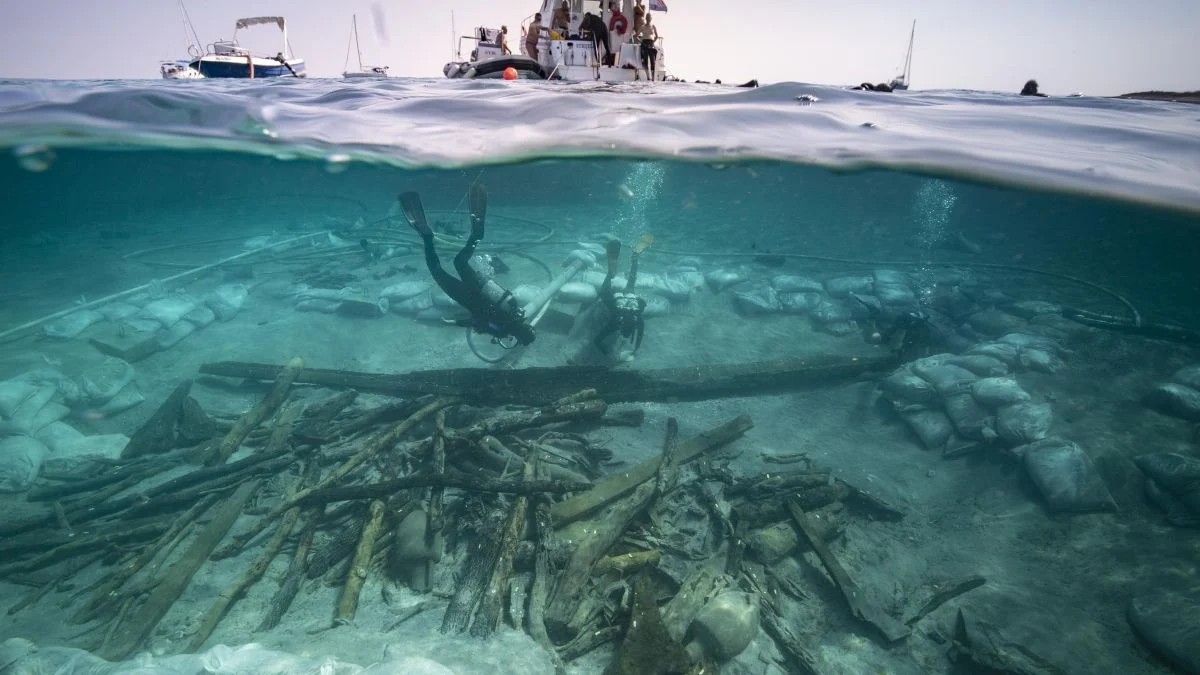
Discovered in 2016 at a shallow depth of just four meters, the Ilovik-Paržine 1 wreck was initially difficult to locate. Over the centuries, the vessel had broken apart and become buried under rocks and sediment.
While this fragmentation might seem like a loss, the burial was actually a stroke of luck for science. By being covered by the seafloor, the wood was shielded from oxygen, preventing the microbes and “shipworms” that typically devour organic matter from destroying the remains. This anaerobic environment preserved not only the wood but also the ship’s cargo of amphorae (storage jars).
The Science of Waterproofing
The real breakthrough came not from the shape of the hull, but from the microscopic traces of what was applied to it. To keep wooden ships from rotting or leaking, ancient shipbuilders relied on organic coatings.
Armelle Charrié-Duhaut, an archaeometrist at the University of Strasbourg, notes that while these materials are often overlooked in archaeology, they are “true witnesses of past naval technologies.”
Through a battery of molecular, structural, and statistical tests on ten different samples, the research team identified two primary substances:
* Pine Tar (Pitch): A sticky, waterproof resin derived from heated pine.
* A Specialized Mixture: A combination of pine tar and beeswax, designed to make the coating easier to apply.
This mixture closely mirrors historical descriptions from the Roman naturalist Pliny the Elder, who described a substance called zopissa —a blend of pitch, salt water, and wax scraped from the hulls of ships.
Tracing a Maritime Journey via Pollen
Perhaps the most ingenious aspect of this study was the use of pollen analysis. Because pitch is incredibly adhesive, it acts as a “time capsule,” trapping pollen from the specific environments where the resin was harvested or applied.
The researchers found a “jumbled mishmash” of flora in the samples, including:
– Coastal and Mediterranean species: Pine, oak, juniper, and olive.
– Shrublands and mountains: Rockrose and the daisy family.
– Wetlands: Alder and ash.
Because this collection of pollen represents diverse ecosystems—from coastal valleys to mountainous regions—it suggests that the ship was not waterproofed just once. Instead, the statistical analysis revealed four or five distinct layers of coating.
A Life of Constant Maintenance
The evidence paints a clear picture of a vessel in constant motion. While the ship was likely constructed in Brundisium (modern-day Brindisi, Italy), it underwent repeated maintenance at various ports along its route.
This discovery changes our understanding of Roman naval logistics. It proves that Roman maritime success wasn’t just about building sturdy ships; it was about a sophisticated, ongoing maintenance culture. The ability to re-coat and repair vessels at different Mediterranean hubs allowed the Empire to maintain reliable trade routes and naval presence across the sea.
“This comprehensive approach allows us to consider the ship as a whole, understanding the techniques used, the phases of its life, its movements, and its environment.”
Conclusion
The study of the Ilovik-Paržine 1 wreck demonstrates that Roman maritime dominance was sustained by a rigorous cycle of repair and specialized chemical knowledge. By using pollen as a biological GPS, archaeologists can now trace the movement and maintenance history of ancient vessels with unprecedented precision.