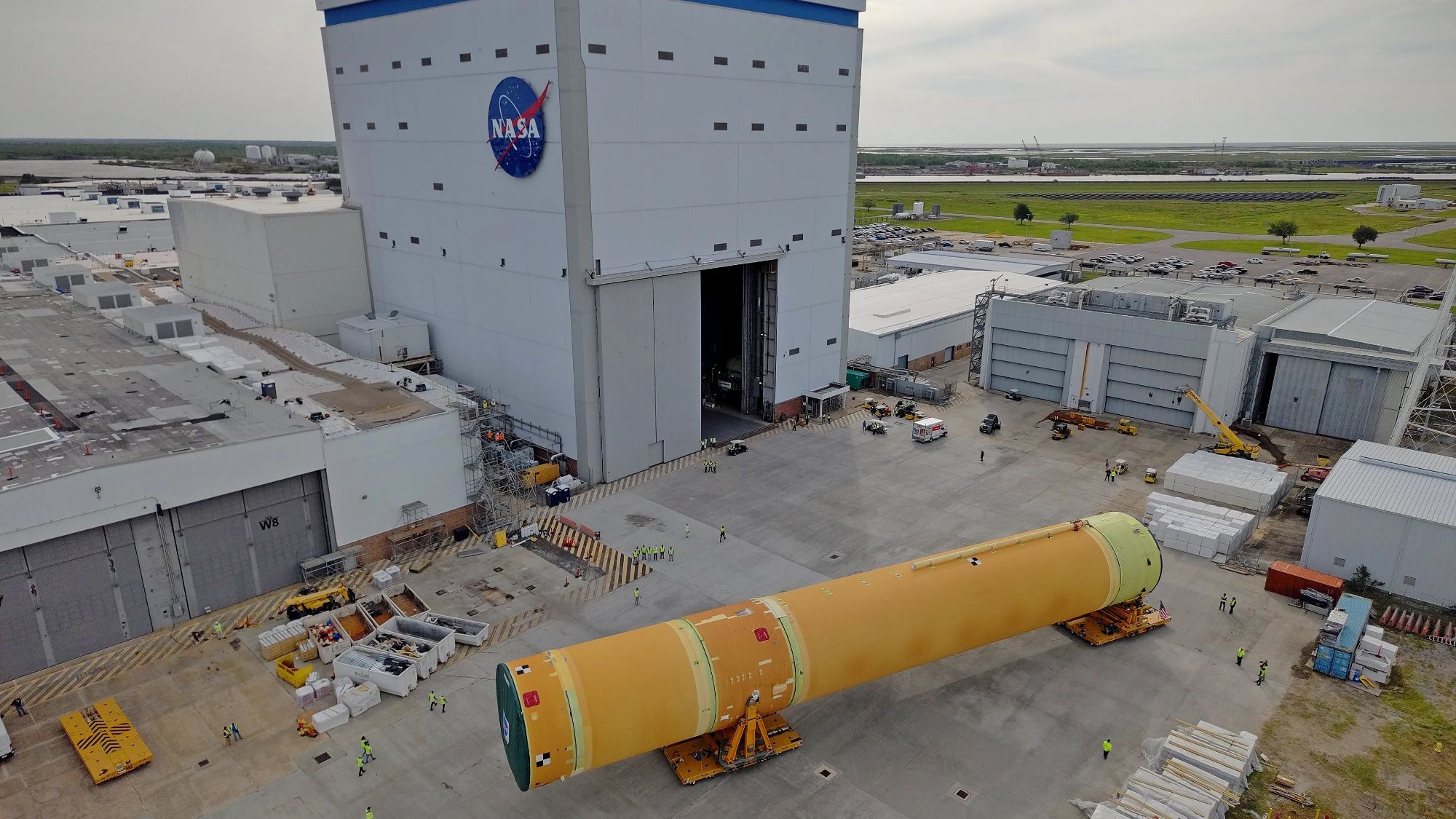
Following the successful completion of the Artemis 2 mission, NASA has reached a significant logistical milestone in its quest to return humans to the lunar surface. On Monday, April 20, the agency began the transport of the massive core stage for the Space Launch System (SLS) rocket, the primary vehicle designated for the Artemis 3 mission.
From Assembly to Transit
The core stage emerged from NASA’s Michoud Assembly Facility in New Orleans before being loaded onto the Pegasus barge. The massive component is currently en route to the Kennedy Space Center on Florida’s Space Coast, where it will undergo final integration.
While the piece is a centerpiece of the rocket, it is not yet complete. The component currently stands at roughly 80% of its final height; the remaining section, which houses the critical engine assembly, will be added during the final stages of construction in Florida. Once fully integrated, the Artemis 3 SLS core stage will stand an impressive 212 feet (64.6 meters) tall.
The Mission Objectives: Testing the Lunar Connection
The Artemis 3 mission, currently targeted for mid-2027, represents a critical shift from orbiting the Moon to actually landing on it. Unlike previous missions, Artemis 3 will focus on two high-stakes technical challenges:
- Rendezvous and Docking: Testing the ability of NASA’s Orion capsule to meet and connect with a lunar lander in Earth orbit.
- Private Sector Integration: Validating the docking capabilities of private lunar landers. NASA has contracted both SpaceX (Starship) and Blue Origin (Blue Moon) to provide the hardware necessary to ferry astronauts from orbit to the lunar surface.
This mission acts as a bridge to the Artemis 4 mission, slated for late 2028, which aims to land humans near the Moon’s south pole—a region of intense scientific interest due to the potential presence of water ice.
Why This Milestone Matters
The movement of this hardware is more than just a logistical feat; it is a signal of NASA’s transition from theoretical planning to physical execution. The SLS rocket serves as the “backbone” of the Artemis program, providing the immense thrust required to escape Earth’s gravity with heavy payloads.
“This is the backbone of Artemis 3,” stated Lori Glaze, acting associate administrator at NASA Headquarters. “We are one step closer to testing the critical capabilities needed to land Americans on the moon, and ultimately, paving the way for our first crewed missions to Mars.”
By successfully testing these docking and landing systems in the near term, NASA is building the operational blueprint required for much more ambitious deep-space exploration, including the eventual human mission to Mars.
Conclusion
The transport of the Artemis 3 core stage marks a decisive step in NASA’s timeline, moving the program from orbital testing toward the complex reality of lunar landings and private-sector partnerships.