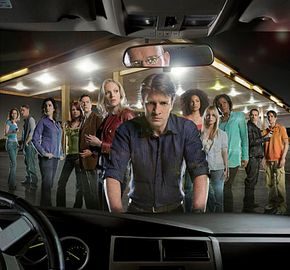
Forget everything you know about how car chases look on television. If you’ve ever wondered how a show can film a high-stakes, cross-country road race in Santa Clarita without putting a single mile on the odometer, the answer lies in a mix of stubborn creativity and heavy-duty visual effects.
Fox’s new series Drive is a wild hybrid. It mashes up the adrenaline of the Grand Prix with the paranoia of a reality TV competition. The premise is simple enough: a diverse cast of strangers gets coerced into an illegal race. The prize? Thirty-two million dollars. The penalty for stopping? Death. It’s Lost meets The Amazing Race, but with stakes that actually matter.
“We’ve created virtual environments, so we do all the driving without taking the cars and people on the road. One of the signatures of the show involves this car-to-car effect that nobody’s ever seen on TV and even in film.”
— Greg Yaitanes, Executive Producer
The fleet of vehicles might suggest a gritty, authentic road trip. You’ve got a Ford Taurus. A classic ’69 Chevy Impala. Even a beat-up gardening truck. But none of these cars leave the soundstage. The actors are suspended in rigs. They stare into green screens. The transcontinental journey happens entirely in the post-production pipeline.
Co-creator Tim Minear (Firefly, Serenity ) and Ben Queen wanted something visually distinct. They didn’t want the standard rear-screen projection tricks that dominate TV. They wanted the essence of 1970s car chase cinema fused with 2007 technology. To pull this off, they brought in Zoic Studios, a visual effects house Minear had previously worked with.
Loni Peristere, Zoic’s visual effects supervisor, admits it took time to crack the code. The challenge wasn’t just technical; it was perceptual. You can fake spaceships. You can hide vampires in shadows. But everyone knows what driving looks like. There is no room for error when the audience can spot a fake tire rotation or an unnatural shadow. The background had to be real. The movement had to be grounded.
The result is what Peristere calls the “Drive” effect. It’s a perspective shift that feels almost omniscient. The camera isn’t visibly bound by rigs. It drifts from the open road, dives into a close-up of a character’s face, and pulls back out to the asphalt without a visible cut. The original pilot featured a seven-minute opening sequence with exactly zero cuts.
Did it stay that way? No. After script rewrites and casting changes, the team broke that glorious run into six segments to accommodate flashbacks. Peristere laughs about it now, calling it “depressing” for a VFX supervisor to lose that continuous shot. But the technique remains unique. It introduces a new style of photography to the small screen.
So, how did they actually shoot it?
Minear explains that the production crew placed cameras all around a camera car on the highway to capture high-resolution background plates. These weren’t simple projections. They were real environments. This allowed the virtual camera to move anywhere within that captured space. It could weave through traffic or slide into another vehicle.
Since physical cameras can’t pass through windshields, the production had to match stunt sequences shot on the open road with precision when the actors moved back to the green screen stage. This required specialized equipment and meticulous planning.
Peristere’s arsenal included a “Caddy Cam”—a Cadillac Escalade fitted with a jib arm on top. This rig could dip to the ground or soar above the cars. They also used specialized lenses to capture the texture of the road.
Crucially, they built multiple versions of each race vehicle. There was an “on-the-road” version with tinted windows for the background plates. Then there was the “on-the-stage” version with no glass at all. This allowed the VFX team to move cameras inside the car, capturing the actors’ performances without the distortion or reflection issues of real glass.
It’s a complex dance of reality and CGI. But for viewers watching Drive, it looks like the cars are actually tearing across the country. The tech hides its own seams. The race feels real. The danger feels immediate.
And the best part? No one actually got hurt. Well, not in the driving department. The tension is all in the editing.
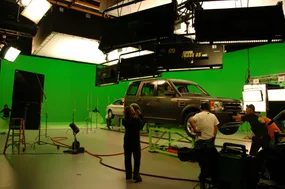
Peristere didn’t just hoist the vehicles into the air for show. He built them up on what he calls air casters. These aren’t your standard hydraulic lifts. They are custom steel rigs equipped with tiny hydrofoils at the base. The result? The cars float. They glide with almost zero friction. You can push a fully rigged sedan with a single finger if you really try.
This setup solved a massive logistical headache. Normally, you can’t park two movie cars side-by-side without them touching or blocking each other’s path. On these floats, the vehicles hover independently. The crew could slide them in any direction with surgical precision. They moved back and forth to the actors inside effortlessly. It wasn’t about suspension. It was about spatial freedom.
Adapting to Green Screen
“You’re driving a ghost car at 80 miles an hour on a set that looks like a giant green box.”
The actors had to sell the illusion that they were tearing up the streets of LA while sitting in a stationary metal box. Ryan Gosling and Bryan Cranston weren’t fighting for traction on asphalt. They were fighting for belief in a vacuum.
The adaptation wasn’t just physical. It was psychological.
Green screen driving requires a different kind of focus. In a real chase, your peripheral vision catches debris, other cars, and the blur of the background. Here, the background is a flat, unlit wall of green cloth. The only movement comes from the projected footage or the vibration of the engine simulator.
Gosling, known for his minimalist approach, had to internalize the speed. He couldn’t look around. He had to trust the rigging. If he leaned too far, the air caster would tilt. If he hit the imaginary brake too hard, the simulation wouldn’t match his body weight shifting.
“The car doesn’t react to you. You have to react to the car that isn’t there.”
This disconnect created a unique tension. The actors were isolated. No other cars were nearby. No pedestrians to dodge. Just the white-knuckle grip on a steering wheel that wasn’t turning. The adrenaline had to be manufactured from pure imagination and the visceral rumble of the engine under their feet.
It’s a marvel of engineering, sure. But the real performance happened in the eyes of the driver. They had to look terrified of a threat that didn’t exist. They had to look exhilarated by a road that wasn’t there. The air casters let the cars move. But it took years of acting chops to make the movement feel real.
The audience sees smooth, weightless drifts. They don’t see the finger-pushes. They don’t see the green screen swallowing the horizon. They just see the movie. Which is exactly what Peristere wanted.
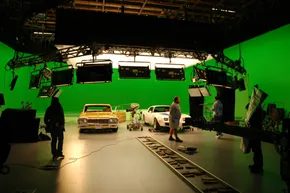
The transition to virtual production isn’t just about standing in front of a green wall. It’s about convincing your body that you are moving through space when you’re actually standing still. Some cast members adapted to the green screen process more easily than others, reports Peristere, who directed or worked closely with the directors on those sequences.
“You have to give them a little driving coaching,” Peristere explains. “When you’re on the road it’s never straight and narrow, it’s always bumpy and fluid. The wheel has little give and you’re constantly correcting for the road. We also had them teach them that when you drive you’re looking six car lengths ahead of you and when things that are happening in their vicinity they have to track with it.”
“I’d say, ‘Don’t forget you’re driving a car!'”
The Best Virtual Driver
Peristere praises Melanie Lynskey, who plays Wendy Pattrakas, a new mom in a minivan on the run from her abusive husband, as “the world’s best virtual driver.”
The former Two and a Half Men actress only learned to drive three years ago.
“I had a terrible phobia of driving,” she admits. “I lived [in L.A.] for four years and took cabs everywhere I went.”
It’s hard to imagine Lynskey navigating traffic with the ease she brought to the green screen set. Her anxiety seems to have vanished when the cameras rolled.
Intimidating but Effective
Kevin Alejandro, who portrays newly-released con Winston Salazar, found the green screen process intimidating at first. “but they’ve done a really good job of keeping the urgency and talking us through it.”
The difference between panic and performance often comes down to guidance. Without it, you’re just staring at green.
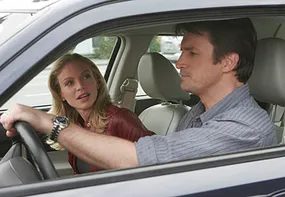
The Art of the Green Screen Drift
“You get used to it after a while, but it’s an acquired skill,” reflects Kristin Lehman, who plays the secretive Corinna Wiles. “It’s like any improv,” adds Michael Hyatt, who as Susan Chamblee is one of three Hurricane Katrina survivors racing together. “We all know how to drive. We just do it on stage.”
Their performances and other elements of every scene must perfectly match the footage previously shot on the road. “We have to match everything — lighting, depth of field, fog, road debris. We have to recreate things like reflections. Everything is choreographed,” states Peristere. He uses a 3-D computer program called Maya “to pre-visualize what the sequence will look like. He built in the highway, the cars, the characters, and the camera equipment so this cartoon version will have the same constraints as the camera car on location does. It’s like a three-dimensional storyboard that lets us know what’s possible so there are no surprises.”
However, problems do arise that need to be fixed in post-production. This process takes twice as long as on “Battlestar Galactica,” Peristere reports, because it’s difficult to simulate real life. On the other hand:
“We can shoot 14 pages of dialog a day on a green screen and put these people in unique locations they could never get to because we are able to composite them there. If you were to do those same 14 pages in the real world that would mean two-and-a-half days of photography on a road with tow-rigs all over the United States with closing down roads and transportation and housing and hotels. If you’re clicking along to the tune of $100,000 a day and you do two-and-a-half days in one, plus visual effects, you’re probably saving 30 percent to 40 percent on those days. It allows us to do more overall. It allows us to be a bigger show and do an eight-day show with the workload of a 10-day show.”
The math is brutal but efficient. Real location shoots for high-stakes driving scenes require massive logistical overhauls. You aren’t just moving cameras. You are shutting down highways. You are housing crews. You are paying for tow rigs to chase down talent. The cost per day hits $100,000 before the ink dries on the contract. Compositing actors into digital backgrounds eliminates that overhead. It turns a multi-day road trip into a single afternoon on a soundstage.
This efficiency changes the show’s DNA. Instead of shooting eight days of footage for a week’s runtime, the team operates at the workload of ten days. They can explore narratives that would be financially impossible on a traditional set. The limitation of the green screen forces innovation. The freedom of the digital highway offers creative payoff.
But the magic is fragile. One mismatched shadow. One off-angle reflection. And the illusion shatters. The audience might not know why. They just feel something is wrong. The actors keep driving. The digital cars keep moving. And the editors keep working through the night to hide the seams.
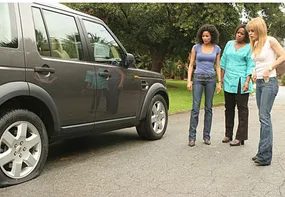
Location scouting isn’t just about finding a spot that looks like a movie set anymore. It’s about building a world that feels real, even when it’s entirely fake. The team behind Drive knows this better than most. They don’t just rely on what’s there. They create what isn’t.
Peristere explains the process clearly. When a scene demands something specific, they send a small unit out. They capture photos from other parts of the country. These images become the foundation for matte paintings. It’s a hybrid approach. Real photos meet digital artistry.
In the first episode, they went to New Orleans during Mardi Gras. The chaos and color of the festival provided the backdrop. Later, in episode three, they sent a unit to Georgia. The goal was simple. Establishing shots had to be clear. They needed to make sure the audience knew these characters weren’t in Los Angeles. The visual cues had to land.
The Cost of Photorealism
Some locations don’t exist in the real world at all. The lighthouse in the opening episode is one such place. It is completely computer-generated. A year ago, this kind of shot would have been impossible. The technology just wasn’t there for that level of photorealism. You can’t have a helicopter flying in and out of a fake environment without it looking like a video game. But the team is using these shots.
“You won’t see too many of those shots because they’re not cheap. But we are using them,” says Peristere.
They aren’t throwing money away randomly. Every CG environment serves a purpose. In episode five, there’s a virtual camera flying over Wendy. She’s moving through a rural area they couldn’t shoot in. The digital camera tracks her movement. The background extends infinitely. It’s seamless.
The next section will look at how these digital tracks compare to their real-world competitors.
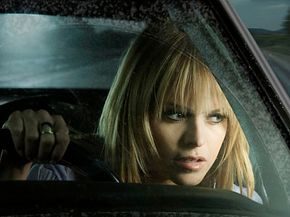
Satellite Tech and the Real Stakes Behind Drive
“Drive” isn’t just relying on standard broadcast tricks. It’s using state-of-the-art tools to map out where competitors actually stand. Satellite graphics play a huge role here.
“Our world is GPS; it’s a way we understand where we are,” notes Peristere.
The show took Google Earth as a direct inspiration. They made a deal with a satellite company to use real images. But raw satellite data isn’t enough for TV. The team painted those images to boost resolution so they work for broadcast television. It grounds the story in a reality we recognize.
Will the First Season End at 13 Episodes?
Pinpointing where characters will land after the initial run is still a bit of a mystery. Minear promises a natural stopping point at 13 episodes. If the show gets picked up, they’ll finish that first race. He doesn’t want the audience to feel like they wasted their time.
“After that, there are ways to roll cast members into another race, give them another function.”
The world is fluid. Some people were working for the race. Others might die if they don’t behave. Some will lose. Some will win. New people can be added at any time. The race evolves. The players evolve. And the things they’re racing for can change entirely.
Why the Pilot Was Scrapped
This fluidity has marked “Drive” from the very start. The original pilot was scrapped. Most of the cast was changed. It’s the same story, but they’re getting into it differently.
In the original cut, the show started on the road. It didn’t visit the worlds these characters came from. The new version fixes that. They visit those origins now. This makes us more emotionally connected to who they are. The characters are much more clearly defined.
Casting Shifts and Character Depth
Look at the roster changes. Taryn Manning played Ellie in the pilot. She also did “Hustle & Flow” and “8 Mile.” Now, Mircea Monroe plays Ellie. Manning took on a new role: Ivy Chitty. She’s a Hurricane Katrina heroine and a struggling musician.
“We found Taryn so interesting and we wanted to find a place for her,” explains Minear.
Nathan Fillion, known for “Firefly” and “Serenity,” took the role of Alex Tully. He’s a landscaper searching for his kidnapped wife.
“He’s Harrison Ford and James Garner put together… a quintessential leading man.”
Fillion sums up Alex as an average guy forced into something he doesn’t want to do. The ultimatum is dire. Win the race or his wife dies.
Alex’s past will be revealed over the episodes. It figures prominently into why he was chosen. And who chose him. Every character has either a desperate reason or a mysterious reason. It all comes out over time.
There’s something each of them can do. It’s not always apparent on the surface.
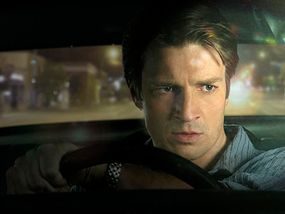
The whole setup feels intentionally shady. It’s Machiavellian by design. Unseen puppet masters are pulling strings behind the scenes, creating a dynamic where alliances shift and motives remain murky.
“Did you ever see that Michael Douglas movie The Game?” Minear asks. “There’s a certain element of that to it.”
People are behind the curtain. They’re either allied with or working against specific teams. Some appear benevolent. Others look like the villains. Monitors line the path, and certain people are already in their pockets.
Minear and Queen also worked hard to avoid being too heavily influenced by The Amazing Race. Though Minear admits there will be crossover elements. He got hooked on the reality show only after watching a set of DVDs.
Queen drew more inspiration from road movies. Specifically classics like The Gumball Rally and Two-Lane Blacktop. But he found them emotionally empty. Too narrow in scope.
“This is the car-chase movie that I never got to see.”
Loni Peristere’s Zoic Studios is busy with the upcoming films Pathfinder, Vacancy, and One Missed Call. They also handled visual effects for the Fox TV pilot for The Sarah Connor Chronicles. Peristere supervised VFX on the independent film One Day Like Rain.
Nathan Filion co-stars with Keri Russell in the indie rom-com Waitress. It’s set for limited release on May 4.
Kevin Alejandro is juggling two roles. He’s recurring as Santos on Ugly Betty. Later this year, he’ll appear in the horror movie Hunter’s Moon and the comedy Strange Wilderness. “I drive a ’69 Impala in that too,” he notes.
Melanie Lynskey joins the ensemble cast of CBS’ western miniseries Comanche Moon. It’s slated to air in November. She also has a cameo in the comedy Big Stan, due out in August.
Taryn Manning has several films in the can. These include the thriller The Speed of Thought, the ’70s-set Your Name Here, Jack and Jill vs. the World, a romantic comedy with Freddie Prinze Jr., and the horror flick The Last Resort, due out in August.
“They’re all so different, so the ‘edgy Taryn’ stereotype is broken,” she says.
Manning is also working on a solo album.
Related HowStuffWorks Articles
- Home Theater Channel
- How Blue Screen Works
- How the Emmy Awards Work
- Inside “The Amazing Race”
- Inside “Serenity”
- How Google Earth Works
- How GPS Receivers Work
- How CGI Scripting Works
- How Satellites Work
More Great Links
- Fox: Drive
- “Drive” Fans
- The “Drive” News Blog
- TimMinear.net