One billion kilometers. That is how far it took.
On July 2 2026 the Tianwen-2 probe finally arrived. It didn’t stop running though it slowed down enough to matter. Just 20 km from 2016 HO3 now. A near-Earth asteroid that acts like a quasi-satellite to our planet.
This kicks off the real work. Before we grab samples before we fly them back to us. There is science to do.
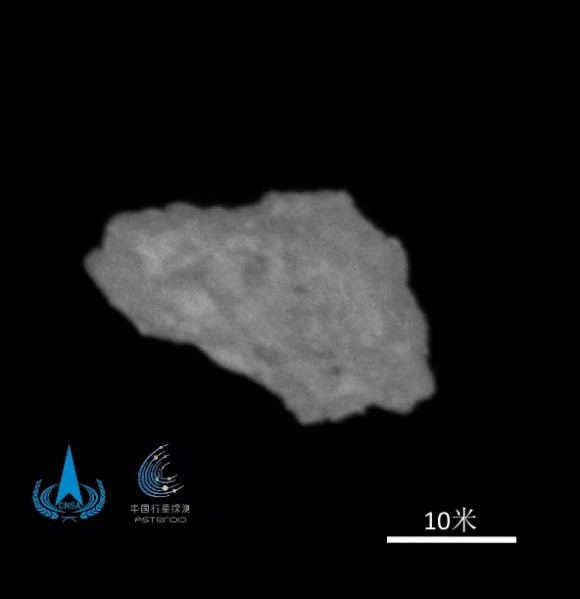
2016 HO3 has a weird name. A longer name actually. Kamo’oalewa. In Hawaiian it means “oscillating celestial fragment.” Found way back on April 27 2016 by Pan-STARRS in Hawaii. It is small too. Only about 30 meters across. Roughly the length of two Olympic swimming pools side by side.
“Among the known near-Earth objects this one is exceptionally rare.”
Dr. Rongqiao Zhang put it bluntly. Most asteroids zoom past. This one hangs out. It shares Earth’s orbital period almost exactly. Stays between 0.1 and 0.3 astronomical units away. Close enough to track. Close enough to talk to. Stable enough to hit with a tiny spacecraft.
How long has it been doing this trick? Only about 100 years. Give or take. It will last another 300. Not forever in cosmic terms but a good run.
Where did it come from? Nobody is sure yet.
Maybe it formed near Earth. Maybe gravity snagged it from somewhere else. Or perhaps—just perhaps—a collision on the Moon blasted this chunk off our natural satellite. The origin remains a mystery. A nice little puzzle to solve.
The Tianwen program has big plans. Four flagship missions total. You remember Tianwen-1? That went to Mars. This one targets small bodies. Next is Mars sample return. Finally a trip to the Jupiter system. Ambitious.
Tianwen-2 does double duty though. After playing with HO3 it will swing around to investigate a main-belt comet called 311P. Two birds one stone.
Launched on May 29 2025 from Xichang. Rode a Long March 3B/G2. Took 400 days of travel. Lots of course corrections along the way. Deep space navigation is tricky when you are aiming for something 30 meters wide that moves like you do.
The approach was steady. June 6: spotted. June 7: capture control at 30 000 km. They joined orbits. By June 19 they were just 2 000 km apart.
Then they got precise. Optical navigation data replaced the blurry guesses from Earth telescopes. Ground observations used to only place the asteroid within hundreds of kilometers. Now? Accuracy is within just a few kilometers.
That is a massive improvement.
Now the cameras roll. Shape composition interior. They need to map it before they touch it. You do not want to grab a rock if you do not know where the solid part is.
What lies beneath the dust of Kamo’oalewa? The data will start coming back soon.