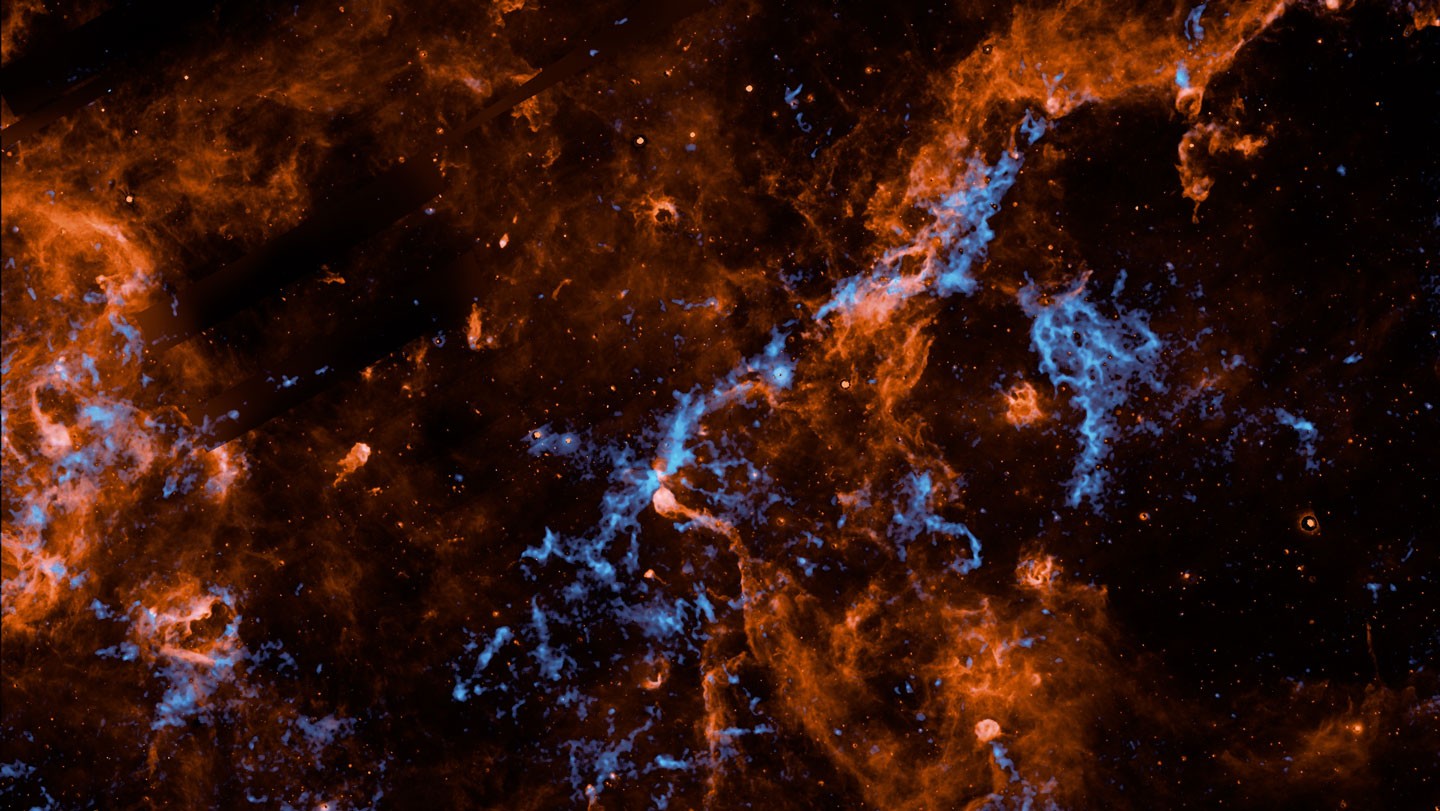
New observations from NASA’s SPHEREx mission have revealed vast, interconnected clouds of water ice stretching hundreds of light-years across the Milky Way. These icy filaments, draped over active star-forming regions, provide a massive reservoir of material that could ultimately form the oceans of newborn planets.
The Cosmic Blueprint for Water
The research, led by astronomer Gary Melnick of the Harvard-Smithsonian Center for Astrophysics, identifies these icy structures within two major stellar nurseries: Cygnus X and the North American Nebula.
The discovery is a significant milestone for several reasons:
* Scale: While previous telescopes like the James Webb Space Telescope (JWST) have mapped interstellar ice, the new maps provided by SPHEREx are dozens of times larger, offering a “zoomed-out” perspective of the galaxy.
* Distribution: The findings confirm that water ice is not just a localized phenomenon but is dispersed across massive expanses of interstellar space.
* Planetary Formation: As stars and planets form from the gravitational collapse of gas and dust, this widespread ice can be swept up into the process.
“If there’s a lot of this ice nearby… that provides a likely answer to how these newly forming worlds could acquire their own oceans,” says Melnick.
How SPHEREx “Sees” Ice
The data comes from NASA’s Spectro-Photometer for the History of the Universe, Epoch of Reionization and Ices Explorer (SPHEREx). Launched in March 2025, the observatory uses infrared technology to survey the entire sky.
Detecting ice in the vacuum of space is a challenge of light and shadow. Because water ice absorbs specific wavelengths of infrared light, it appears as dark patches or “wispy clouds” against the backdrop of starlight. By analyzing these absorption patterns, researchers determined that the ice is likely coating the surfaces of countless microscopic dust motes, creating a “frozen fog” that threads through the densest parts of these nebulae.
Why This Matters for the Search for Life
This discovery adds a vital piece to the puzzle of how life-sustaining environments are created. If much of Earth’s water originated as interstellar ice, then the presence of these massive icy clouds in stellar nurseries suggests that the “ingredients” for life may be a standard feature of planetary formation rather than a rare accident.
The researchers are now working to quantify exactly how much ice is present in these regions. By determining the abundance of water, scientists hope to predict which emerging solar systems are most likely to host planets with vast, liquid oceans.
Conclusion
The mapping of these massive icy filaments reveals that the building blocks of water are widely distributed throughout our galaxy’s star-forming regions. This suggests that the potential for life-sustaining oceans on new worlds may be a common outcome of the cosmic process of star formation.