Cosmic rays.
That’s the name for the charged particles blasting through our galaxy. They move fast. Faster than anything humans have built on Earth. The Large Hadron Collider is impressive. These particles laugh at it.
Mostly, they are protons. Some electrons, sure. But protons.
For decades, astronomers knew there had to be a source. A cosmic accelerator. A “PeVatron.” The problem was proving it. You can’t just look at the sky and say, “Yep, that’s protons.” Not without getting confused.
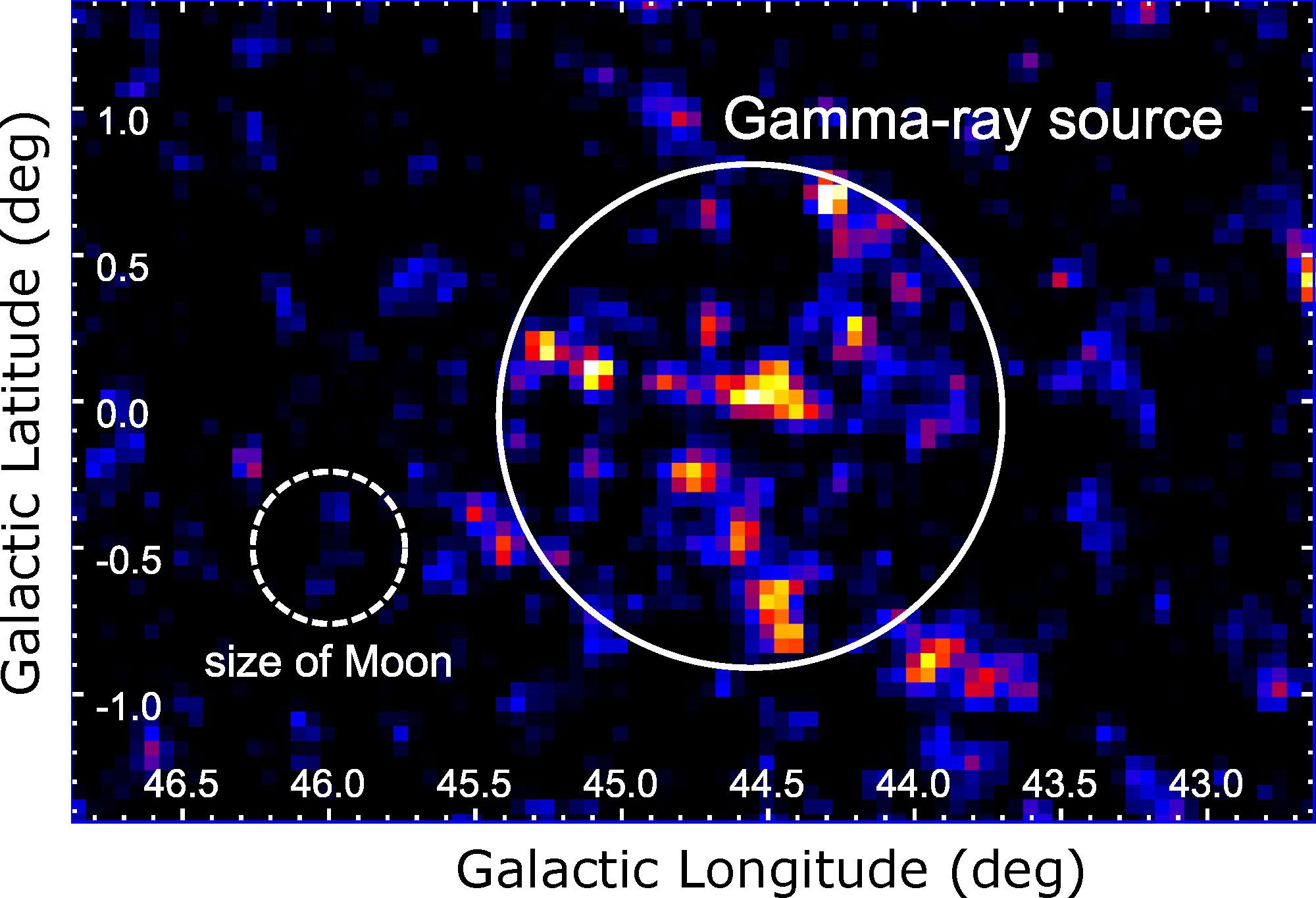
An international team led by Hiroshima University has done it. They confirmed that an object called LHAASO J1911+1014u is indeed a proton PeVatron. This isn’t a guess. It’s not a “maybe.” It’s the highest-energy proton source we’ve pinned down so far in the Milky Way.
Why the Proton Problem Matters
Here is the technical hurdle: gamma rays.
Gamma rays are high-energy light. They pop into existence when cosmic rays smash into things. Usually gas. Sometimes magnetic fields. The issue? Both protons and electrons create gamma rays.
If you see a burst of gamma rays, how do you know which particle caused it?
Electrons are sneaky. They can mimic proton signatures. This has made confirming a “proton PeVatron” nearly impossible for a long time. A PeVatron accelerates protons to energies above one peta-electron volt (one quadrillion eV). That is huge. It’s the energy ceiling for our galaxy’s standard particle accelerators.
“Finding a cosmic-ray proton accelerator above that PeVeV level… is one of the most exciting topics in the modern astrophysics,” Tsunefumi Mizuno said. Mizuno is the lead author and an associate professor at Hiroshima’s Astrophysical Science Center.
We had candidates. Dozens of them. But no proof. LHAASO J1991+1014a sat there, glowing with energy over 0.1 PeV. But without clear differentiation between proton and electron sources, it remained a suspect, not a convict.
Three Arrows, One Target
Mizuno cited an old Japanese proverb. “One arrow is easy to break. Three bundled together, not so much.”
He applied that logic. Instead of relying on one instrument, the team bundled three distinct datasets. They needed to rule out electrons and isolate protons.
- Gamma-rays from space: NASA’s Fermi Large Area Telescope measured gamma rays around 1 GeV. That’s one billion electron volts.
- Radio waves from the ground: Japan’s FOREST survey using the Nobeyama 45m telescope mapped interstellar gas.
- X-rays from space: NASA’s Chandra Observatory watched for faint X-ray emissions.
The results? They ruled out electrons. Cold turkey.
The Smoking Gun: Gas, Gamma Rays, and Silence
How did they know it wasn’t electrons?
Clue 1: The energy span.
The gamma-ray emission didn’t stop. It stretched continuously from over 100 trillion eV down to 400 million eV. According to the physics, an electron accelerator shouldn’t have the power to sustain that shape. Protons could.
Clue 2: The gas map.
Fermi saw gamma rays. FUGIN saw dense clouds of interstellar gas. The maps matched perfectly. High-energy protons smash into gas. Gas hits gas. Gamma rays explode. If it were electrons, the map would look different. Electrons don’t interact with gas to create gamma rays the same way. They interact with light and magnetic fields. The correlation was undeniable.
Clue 3: The lack of noise.
This is the subtle one. If you had a population of high-energy electrons, Chandra would have seen strong diffuse X-rays. Electrons spiral in magnetic fields and scream in X-rays. Chandra saw… almost nothing. Very weak emission. Silence where there should be noise.
“Three pieces of evidence pointed to proton PeVatron,” Mizuno said.
The electrons were ruled out. The gas correlation confirmed the protons. The silence from Chandra sealed it.
LHAASO J11+101u: Where and What
The object sits in Aquila. Near Altair. That’s the bright star that completes the Summer Triangle. We all know that triangle from July nights.
Astronomers initially thought this was a supernova remnant. Just a dead star blowing off its guts. But then they detected emissions over 100 TeV (trillion electron volts). That changed the narrative.
It’s not just a remnant. It’s a working accelerator.
The study, published in The Astrophysical Journal, uses what the team calls “comprehensive multiwavelength modeling.” That’s a fancy way of saying they looked at the source in radio, X-ray, and gamma-ray light and forced the data to make sense. Only one explanation fit: proton acceleration.
Beyond the One Source
This doesn’t end here.
The Milky Way is full of these things. Dozens of other potential proton PeVatrons have been flagged by LHAASO. Now we have a template. A confirmed example. A baseline.
“We now plan to examine those candidates systematically,” Mizuno noted.
We are moving from guessing to verifying. The next step is finding out which of the other glowing blobs in our galaxy are actually pushing protons to quadrillion-electron-volt speeds.
Until then, we know one thing for certain. Space is accelerating protons faster than we ever imagined. And now, finally, we can prove it.
“This research is achieved by team effort,” Mizuno said. “One arrow is easy to break…”
Three arrows. Bundled. Confirmed.