Urokodia fossils from 518 million years ago show the first known structures that became spider fangs. This changes how we understand early chelicerate evolution.
Hidden inside rocks in southern China, a tiny creature waited. For over half a billion years. Then, scientists at Yunnan University and the University of Leicester looked closer. They found two small limbs. These weren’t just legs. They were the ancestors of everything that bites with pincers. Scorpions. Ticks. Spiders.
The study, published in Nature, centers on a marine animal named Urokodia. It lived long before spiders walked on land. Yet it held the blueprint for their most famous weapon. The fangs.
What is Urokodia and where was it found?
You won’t find this in a garden. Urokodia came from the Chengjiang fossil site. Located in Yunnan Province, China, this site is famous for preserving entire ancient ecosystems. The fossils there date back to the Cambrian period. A time when complex animal life was just figuring things out.
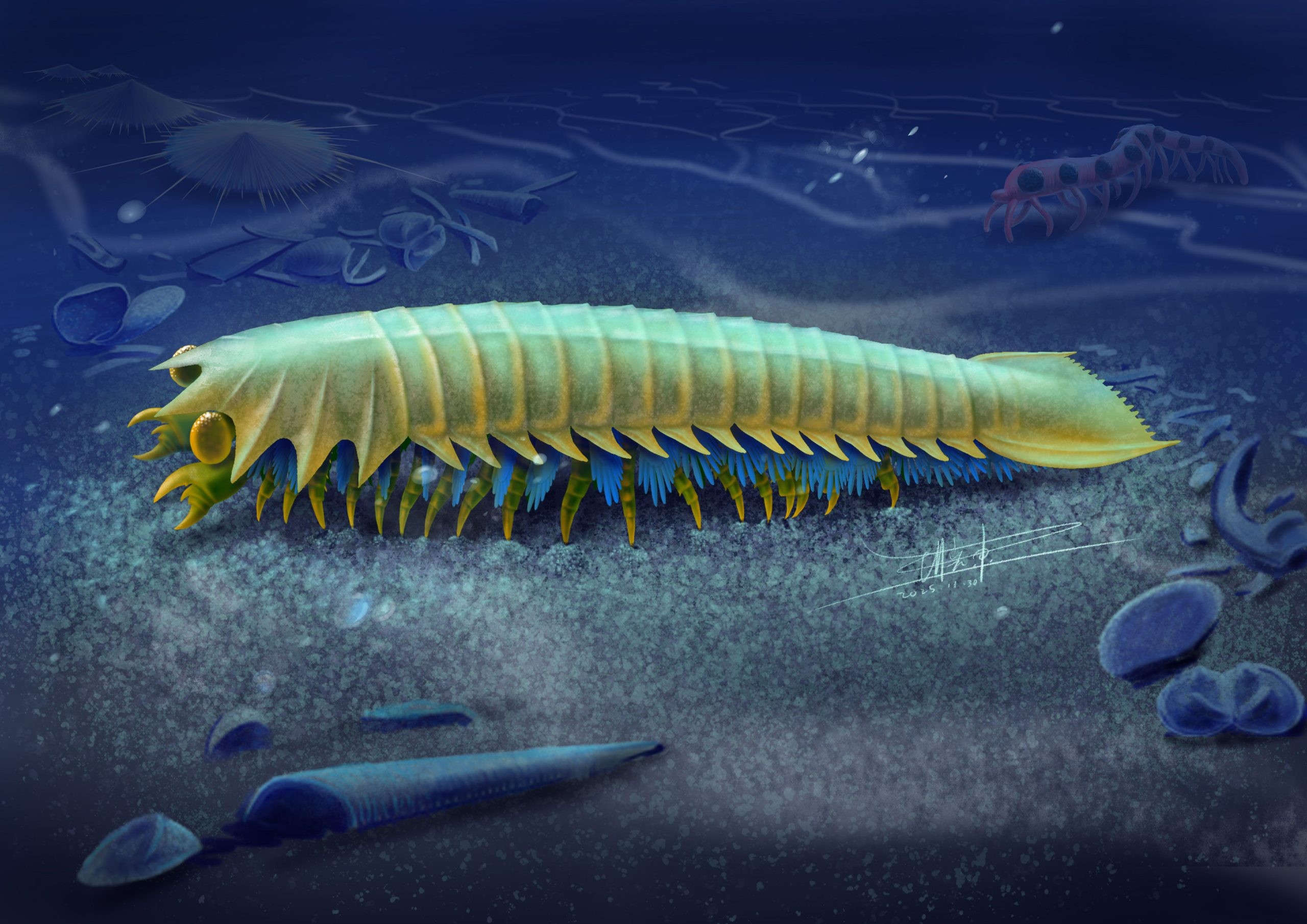
The creature itself was tiny. About 2 to 3 centimeters long. It looked nothing like a spider. Or a scorpion.
- It had a narrow body.
- Segmented like a worm.
- Jointed limbs ran along its belly.
- Large eyes sat on stalks at the front.
At first glance? Hard to classify. Researchers needed to see what was hidden. The rock surrounded it completely. Surface details weren’t enough to place it on the family tree. They needed to see inside. Without breaking the stone.
How X-rays revealed hidden chelicerate anatomy
Enter X-ray tomography. Think of it like a medical CT scan, but for fossils. Scientists collected images from every angle. They built a 3D digital model of what lay inside.
The results were surprising. Soft tissues usually rot away in millions of years. Not here. Urokodia was essentially mummified within the rock. This preservation gave researchers access to details invisible to the naked eye.
The big find? Two pincer-like limbs. They sat right behind the eye stalks. Their structure matched early chelicerae. These are the specialized front appendages that define the group Chelicerata. Today, chelicerae are either pincers (in scorpions) or fangs (in spiders). Urokodia had the former.
“We were using X-ray tomography… when suddenly we noticed the pincer-like legs. We knew immediately this was a distant ancestor,” said Professor Yu Liu of Yunnan University.
The scans showed more than just limbs. The legs featured structures resembling book gills. Layered breathing organs. Like the pages of a book. They pulled oxygen from water. Horseshoe crabs still use similar gills today. This suggests Urokodia breathed much like its modern distant relatives.
Why early pincers mattered for evolution
Chelicerates are a massive group. Over 100,000 species. They have jointed limbs. External skeletons. And those defining front appendages. Urokodia bridges the gap. It shows how simple marine predators developed tools to grip and stab prey.
This isn’t just about bugs. It’s about survival strategies. The ability to seize food efficiently allowed these animals to diversify. They moved from ocean to land. They adapted. The basic equipment for hunting emerged in the sea. Long before the first arachnid crawled out of the water.
People often fear spiders. Movies help. Arachnophobia made them seem like monsters. But the truth is boring. Most spiders pose no threat to humans. Their fangs evolved to catch insects. Small things. Venom was a tool for dinner. Not a weapon for us.
Who studied this ancient fossil record?
The work was led by Professor Yu Liu. He splits time between Yunnan University and the University of Leicester as a visiting professor. Co-author Professor Mark Williams from Leicester’s School of Geography, Geology and Environment called the finds “spectacular.”
They highlighted the broader context. The Chengjiang site holds fossils from over 200 different animal types. It’s a snapshot of the dawn of animals. Urokodia is just one piece of that puzzle. But a critical one.
The study answers a specific question. How did chelicerae originate? The answer lies in these small, pincered marine creatures. They reshaped predation. And they set the stage for everything that followed.
The research was funded by the Department of Science and Technology of Yunan Province and the Yunnan Revitalization Talent Program. The paper, “Urokodia sheds light on the origin chelicerae and book gill of Chelicerata,” appeared in Nature on July 1, 2026.