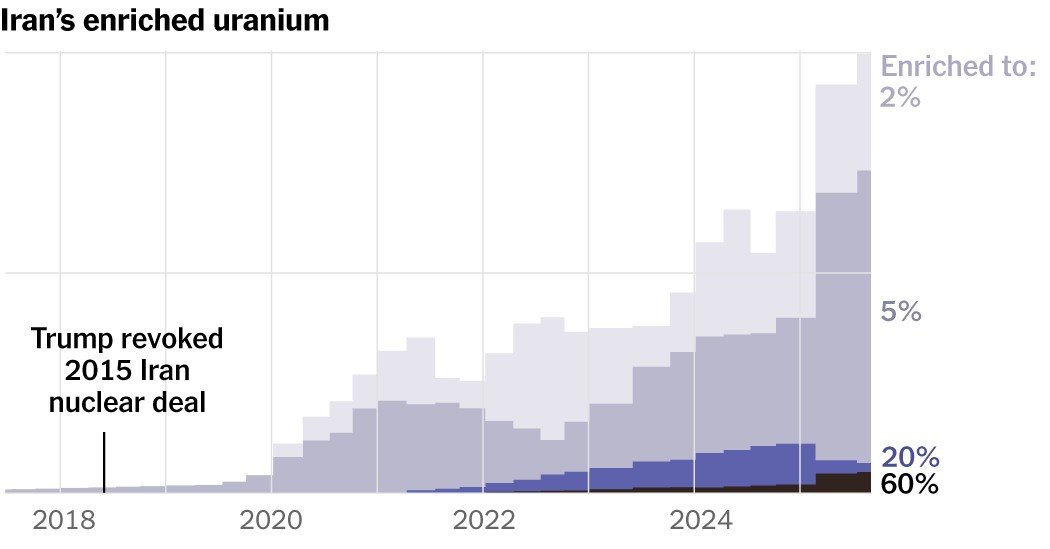
Following years of diplomatic shifts and recent military conflict, a critical question remains at the center of Middle Eastern security: Where is Iran’s enriched uranium, and can it still be used to build a nuclear weapon?
Since the United States withdrew from the Iran nuclear deal eight years ago, Tehran has amassed an estimated 11 tons (22,000 pounds) of enriched uranium. However, following recent military strikes, the exact location and status of this massive stockpile have become a matter of intense uncertainty.
The Physics of Enrichment: Why Concentration Matters
To understand the gravity of this stockpile, one must understand the process of uranium enrichment. Uranium is not a single “level” of fuel; its utility depends entirely on its concentration:
- Low-enriched uranium: Used primarily as fuel for nuclear power reactors to generate electricity.
- High-enriched uranium: As concentrations rise, the process becomes exponentially faster and easier. Moving from 20% enrichment to 60% is significantly simpler than starting from scratch.
- Weapons-grade uranium: The ultimate goal for a nuclear program is reaching approximately 90% enrichment, the threshold required to produce a functional atomic bomb.
A Landscape of Destruction and Secrecy
The geopolitical landscape changed drastically in June 2025, when a 12-day war saw the United States conduct airstrikes against Iran’s primary nuclear infrastructure. The targets included:
- Enrichment plants at Natanz and Fordow.
- Uranium storage tunnels located in Isfahan.
The conflict has created a “black box” regarding Iran’s nuclear capabilities. One month after the strikes, Iran suspended all cooperation with the International Atomic Energy Agency (IAEA). This means the international community has lost its “eyes on the ground.” Without on-site inspections, experts are forced to rely on satellite imagery, which cannot peer through solid earth or thick concrete.
The Challenge of Verification
The 11-ton stockpile is currently a ghost in the machine. Several factors make tracking or destroying it nearly impossible:
- Hidden Locations: Much of the material may be buried under wartime rubble or hidden in undisclosed underground facilities.
- Hazardous Material: Because uranium is both radioactive and chemically toxic, retrieving it from damaged or collapsed sites is a high-risk operation.
- The “Existence” Dilemma: In some cases, it is difficult to even confirm whether the material is still intact or has been rendered unusable by the strikes.
Is a Nuclear Threat Imminent?
Despite the massive scale of the stockpile, military and nuclear experts offer a nuanced view of the actual danger.
While the amount of uranium is staggering, having the raw material is not the same as having a bomb. Experts note that even if Iran were to recover its buried supplies, the technical process of converting that material into a functional warhead would likely take many months, if not over a year. Consequently, most analysts agree that Iran did not pose an immediate, “imminent” nuclear threat at the onset of the war.
The Trump administration has maintained a firm stance, asserting that U.S. satellite intelligence is monitoring the buried caches. They argue that because the physical infrastructure and technical “know-how” were largely destroyed during the strikes, the remaining uranium may be of little practical use to Tehran.
The central tension remains: while the physical material may still exist, the ability to transform that material into a weapon depends on a complex web of infrastructure that has been severely