Recent re-evaluations of radar data from Saturn’s largest moon, Titan, suggest that its vast, flat plains are not composed of traditional rock, but are instead buried under a thick layer of organic material. Researchers believe these landscapes may be covered in up to a meter of “fluffy” organic snow that has drifted down from the moon’s hazy atmosphere.
A Departure from Standard Planetary Models
Titan presents a unique challenge to planetary scientists. Unlike the Moon, Earth, or Venus, which possess relatively straightforward rocky surfaces, Titan’s composition behaves differently under radar observation.
Alexander Hayes of Cornell University and his team recently conducted a deep analysis of data captured by the Cassini spacecraft during its mission from 2004 to 2017. Their findings indicate that the standard models used to interpret planetary surfaces fail when applied to Titan. Instead of a solid, uniform crust, the radar signals suggest a two-layer structure :
- A soft, low-density upper layer: A “blanket” ranging from several centimeters to a full meter thick.
- A harder underlying terrain: The denser material beneath the organic coating.
The Mechanism: Atmospheric Fallout
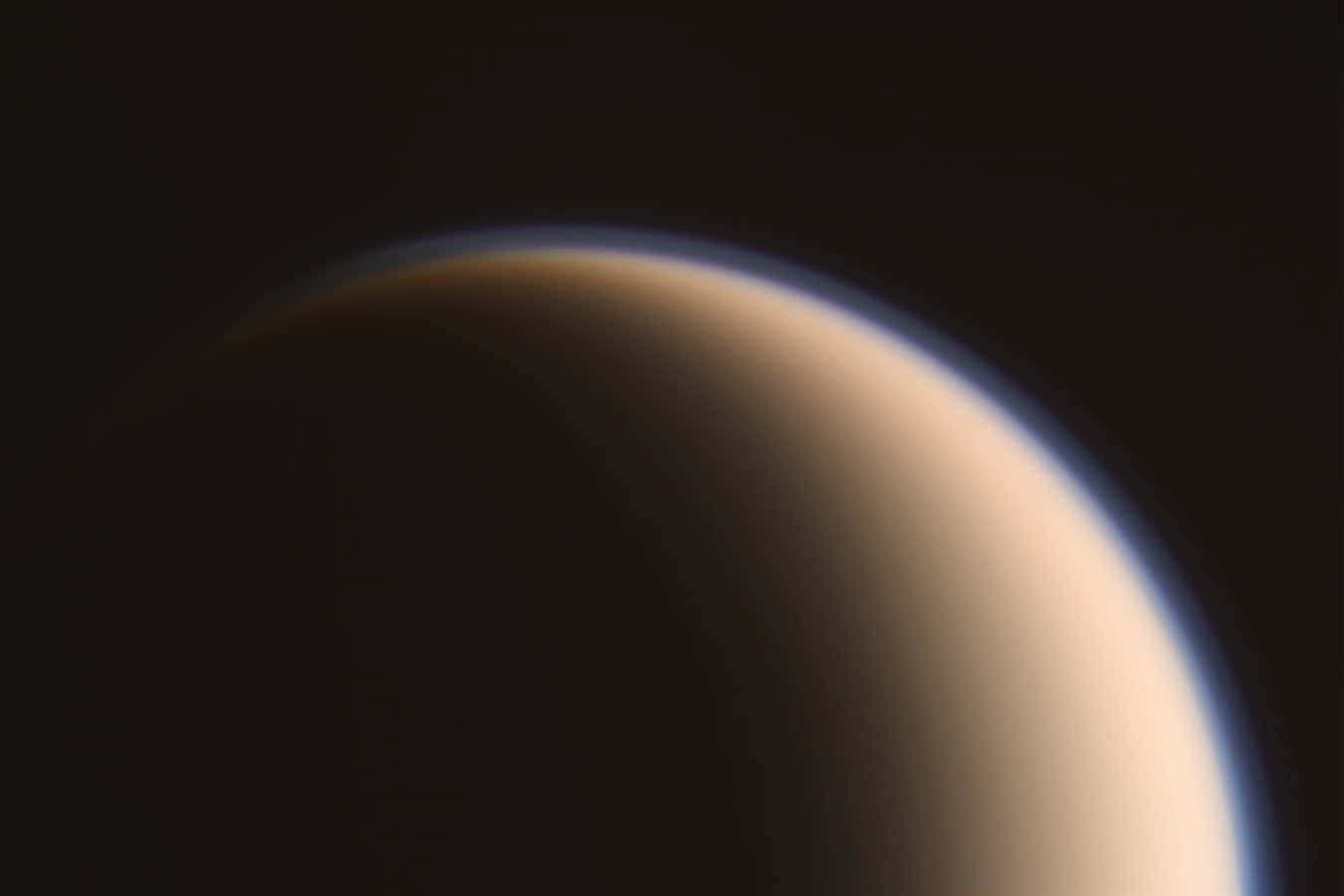
This “blanket” is likely composed of complex organic molecules. Titan possesses a thick, smog-like atmosphere; scientists theorize that these organic particles gradually settle from the sky, much like snow on Earth. Over time, this falling material accumulates, compacting and solidifying to create the strangely uniform and flat plains that cover approximately 65 percent of the moon’s surface.
This process is not static. Titan’s environment is dynamic, characterized by:
– Atmospheric precipitation (rain)
– Wind patterns
– Erosional forces
Understanding how this organic layer builds up—and how it is reshaped by weather—is essential to grasping the broader geological and chemical processes at work on the moon.
Why This Matters for Future Exploration
The discovery has significant implications for the next decade of space exploration. As we move from observation to physical interaction, the composition of the surface becomes a matter of engineering survival.
“Titan is a different beast in terms of the radar-scattering properties of the surface,” notes Hayes, emphasizing that traditional geological assumptions cannot be applied here.
The upcoming NASA Dragonfly mission, slated for launch in 2028, is specifically designed to address these mysteries. Upon its arrival in 2034, the rotorcraft will attempt to measure these layers directly. This data is critical for two reasons:
– Scientific Discovery: It will reveal how Titan’s organic cycle functions.
– Mission Safety: It will inform the design of future landing craft, ensuring they can navigate and land safely on a surface that may be much softer or more porous than anticipated.
Conclusion
By identifying a dual-layer surface composed of organic “snow,” researchers have provided a vital roadmap for understanding Titan’s unique geology. This finding sets the stage for the Dragonfly mission to transition from remote sensing to direct, physical exploration of this complex world.