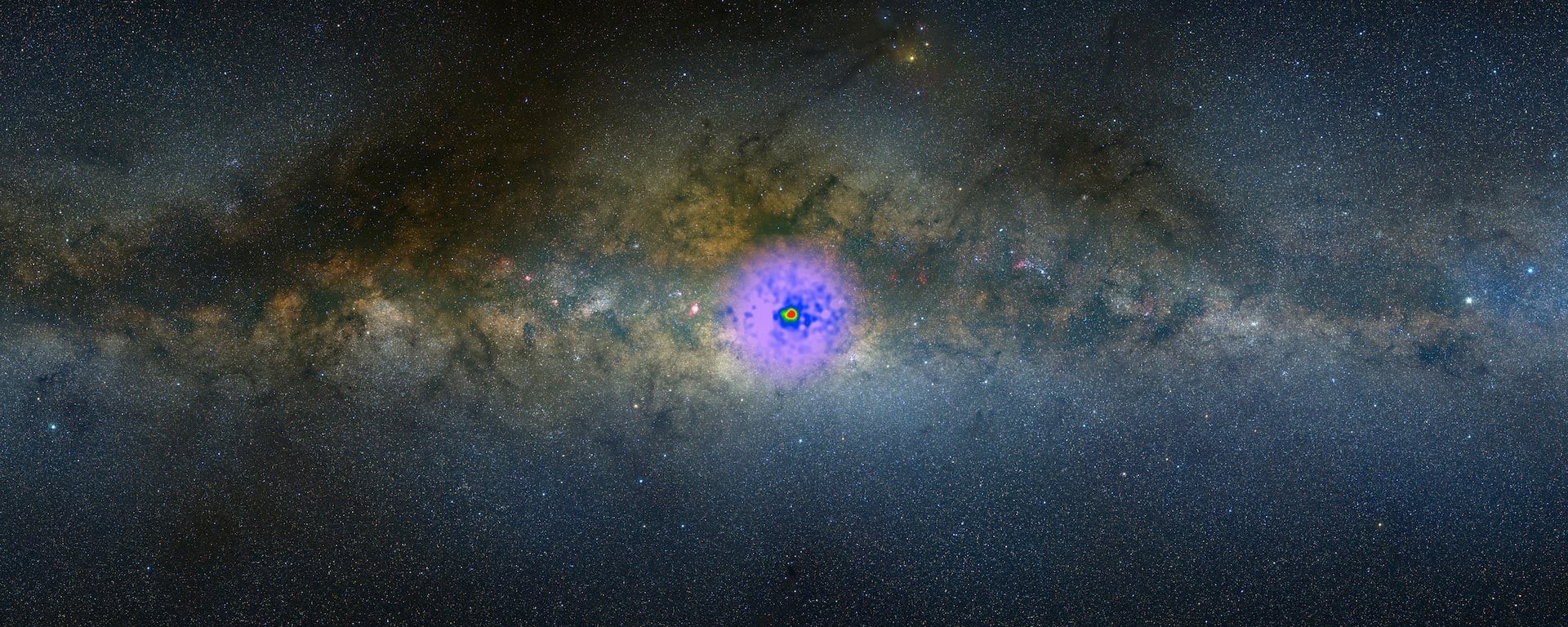
Dark matter is back on the menu.
Or at least it didn’t get kicked off. For years, astronomers have squinted at a strange gamma-ray haze hugging the center of the Milky way, debating whether it was invisible matter dying slowly or just a horde of neutron stars nobody wanted to find.
Now an international crew led by folks from the University of Vienna and Berkeley National Lab has thrown some heavy computation at the problem.
They used machine learning. Specifically, to stare at the data longer than previous teams did. Their new paper in Physical Review Letters suggests that while we still don’t have the final answer, you can’t write dark matter off yet. Not by a long shot.
The Crowded Room
Let’s call it the Galactic Center Excess. That’s the technical name for this roughly spherical, faint gamma-ray glow stretching across thousands of light-years. It’s right at the heart of our galaxy, which is the problem.
It is bright there.
It is crowded there.
It’s like trying to hear a whisper at a metal concert.
One school of thought says this glow is dark matter annihilating itself—a fancy theoretical dance where particles meet and vanish into light. The other camp says it’s millisecond pulsars. Those are rapidly spinning neutron stars. Fast, small, and mostly hidden from plain sight.
Years of standard analysis seemed to back the pulsars. They looked like distinct sources, just blurred out by distance. Dark matter started to look like the odd man out.
“Interpreting the signal is difficult because the Galactic Center is exceptionally bright.” — Florian List, University of Vienna
Standard stats missed something.
Adding the Missing Piece
The old analyses tracked where the photons hit. That’s it.
They ignored how much energy each one carried.
That’s like describing a song but refusing to talk about the melody. You can track the rhythm without the notes, but you won’t know the tune.
To fix this blind spot, the researchers trained a machine learning system on over one million simulated gamma-ray snapshots. For the first time, they looked at location and energy at the same time. A fuller picture. A sharper lens.
And the result?
It flips the script.
If those points of light really are millisecond pulsars, the math says they have to be incredibly faint. We are talking so dim they barely stand out from background noise.
A Sea of Invisible Stars?
Here’s the rub.
If those faint blips are pulsars, there has to be so many of them.
Nick Rodd from Berkeley ran the numbers. We aren’t looking at the few thousand assumed before.
We need at least 35,0 emission sources. Clustered right at the center.
“The sources would have to be so almost indistinguishable from annihilating dark matter.”
Fifty thousand. That is a lot of dead stars packed into the galaxy’s core. It feels crowded. Too crowded?
Does nature really like clustering fifty thousand rapid-spinners in one tight spot?
We don’t know.
The new data weakens the biggest argument against dark matter. It strips away the easy explanation of “it’s just unresolved bright pulsars.”
Does it prove dark matter is causing the glow? No.
Prove that next time.
This just says: stop laughing at the ghost story. It might be a ghost. Or it might be a crowd. We’re still looking in the dark, but we’ve got a better flashlight now.
Maybe we should have added the energy data sooner. Probably yes.