There is a steady stream of power hitting our planet every second. Scientists call it the solar constant, a figure that represents the total radiation energy the Sun delivers to Earth. It sounds like a fixed number, a rigid anchor in the chaotic sky, but the reality is a bit more dynamic than the name suggests.
To understand how much energy we actually receive, you have to imagine a theoretical surface. This surface sits at Earth’s mean distance from the Sun. It is positioned perfectly perpendicular to the Sun’s rays. This setup removes the angle of incidence from the equation, giving us a clean measurement. You cannot measure this accurately from the ground. The atmosphere absorbs and scatters radiation, throwing off the data. We need satellites. Only from space, where the air is thin and the sky is clear, can we get the true value.
The number is approximately 1.366 kilowatts per square metre.
That is roughly the power output of 13 or 14 standard lightbulbs, packed into a single square metre of space. It is bright. It is intense.
But is it constant?
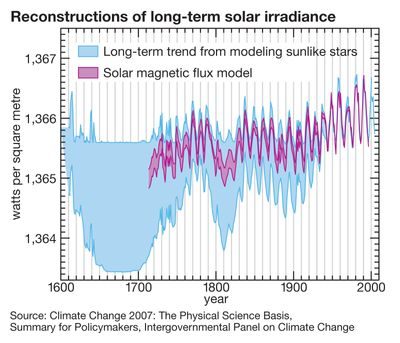
In the grand scheme of things, yes. Over the course of a human lifetime, the variation is negligible. However, look at the 11-year solar cycle, and the picture shifts. The value increases by about 0.2 percent at the peak of this cycle. That might sound tiny, but in energy terms, it is measurable.
Why does it rise? You might expect more sunspots to mean less light. Sunspots are cooler, darker regions on the Sun’s surface. They block out light. When sunspot activity is high, emission drops by a few tenths of a percent. But the Sun has a counterweight. Associated with these active regions are bright spots called plages. These features are more extensive than sunspots. They last longer. Their increased brightness more than compensates for the darkness below. The net result is a slight uptick in total radiation.
The constancy breaks down on a different timeline entirely. We often think of the Sun as a stable furnace that has burned the same way for billions of years. It hasn’t. As the Sun fuses hydrogen into helium in its core, its structure changes. It gets hotter. It gets brighter.
The solar constant increases by about 10 percent every billion years.
This matters. It matters for climate models. It matters for understanding why Earth was frozen during the Hadean eon despite a fainter young Sun. It matters for the future, when that 10 percent increase will drive significant climatic shifts. We are living in a narrow window of stellar stability, receiving just enough energy to keep the oceans liquid and the atmosphere complex.
The number 1.366 kW/m² is useful. It is a baseline. A reference point. But it is not a law of physics. It is a snapshot of a star that is slowly, steadily, waking up.