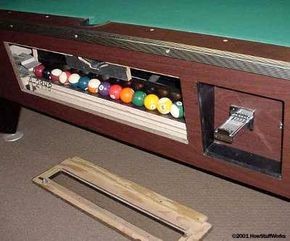
Ever stared at a slot-machine-style pool table in a dive bar or arcade, wondering how that white ball magically reappears in your hand? It’s a mystery of mechanics. Look under the hood and you’ll see a network of chutes linked to the six pockets. Every pocketed object ball gets funneled into a collection chamber, lined up single-file behind a Plexiglas window. Those numbered balls stay locked away until someone drops in a coin.
The real puzzle is the cue ball. It can’t get stuck in that storage bin. If you commit a scratch, that ball has to get out. Manufacturers have tried everything to solve this. They’ve tossed around ideas like light sensors detecting reflections or balance mechanisms weighing balls by mass. Some even proposed a metallic core ball that would trip an electromagnetic sensor.
Most systems just don’t work as well as the two methods actually used today. You either get a bigger ball or a magnetic one.
The Oversized Cue Ball Method
The most common solution is simple geometry. The cue ball is slightly larger than the standard object balls. It’s about 2 3/8 inches (6 cm) in diameter. That’s roughly 1/8th of an inch bigger than the standard 2 1/4-inch ball.
This tiny difference is enough to break the system. As balls roll into the return chute, they hit a gauging mechanism. The smaller numbered balls slip through the gaps. The oversized cue ball is too wide. It gets diverted into a separate chute and drops out an opening on the side of the table. No electronics needed. Just physics.
The Magnetic Cue Ball Alternative
Some tables skip the size difference entirely. Instead, they use a magnetic cue ball. A magnet is embedded in the core of the white ball. When it rolls into the return system, it passes a magnetic detector. The sensor triggers a deflector that pushes the cue ball into the side exit. The numbered balls, lacking that magnetic core, continue on to the storage chamber.
This option appeals to players who hate the feel of a larger ball. But it’s not perfect.
Trade-Offs in Table Mechanics
Both systems work, but each has flaws. Beginners might not notice the extra bulk of the oversized ball. Advanced players often do. That 2 mm difference can throw off your aiming and rolling feel.
Magnetic balls have their own issues. The embedded magnet can alter the ball’s roll. It doesn’t always behave like a true, balanced sphere. Plus, the internal machinery makes the ball more fragile. Drop a magnetic cue ball on a hard floor, and it’s more likely to crack or shatter than its non-magnetic counterparts.
Most modern tables accept either type. You can switch them out depending on your preference or what the house provides. But whether it’s a bigger ball or a magnetized core, the goal is the same: get the cue ball back to you so the game can keep going.
The cue ball is not magnetic.
That last bit might seem contradictory. We just said magnetic cue balls exist. Here’s the nuance: a standard, regulation cue ball used in sanctioned tournaments is not magnetic. It’s just hard plastic or phenolic resin. The magnetic feature is an add-on for coin-op machines specifically. In the professional world, you won’t find magnets in the white ball. Ever.
So next time you’re at the arcade, watch the return. See if it’s the size that saves you or the magnet. Either way, enjoy the game before the lights flicker off.