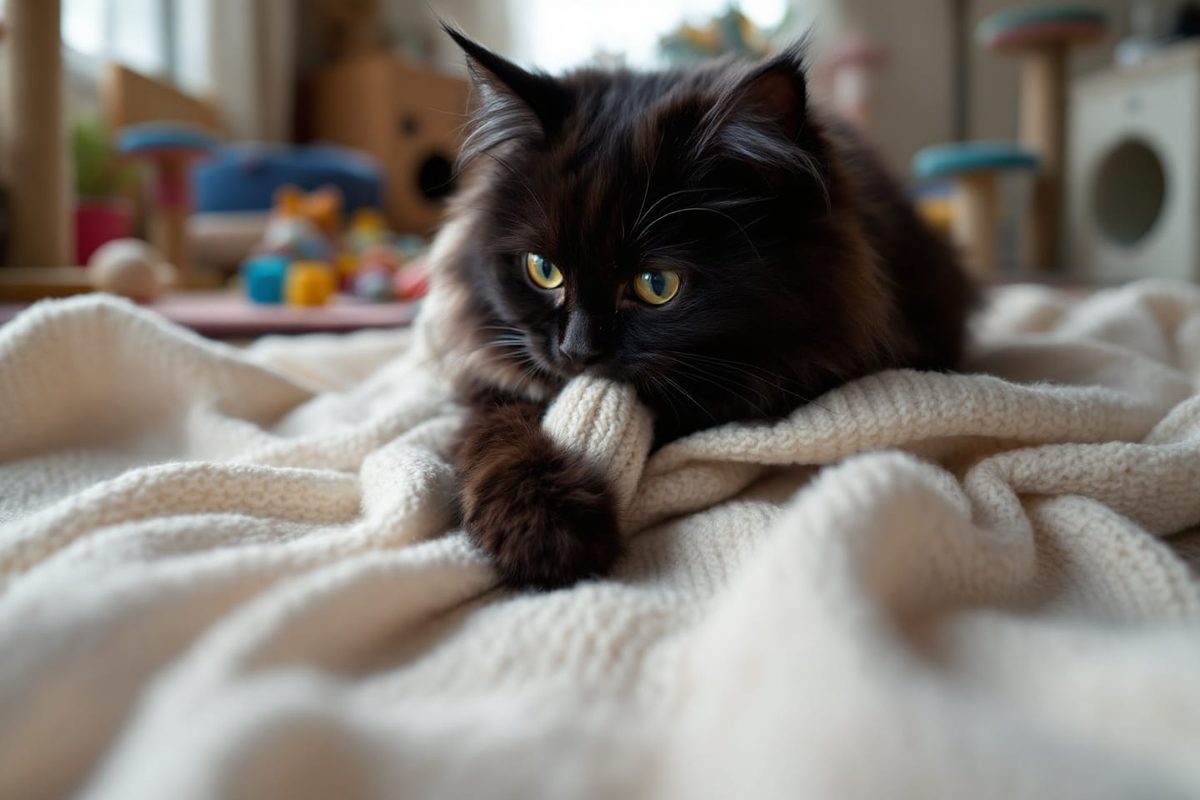
It’s mid-October. The air became sharp. When I opened my closet and took out a new sweater, it had a hole where the shoulder should have been. Another shirt? Covered with small puncture marks. It’s less like laundry damage and more like a cat thinking your jeans are a wrestling ring.
Why do these whiskered beasts ignore the cardboard box next to the basket and attack your clothes? Is it malice? Boredom? Or something deeper?
It’s not just about saving your favorite knits. It’s about understanding what your cat is trying to tell you when it turns your closet into a chew toy.
The instinct behind destruction
Cats are known as graceful and solitary creatures. But elegance aside, you’ll find an ancient predator with very specific needs. When cats attack clothes, they usually don’t mean it maliciously. They react to their environment.
Fresh laundry is the main goal. Why? Because it’s full of your scent. Your scent gives cats a sense of security. Very comfortable. But it’s also a texture that calls for exploration.
If your cat is obsessed with chewing, pulling, or rolling clothes, you may be experiencing one of three things.
- Boredom: In autumn, the days are short. There is a lack of light. If cats don’t get enough mental stimulation, they create their own entertainment. Your clothes are accessible, soft and fun.
- Stress: Changes in daily life can cause anxiety. Have you moved? Is your partner moving? Have you changed your work schedule? Cats feel these changes deeply. Chewing can be a coping mechanism.
- Hunting instinct: Grasping, biting and tearing movements mimic the hunting cycle. It’s hardwired.
When cats chew fabric, they are often trying to control anxiety or release unused energy. This is rarely aggression towards you.
Is it hunger or just habit?
This is where a little-known factor comes into play: fiber deficiency.
Some cats may have an irresistible urge to chew on textiles because their diet lacks certain fibers. They are not hungry. They are starving for the act of chewing. This is especially common in indoor cats who do not have enough natural foraging opportunities.
If your cat seems to focus on chewing but eats regularly, check its food. Are you getting enough roughage? In some cases, simple dietary changes can stop their destructive habits.
How to stop a clothing carnage
You don’t need to buy dozens of new toys to fix this problem. You need to redirect the behavior. Our goal is to make your clothes boring and your cat’s alternatives attractive.
Replace the Target
Does your cat want to bite? Give them something easy to chew.
- Fiber-rich toys: Look for chew sticks and toys made from natural fibers. These allow for oral fixation without damaging the jeans.
- Interactive Play: If they attack your clothes while you’re gone, use the puzzle feeder. These keep their brains and mouths busy.
- Hidden treasures: Wrap the toy in a clean sock or hide it in a box. This adds a layer of discovery that mimics hunting.
Enrich the Environment
A rich home is a peaceful home. You don’t have to spend a fortune.
- Vertical space: Cats feel safe when they can look down into their territory. Even a simple cat tree or a few shelves can make a huge difference.
- Window seat: Window seats offer endless visual stimulation. Birds, leaves, shadows – this is cat TV.
- Natural textures: Offer cat grass or Catnip. These provide the chewy satisfaction they seek in a safe and edible form.
Control Access
In some cases, installing a physical barrier may be the best solution.
- Close the closet: Keep the wardrobe doors closed. This is the only way to keep your sweater safe.
- Manage the laundry: Do not leave dirty clothes in open baskets. Cats are attracted to this smell. If you can’t smell it, you don’t want to bite it.
The Bottom Line
Your cat is not going to ruin your life. They are just trying to communicate. Whether it’s boredom, stress, or a need for fiber, their behavior is a clue.
By understanding the “why” you can fix the “how”. Stop the chewing. Save the sweater. Let your cat be the cat.
The fall wardrobe is safe. At least for now.
Your cat won’t resent your laundry. This is not revenge. He doesn’t even want to learn how to wash dishes. If your cat starts chewing on your shirt, it’s a sign of trouble. boring. pressure. A primal urge to bite. They just express their displeasure in a knowing way.
Recovery is not punishment. This is a redirect.
Fiber obsession can often be stopped by providing suitable chew toys and enriching the environment. But it takes a little creativity. We need to focus on their needs. This is especially true as winter approaches. Outdoor activities are reduced. The days are getting shorter. The cat was trapped inside.
Understanding impulses
Why do cats chew fabric? It’s rarely mean. This is behavioral.
Even adults can develop teeth. Sometimes it’s anxiety. Sometimes it’s just boring. Indoor cats lack the thrill of hunting and exploring. They need an escape route. Clothes provide texture. They provide fragrance. It can be disturbing.
Ignoring this behavior will only make the situation worse. Yelling makes it worse. Cats are associated with stress, not clothes.
Winter factors
The cold changes everything.
Reduce your walking. Avoid sunlight. I started spending more time on the sofa. This feeling of isolation causes anxiety. A restless cat can get into trouble. Your sweater becomes a toy. Your jeans become a chew toy.
This must be compensated. Abundance is the key.
Practical solutions
Let’s start with an observation. Be careful around cats. What triggers chewing? Is it when you are at work? when do you go to sleep When is your house quiet?
Try your solution next. Please change. One size does not fit all.
Chew toys: We offer safe and sustainable alternatives. A rubber toy designed to be chewed. Cat grass. A pillow filled with catnip. The goal is to satisfy your oral fixation without ruining your wardrobe.
Enrichment of the environment:
- Puzzle feeder: Acts as bait.
- Vertical mode: Cat tree. shelf. By the window.
- Interactive game: Laser pointer. Feather reed. daily meetings.
These simple steps will do more than protect your clothes. It can improve your cat’s health. A stimulated cat is a happy cat. Happy cats don’t attack jeans.
Protect your wardrobe
It’s not just about saving fabric. It’s about relationships.
Positively guiding behavior creates trust. Show your cat that you understand him. This is important. Especially during the long and dark months.
The days are short. Cold night. Closing the interior.
Your cat needs your attention. To adapt. deliver.
Conclusion
Don’t panic. Don’t punish.
To observe. Integrate. Suggest an alternative.
The goal is peaceful coexistence. The clothes were in perfect condition. The cat is still happy. It’s not a perfect balance. This is a daily negotiation. But it works.
With the cold weather, the stakes change. Cats’ boredom spikes. Your patience will be tested.
But the solution is simple. News. We offer better options.
Your clothes stay safe. Cats stay sane.
to a large extent.