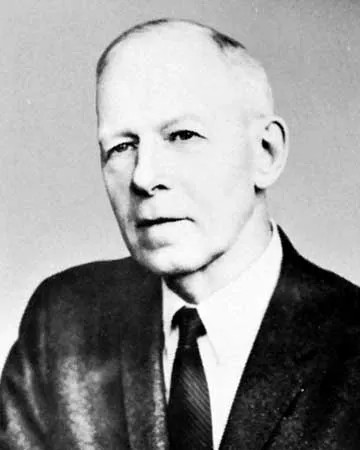
Robert Sanderson Mulliken didn’t just study chemistry. He rewrote the rules of how atoms stick together.
Born in Newburyport, Massachusetts in 1896, he became one of the most influential figures in physical chemistry of the 20th century. He died in Arlington, Virginia in 1986. But his legacy is not in the cemetery. Every textbook explains why water is wet or why iron rusts.
In 1966, the Nobel Committee awarded him the Chemistry Prize. The quote was dry: “Basic work on chemical bonds and the electronic structure of molecules.” Dry text. Massive impact.
From MIT to the atomic bomb
Mulliken’s path was not a straight one. He graduated from MIT. Then came the First World War. He worked for those years – and for several years after that – in the government’s chemical research. Practical stuff. Concrete results.
He eventually pivoted to academia. He studied under physicist Robert A. Millikan at the University of Chicago. He received his doctorate in 1921. Taught for several years at New York University. Then he returned to Chicago in 1928. He stayed there until 1985. Almost sixty years in one place. That kind of longevity changes the way you see the field.
But the real work began in the 1920s.
The Molecular Orbital Breakthrough
Before Mulliken, chemists had a problem. They understood atoms. They understood how electrons orbit nuclei. But molecules? Those were messy. The prevailing opinion was static. Atoms were like building blocks. You snapped them together. The electrons remained in their original places. It was a simplified model. It worked in simple explanations, but failed when reality got complicated.
Mulliken saw the flaw. He argued that the atoms that make up a molecule don’t just sit next to each other. They merge together. Their electron configurations change. They become something new.
He introduced the concept of molecular orbitals.
Instead of electrons belonging to certain atoms, they belong to the molecule as a whole. The electrons are delocalized. They spread. This was a quantum mechanical change. It was radical at the time. It required new mathematics. It required a new way of thinking.
In this framework, he systematized electron states. In 1952, he expanded the theory further. He developed a detailed quantum mechanical description of the behavior of electron orbits when different atoms fuse together.
“The original electron configuration of atoms is converted to a general molecular configuration.”
It wasn’t just a theory. It explained chemical bonding with an accuracy that would never be possible with static models. It answered the “how” of molecular stability. Clarified why some molecules react and others don’t. It mapped the electronic structure with a clarity previously lacking.
War and diplomacy
Mulliken’s science did not remain in the laboratory. World War II drew him into the plutonium project. This was part of the development of the atomic bomb at the University of Chicago. High stakes. Top secret. He applied his knowledge of nuclear and molecular physics to a project that would change global geopolitics.
The world after the war