


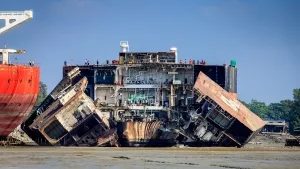
Die Geschichte eines großen Schiffes endet selten im Meer, sondern fast immer an den Stränden Südostasiens. Es ist ein brutaler, langsamer Prozess. Rostige Hüllen liegen im flachen Wasser, umgeben von Ölfilmen, die sich in den Regenbogenfarben der Tonne schillern. Die Elektronik ist weg. Die wertvollen Bauteile sind verkauft. Was übrig bleibt, ist ein riesiges Skelett aus Stahl.
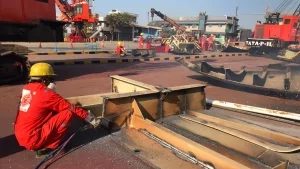
Davor hämmern Arbeiter. Mit einfachen Werkzeugen schneiden sie Metallplatten aus dem Rumpf. Es ist körperlich harter Schindlodrache, der die Existenz vieler Familien sichert. Aber die Folgen sind verheerend. Für die Umwelt. Für die Gesundheit der Arbeiter.
Es gibt einen Ruf nach besseren Methoden. Nachhaltig. Sicher. Und plötzlich taucht ein neuer Name auf: Deutschland.
Die Hongkong-Konvention und ihr Potenzial
Könnten Ozeanriesen eines Tages in Deutschland zurückgebaut werden? Unter strengen Umweltauflagen? Die Frage ist nicht nur theoretisch. Sie hängt an einem einzigen Dokument. Der Hongkong-Konvention.
Dieses internationale Abkommen zielt darauf ab, das Recycling von Schiffen sicherer und umweltfreundlicher zu machen. Es setzt Standards. Es verbietet bestimmte gefährliche Materialien. Es verlangt ordnungsgemäße Dokumentation. Bis jetzt ist es nicht in Kraft getreten. Warum? Weil zu wenig Länder es ratifiziert haben.
Doch die Idee ist nicht neu. Sie ist nur langsam.
“Die Konvention bietet den Rahmen, um Schiffsschrott von einer Umweltkatastrophe zu einer kontrollierten Industrie zu machen.”
Wie wahrscheinlich ist dieser Wandel? Realistisch gesehen mittelmäßig. Langfristig gesehen unvermeidlich. Die Nachfrage nach recyceltem Stahl wächst. Die Kosten für umweltfreundliche Entsorgung in Europa sinken langsam, aber sie sind immer noch höher als in Bangladesch oder Indien.
Wie lange lebt ein Schiff eigentlich?
Um die Recycling-Frage zu verstehen, muss man wissen, wie lange diese Stahlriesen durchhalten. Im Durchschnitt sind sie 25 bis 30 Jahre alt, bevor sie verschrottet werden. Langlebigkeit ist kein Zeichen von Qualität, sondern von überdimensionierter Bauweise. Schiffe sind für die Härte des Meeres gebaut. Nicht für die Weichheit des Recyclinghofs.
Doch die Alterung ist unterschiedlich. Einige Flotten werden früher ausgesondert, weil sie unwirtschaftlich werden. Neue, effizientere Motoren machen ältere Modelle obsolet. Andere Schiffe halten länger, wenn sie gut gewartet werden.
Das Problem: Wenn ein Schiff alt ist, ist es auch voller Schadstoffe. Asbest. PCB. Schwermetalle. Diese Stoffe wandern nicht nur ins Meer. Sie wandern in die Körper der Arbeiter.
Warum Deutschland anders sein könnte
In Deutschland gibt es Regeln. Strenge Regeln. Der Schutz der Arbeiter ist keine Option, sondern Gesetz. Die Umweltüberwachung ist lückenloser. Das bedeutet: Mehr Kosten. Mehr Bürokratie. Mehr Zeit.
Aber es bedeutet auch: Sauberkeit.
Werden Schiffe in Deutschland recycelt, landet der Stahl in einem geschlossenen

It looks like a scene from a dystopian movie, but it’s the daily reality on the beaches of Chittagong, Bangladesh, and Alang, India. These coastlines have become the world’s largest graveyards for ocean giants. About eighty percent of these massive vessels end up here after up to three decades of service. The cost of this final voyage is paid by the environment and the people who dismantle them.
When high tides roll in, crews in these countries drive the ships onto the sand. Then, human labor takes over. Workers take apart the hulls by hand. Most lack protective gear. They are exposed to toxic materials that leak freely into the ocean and groundwater. Their wages are often meager, despite the extreme danger. Anja Binkofski from the German Maritime Museum in Bremerhaven points out that these laborers are rarely shielded from the hazards they face.
This isn’t just an issue for Asian-flagged ships. European vessels are also among those being dismantled on South Asian shores. Under strict European law, this practice is illegal. Yet, it happens routinely. Shipowners simply change the flag. They re-register the vessel to hide its true origin. The motive is purely financial. Legal scrapping in a European yard costs more due to higher labor standards and wages. It is simply not profitable for owners. By bypassing these regulations, they keep their bottom line intact, while the ecological and human costs are outsourced to the Global South.
Why Germany could be the next hub for ship recycling
The argument for shifting ship dismantling from South Asia to Northern Europe isn’t just about geography—it’s about emissions. Binkofski suggests that ship recycling in Germany could turn decommissioned vessels into a local steel resource. The math is stark. Producing new steel is energy-intensive and polluting. Recycling the steel already inside a hull saves 80 to 90 percent of those emissions.
This isn’t just an environmental win. It’s an economic lifeline.
For structurally weak regions and shipyards that have been left without orders, this model offers a second chance. A circular economy centered on shipbreaking could breathe life back into these industrial zones. Currently, recycled steel hasn’t fully entered the mainstream circular supply chain. Interest exists, though. Germany’s first ship recycling permit has been granted. Others are waiting for certification.
Bureaucracy remains the enemy, however.
High labor costs in Germany don’t help. Strict environmental regulations add complexity. Legal frameworks are still fragmented. Binkofski points out a specific bottleneck: repair yards currently can only dismantle 75 percent of a ship under standard rules. The final 25 percent triggers waste management laws, creating a legal gray zone that stalls progress.
The Hong Kong Convention’s promise and pitfalls
A shift may finally come from international law. The Hong Kong International Convention for the Safe and Environmentally Sound Recycling of Ships is set to enter into force on June 26, 2025. Backed by the International Maritime Organization (IMO), it aims to standardize recycling globally.
The goal? Stop toxic paint particles, oil residues, and chemicals from leaking into water or settling in sand. It mandates safe labor conditions and environmentally sound practices. A hazard inventory, already required for EU-flagged vessels since 2019, will increase transparency regarding disposal materials.
But who enforces it?
The convention is politically significant. It is not legally binding. Compliance relies on national implementation, which varies wildly. Binkofski views the June 2025 deadline with caution. A treaty is only as good as its enforcement. Without teeth, standards remain aspirational.

