


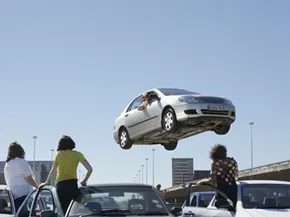
There is no single highway to becoming a precision driver. If you want to slide cars for a living, you just need to find one of the many specialized driving schools scattered around the world. These programs are intensive. They usually last three to five days and cram your brain with the specific maneuvers directors need for film production.
You will learn the art of the 180- and 360-degree slide. This involves spinning the car while locking the wheels. You will practice hard braking to a mark. You will master forward and backward slides where the tires lock up. There is the fishtail, where the rear of the car swings from side to side. Then there is threshold braking—stopping hard without locking the wheels. And the box 90, sliding precisely into a parking spot at a right angle.
These are just the basics. Driving schools charge anywhere from a few hundred to several thousand dollars. You generally get what you pay for. But here is the catch. They cannot place you in jobs. You are on your own. Like any freelance film professional, you are your own boss. The only way to get work is to meet the people who hire or get recommended by someone who already trusts you.
Union Rates and Residuals
To work on union commercials and films, a precision driver needs to be a member of the Screen Actors Guild (SAG) or the American Federation of Television and Radio Artists (AFTRA). Even if the driver’s face never appears on screen, they are paid as onscreen talent. This means a minimum day rate of about $500 for 10 hours of work before overtime kicks in.
The hours count from the moment you are required to be at the location until the assistant director releases you. Not the hours behind the wheel. In fact, the vast majority of your time is spent waiting for the driving sequences to be shot. You sit in the car. You wait. You drive for three seconds. Then you wait again.
Precision drivers also get residual payments if the commercial or TV show airs multiple times. Stunt driving requires additional money in the form of a higher rate or pay bumps. This depends on the level of difficulty or danger. The stunt coordinator usually determines this, but you can negotiate.
But it is not about the money. A driver who works a lot can make well into the six figures. A small percentage of drivers get the bulk of the work. The others do it because they love driving. Where else can you perform a 180-degree slide between two parked cars without getting arrested? Most precision drivers are car junkies who live on adrenaline. They do not live for danger though. Their job is to avoid danger and be in control at all times.
The Art of Precision
Not all jobs require chases and skids. The word precision really says it all. It is more about working in concert with the camera or camera car that is following you. Often, it requires landing the car on an exact mark so the camera can film it from dead center. Start paying attention to car commercials. Notice if you ever see a slide into a stop that is off-center or askew. Dozens of people work hundreds of hours to make sure that nothing is ever off by even one inch.
You might be cut out for a career as a precision driver if you are young, fit, have exceptional driving skills, and you are less than six feet tall. Why? Most of the actors you will be doubling are young, fit, and many of them are not exactly giants. Plus, being smaller in a commercial picture car means the interior looks roomy and spacious. That helps sell cars. It is the only objective of any car spot.
The industry is competitive. The money is good if you are in the top tier. But for most, it is a passion project wrapped in a high-pressure job. You control the machine. You hide in plain sight. You make the impossible look easy. And then you go home and wait for the phone to ring.


