Take a heavy atom like uranium or plutonium. Hit it with a neutron. Watch it crack.
That split is nuclear fission. It isn’t a chemical reaction. It’s something far more violent and energetic. The nucleus divides into two roughly equal fragments. Heavy pieces. Radioactive byproducts. But the real story isn’t the debris. It’s the energy.
A massive amount of energy bursts forth when the atom breaks apart.
This process is the engine behind nuclear power plants. It’s also the mechanism behind nuclear weapons. The difference lies in control. One creates a runaway chain reaction. The other sustains a steady, manageable pulse.
The Mechanics of the Split
Why does splitting an atom release power? The answer lies in mass defect.
The combined mass of the two fragments is slightly less than the original nucleus. That missing mass doesn’t vanish. It converts directly into energy. Albert Einstein’s equation, E=mc², explains this conversion. A tiny bit of mass yields a colossal amount of energy because the speed of light squared is such a huge number.
The fragments fly apart. They carry kinetic energy. They slam into surrounding atoms. Heat rises. Steam turns turbines. Electricity flows.
Controlling the Chain Reaction
Fission doesn’t happen in isolation. The splitting process often releases additional neutrons. These neutrons can strike other uranium atoms. Those atoms split. They release more neutrons.
This is a chain reaction.
If left unchecked, the reaction accelerates exponentially. That’s a bomb. If controlled, the reaction remains steady. That’s a reactor.
Control rods made of neutron-absorbing materials like boron or cadmium are inserted into the core. They soak up excess neutrons. They slow the reaction down. Operators adjust these rods to maintain the desired power level.
Why It Matters Today
Nuclear fission provides a significant portion of the world’s low-carbon electricity. It runs reliably. Unlike solar or wind, it doesn’t depend on weather. It produces no direct carbon emissions during operation.
However, the waste remains. The radioactive fragments from the split atoms stay hazardous for thousands of years. Storage and disposal are ongoing challenges. The technology is powerful. It is also deeply complex.
Beyond Energy
Fission isn’t just about power plants. Medical isotopes are often produced in reactors. These isotopes help diagnose and treat diseases. Cancer therapies rely on precise radiation sources. Some come from fission byproducts.
The science is simple in concept. Split a heavy nucleus. Get energy. The application is where complexity takes over. Safety, waste, and politics complicate the picture.
The physics doesn’t change. The consequences do.
As technology advances, new reactor designs aim for greater efficiency and safety. Small modular reactors promise cheaper, scalable power. Fusion research offers a different path entirely—combining atoms rather than splitting them. But fission remains a cornerstone of the current energy landscape.
We rely on it. We fear it. We manage it.
The atom splits. The energy flows. The question isn’t whether we can do it. It’s whether we can do it wisely.

How Nuclear Fission Actually Works
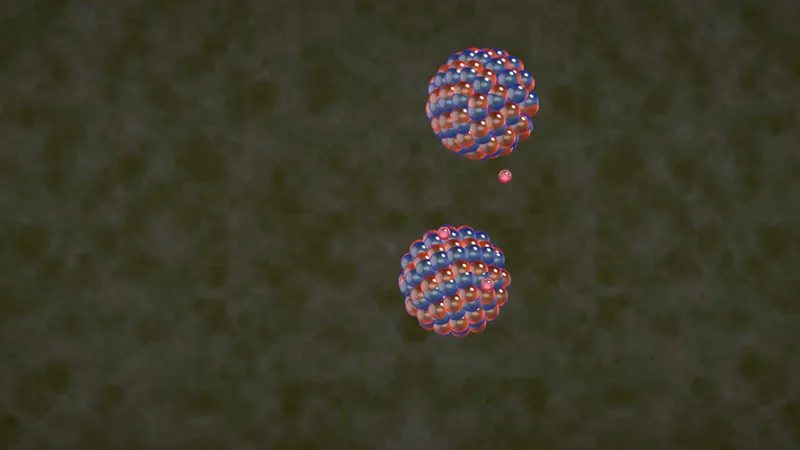
It starts with a split. In nuclear fission, the nucleus of an atom breaks apart into two lighter nuclei. This doesn’t just happen for fun. Sometimes it occurs spontaneously. More often, you have to force the issue.
You can induce the break using particles like neutrons, protons, deuterons, or alpha particles. Gamma rays work too.
Once that nucleus cracks, the payoff is massive.
Energy releases in large quantities. Radioactive products form instantly. Several neutrons fly off into the void.
And here is the kicker. Those freed neutrons? They don’t just drift away. They hit nearby nuclei of fissionable material. Inducing fission there. Releasing even more neutrons.
The sequence repeats. A chain reaction kicks in. Nuclei undergo fission in droves. An enormous amount of energy explodes outward.
Controlled Power vs. Uncontrolled Destruction
Put this chain reaction under control. Do it in a nuclear reactor. You get power. Clean, dense energy for society’s benefit.
Do it wrong. Or do it on purpose. Like in an atomic bomb. The result is an explosion of awesome destructive force.
The same physics. Opposite outcomes. One feeds cities. The other levels them.
The Atomic Age and Its Complications
The discovery of nuclear fission opened a new era. The Atomic Age.
Its potential for good or evil has shaped everything. Sociological shifts. Political upheavals. Economic booms. Scientific leaps.
It also brought grave concerns. The risk-to-benefit ratio isn’t simple. It’s a constant tightrope walk.
Even from a purely scientific perspective, fission remains complex. It presents puzzles. Theoretical explanations are incomplete. We understand the mechanics better than the full picture.
We know how to split the atom.
We are still figuring out what it truly means to hold that power.
The word “fission” wasn’t invented until 1939. German physicists Lise Meitner and Otto Frisch coined the term to describe a heavy nucleus splitting into two lighter ones of roughly equal size. It was the end of a chaotic scientific saga and the start of an intense period of research.
The real story began earlier. James Chadwick discovered the neutron in England in 1932. Enrico Fermi and his team in Italy soon started bombarding elements with these neutral particles. By 1934, they noticed something strange. Bombarding uranium with slow neutrons created four different radioactive species. They emitted beta particles. Scientists thought they had found transuranium elements with atomic numbers 93, 94, or higher.
Radiochemists flocked to study these new isotopes. The results were confusing. Confusion lasted until 1939.
Otto Hahn and Fritz Strassmann in Germany proved definitively that those “transuranic” elements were actually barium, lanthanum, and other mid-periodic table elements. They followed a clue from Irène Joliot-Curie and Pavle Savić in France.
Ida Noddack had suggested in 1934 that lighter elements could form from heavy nuclei. The idea was ignored. It challenged accepted nuclear physics and lacked chemical proof. Hahn and Strassmann provided the proof.
Meitner and Frisch used the liquid-drop model to explain the process. They pointed out the massive energy release. Labs worldwide confirmed the reaction. Within a year, over 100 papers described the process.
The chemical evidence that was so vital in leading Hahn and Strassmann to the discovery of nuclear fission was obtained by the application of carrier and tracer techniques.
How scientists identified fission products
The chemical techniques were crucial. Invisible amounts of radioactive species were created. Scientists deduced their identity by tracking how they moved with known carrier elements.
They added known radioactive tracers. They compared behavior to identify the unknowns. These radiochemical methods have since isolated 34 elements from fission. The range spans from zinc (atomic number 30) to gadolinium (atomic number 64).
The wide range of radioactivities makes fission a rich source of tracers. These are used in chemical, biological, and industrial applications.
Which isotopes cause fission and why it matters
Early experiments used ordinary uranium. It was quickly established that uranium-235 was responsible. It fissions with slow neutrons.
Uranium-238 is more abundant. It requires fast neutrons with energy exceeding 1 MeV to fission. Thorium and protactinium nuclei also fission with fast neutrons.
Other particles work too. Fast protons, deuterons, and alphas induce the reaction. Gamma rays are effective as well.
The invention of the nuclear reactor
In 1939, Frédéric Joliot-Curie, Hans von Halban, and Lew Kowarski found that several neutrons were emitted during uranium-235 fission. This suggested a self-sustaining chain reaction.
Fermi and his coworkers saw the potential. They recognized the power of a controlled reaction. On December 2, 1942, they succeeded.
They operated the world’s first nuclear reactor. It was called a “pile.” It consisted of uranium and graphite blocks. It was built on the University of Chicago campus.
The Manhattan Project followed. It was a secret effort. It developed the atomic bomb after the U.S. entered World War II.
When the war ended, efforts shifted. Scientists developed new reactor types. They aimed for large-scale power generation. This birthed the nuclear power industry.
The fundamentals of the fission process were now clear. The technology had moved from theory to reality. The implications for energy and warfare were immediate. The world changed in ways few could have predicted in 1934.
The secret to nuclear fission isn’t magic. It’s structural. You have to look at how nuclear matter is built. And how stable it is.
Nuclei are made of nucleons. That’s just the fancy word for protons and neutrons. The total count of these particles is your mass number. Simple enough. But here is where it gets weird. The actual mass of a nucleus is always less than the sum of its parts. If you took all those free neutrons and protons and weighed them separately, they would weigh more than the nucleus they created.
The difference between those two weights is the mass defect. And that missing mass? It didn’t disappear. It turned into energy.
Einstein’s equation explains this. E = mc 2. Energy equals mass times the speed of light squared. It is a massive conversion rate. That mass defect is a direct measure of binding energy. Which is basically the glue holding the nucleus together.
Think of it this way. When a nucleus forms, it releases energy. You have to put that same amount of energy back in to break it apart. To decompose it into individual nucleons. The higher the binding energy, the more stable the nucleus. The harder it is to pull apart.
“The difference is known as the mass defect and is a measure of the total binding energy (and, hence, the stability) of the nucleus.”
This stability matters. Because if the nucleus is unstable, it might split. Fission. If it’s stable, it sits there. Waiting.
The energy released during formation is the same energy you would need to supply to destroy it. It’s a closed loop. A tight seal. Mass becomes energy. Energy holds mass together. And that is why some atoms split easily while others sit undisturbed for billions of years.
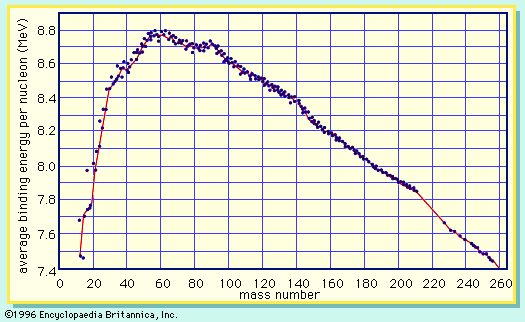

Look at the curve of average binding energy per nucleon. It’s a familiar shape in physics, peaking right around mass number 56. That’s the sweet spot. That’s iron.
The graph tells a simple story about stability. Iron sits at the top of the hill. If you have a nucleus heavier than iron, it wants to split. It wants to break into lighter chunks that sit lower on the energy slope. The difference in binding energy doesn’t just vanish. It gets released. This is fission.
If you have something lighter than iron, the path is different. Those nuclei can gain stability by smashing together. They fuse into a heavier nucleus with a greater mass defect. The mass difference converts into energy. This is fusion. It’s the engine of the sun. It’s the basis of the hydrogen bomb. It’s also the holy grail for clean power generation, a field that has seen decades of active, often frustrating, pursuit.
The Barrier to Spontaneous Decay
Here is where the simple energy model breaks down.
If energy considerations were the only factor, all matter would eventually collapse into iron. Everything would seek that most stable configuration. But it doesn’t happen. The universe isn’t that lazy—or that efficient.
There are barriers. Other factors stop the spontaneous conversion.
To understand why, physicists treat the nucleus like a charged liquid drop. It’s a qualitative analogy, but it holds up. The strong nuclear force binds nucleons together. It’s attractive. It’s powerful. But it’s short-range. It only works between closest neighbors.
Nucleons on the surface have fewer neighbors than those buried in the interior. This creates surface tension. The drop wants to minimize its surface area to reduce energy. The most efficient shape for enclosing volume is a sphere. So, the nucleus assumes a spherical shape.
The Coulomb Repulsion Problem
Protons don’t play by the same short-range rules. They are positively charged. They repel each other via the long-range Coulomb force.
As the nucleus grows larger, this repulsion becomes a serious problem. Once you pass a nucleon count of about 40, the attractive force of the strong interaction struggles to keep everything glued together against the electric push.
The solution? Dilution.
Heavier nuclei maintain relative stability by adding excess neutrons. Neutrons add to the strong force attraction without adding to the Coulomb repulsion. They act as glue, diluting the proton density. You need more and more neutrons as the mass number climbs to keep the drop from flying apart.
This delicate balance defines the limits of the periodic table. It explains why some elements are stable and others decay. It explains why we can’t just let the universe run downhill into a pile of iron balls. The barriers are real. The physics is complex. And the energy locked in those heavy, neutron-rich drops? Still waiting to be unlocked.
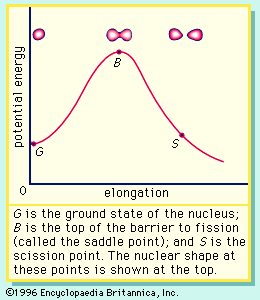

When a nucleus gets excited, it starts to wiggle. It stops being a perfect sphere.
Surface forces jump in immediately. They want to snap the nucleus back into a round shape because a sphere minimizes surface tension. But there is a counter-force. The protons inside are pushing each other away. As the nucleus stretches, those protons get farther apart. The repulsion drops.
These two opposing tendencies create a problem. A barrier.
Figure 2 shows this clearly. The energy curve climbs at first. Why? Because the strong nuclear force—the glue holding the nucleus together—is short-range and potent. It fights the deformation.
But the Coulomb repulsion between protons weakens faster than the surface tension grows. Eventually, they meet in a stalemate.
This is point B.
This specific location is known as the “saddle point.”
In a three-dimensional map of potential energy, this peak looks like a horse saddle. It is the highest point of resistance before the nucleus commits to splitting. If you don’t have enough energy to get over this saddle, nothing happens.
Beyond point B, the rules change. The Coulomb repulsion takes the wheel. It drives the nucleus into further elongation. The protons push harder than the surface tension can hold. The nucleus stretches until it snaps.
This is point S, the scission point. The nucleus breaks in two. Qualitatively, fission is just the result of protons refusing to stay close.
Induced fission
Not every nucleus splits on its own. The height of that energy barrier depends entirely on which nucleus you are looking at.
To force fission, you have to excite the nucleus. You need to hit it with enough energy to clear the barrier. You can do this with gamma rays (photofission) or by smashing a particle into it. Neutrons, protons, whatever works.
Here is where the odd-even nature of neutrons matters. It changes the binding energy.
If you add a neutron to a nucleus that already has an odd number of neutrons, you get an even number. This pairing is stable. The binding energy increases.
If you add a neutron to an even-neutron nucleus, you get an odd number. The binding energy gain is smaller.
This difference explains why some materials split with slow neutrons while others demand fast ones.
Most heavy elements are unstable regarding fission, but they sit in a deep hole. They need a kick to get out.
- Uranium-233, Uranium-235, Plutonium-239: These have odd numbers of neutrons. Adding one more neutron releases enough binding energy to push them over the barrier. Slow, low-energy neutrons work fine.
- Thorium-232, Uranium-238: These have even numbers of neutrons. The binding energy gain is too weak. You need the kinetic energy of the incoming neutron to make up the difference. A fast neutron with about 1 MeV of energy is required.
The math is simple. If the activation energy isn’t there, the barrier holds.
Spontaneous fission
Quantum mechanics is weird. It deals in probabilities, not certainties.
Even in its ground state—the lowest energy configuration, sitting safely below the barrier—a fissionable system has a small, finite chance of being on the other side.
Take uranium-238. It is confined inside the barrier. But quantum tunneling allows it to penetrate the wall. It doesn’t climb over. It passes through.
This is spontaneous fission. No outside influence required.
The probability is tiny. For uranium-238, it takes more than $10^{15}$ years for half the material to decay this way. That is a long time.
But for the heaviest nuclides known, the probability spikes. The barrier becomes thinner. Spontaneous fission becomes the dominant mode of decay. Some of these super-heavy nuclei last only fractions of a second.
This instability is a hard limit. It may prevent the formation of even heavier nuclei altogether. The universe draws a line in the sand, and spontaneous fission is the eraser.
The stages of fission
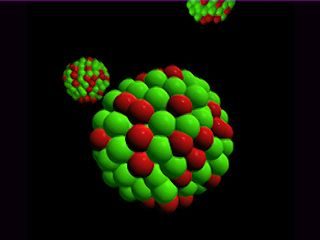

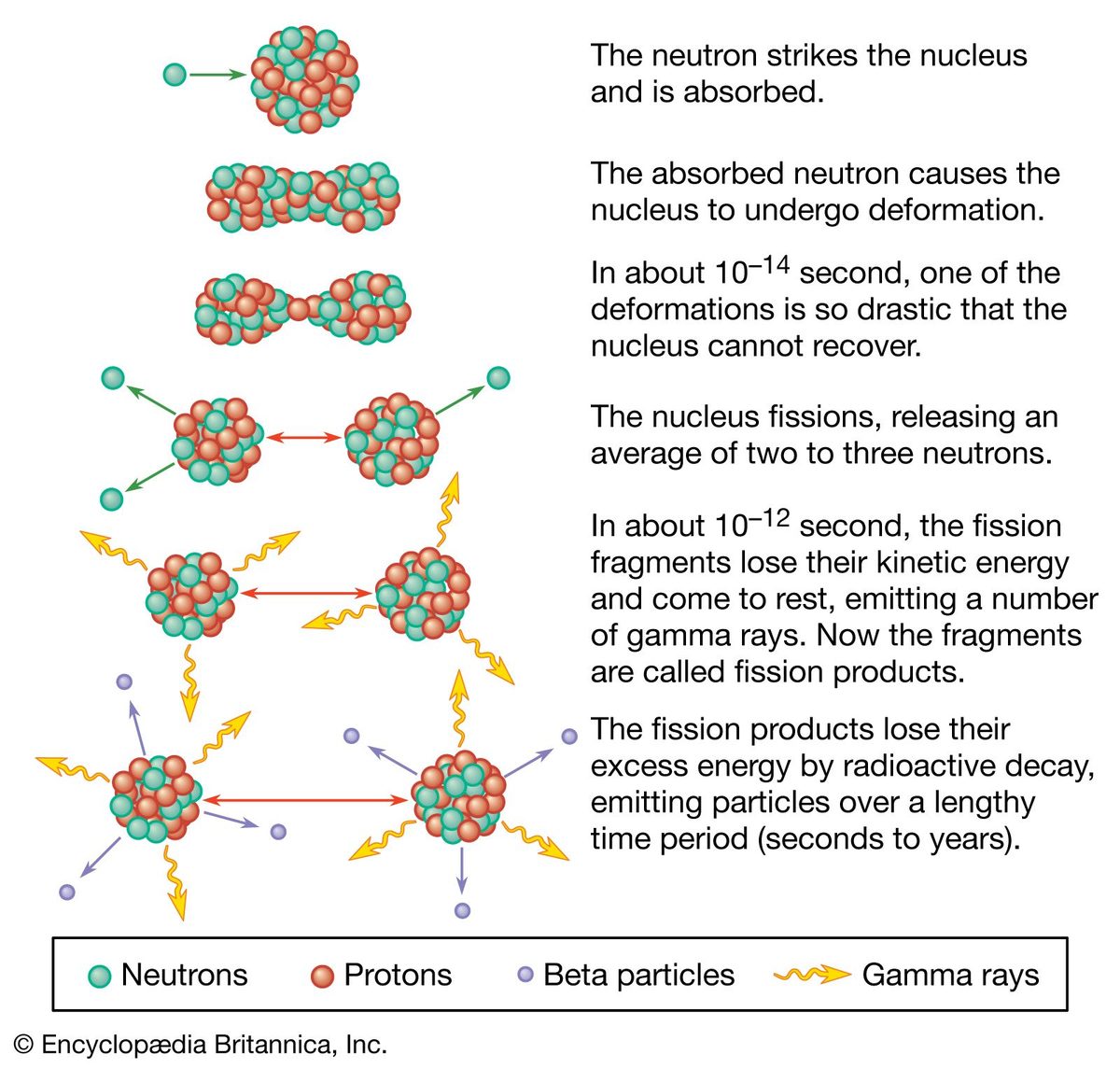

Figure 3 maps out the timeline of a heavy nucleus splitting. The clock at the bottom tells us just how fast this happens. It is not a slow burn. It is violent and instantaneous.
The probability of splitting
When a heavy nucleus cracks open, it does not always break into the same pieces. The neutrons and protons shuffle around in unpredictable ways. This creates a probability distribution for mass and nuclear charge.
Scientists call the likelihood of a specific fragment appearing its fission yield. It is measured as a percentage of all fissions that result in that particular outcome.
Once the nucleus snaps, the two halves recoil. They are positively charged. The Coulomb repulsion between them is immense. They fly apart with kinetic energy determined by their charges and the distance between their charge centers at the moment of scission. Even for the same mass split, the energy varies. The parameters shift. The recoil speed changes.
Stripping and slowing down
The fragments move too fast for their own electrons. The atomic electrons cannot keep up. They are stripped away.
The fission fragments fly apart as highly charged atoms, not neutral entities.
The nuclear charge is not neutralized by atomic electrons immediately. The fragment is still deformed. As it snaps back into a stable shape, it releases deformation energy. This converts into internal excitation energy. Neutrons evaporate. Prompt gamma rays are emitted almost simultaneously.
These fast-moving, highly charged atoms collide with the medium they are passing through. In air, the range is only a few centimeters. The kinetic energy transfers to the medium as ionization and heat. The atom slows down.
During this slowdown, it grabs electrons from the surroundings. It becomes neutral by the time it stops. Now it is no longer a fragment. It is a fission product.
The mass number may have changed. Neutrons were lost during the transition. The product is still radioactive. It is not stable. It undergoes beta decay. The time scale? Fractions of a second to many years. Beta emission produces electrons and antineutrinos. Gamma rays and X-rays often join the party.
The hidden variables
Mass, charge, and kinetic energy distributions depend on the fissioning species. They also depend on the excitation energy of the act.
The phenomenology is extensive. There are many aspects to interpret. Consider the systematics of fission cross sections. That is a measure of the probability for fission to occur. Consider the variation in prompt neutrons emitted. This varies by species and mass split.
Look at the angular distribution of fragments relative to the particle beam. Look at spontaneous fission half-lives. Look at spontaneous fission isomers, which are excited states of the nucleus.
Some events emit light particles like hydrogen-3, helium-3, or helium-4. Not always. But in small, significant numbers. Delayed neutron emitters exist among the products. The time scale of each stage matters. The distribution of energy release among particles and radiation is complex.
A full discussion of all these facets is impossible here. But a few details provide insight. They offer a taste of the fascination.
Fission fragment mass distributions
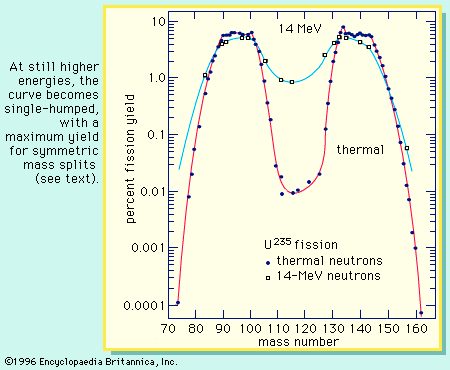

The way fission fragments split apart is one of the most defining characteristics of the entire nuclear process. It is not random. It depends heavily on two things: the mass of the nucleus splitting and the excitation energy present when it happens.
At low excitation energies, things get asymmetric. Take uranium-235 or plutonium-239. They don’t split into two equal halves. Instead, they favor an unequal division. This creates a two-humped probability distribution. The light group of fragments shifts to higher mass numbers as the fissioning nucleus gets heavier. The heavy group stays mostly stationary.
Increase the energy, and the rules change.
Symmetric splits become more likely. Asymmetric ones drop off. The valley between the two peaks fills up. At high excitations, the curve becomes single-humped. The maximum yield sits right at symmetry.
Not all nuclei play by the same rules. Radium isotopes exhibit a strange triple-humped distribution. Lighter nuclides stay single-humped and symmetric. But they require significant activation energy to fission in the first place. Then there are the very heavy nuclei near fermium-260. Here, spontaneous fission yields a symmetric, single-humped curve. The kinetic energies of the resulting fragments are unusually high.
Understanding these distributions has been a major puzzle. A complete theoretical explanation remains elusive, despite significant progress.
How Decay Chains Restore Balance
Stability demands a specific neutron-to-proton (n /p ) ratio. This ratio must increase as the proton number rises. Up to calcium (20 protons), the ratio holds at unity. After that, it climbs. For the heaviest elements, it reaches about 1.5.
When a heavy nucleus fissions, it emits a few neutrons. This helps, but not enough. The remaining fragments still have too high an n /p ratio for stability. They are unstable.
They fix this through radioactive decay. Specifically, beta-minus decay. Neutrons convert into protons. A negative electron (beta particle) and an antineutrino are emitted. The mass number stays the same. The atomic number increases by one. A new element is born with each conversion.
These successive beta decays form an isobaric fission-product decay chain. Every mass number has its own chain. The half-lives of these radioactive species generally increase as they approach the stable isobar at the end of the line.
To be clear on the terminology:
– Isotopes share the same nuclear charge (Z, protons) but differ in neutron count and mass number (A ).
– Isobars share the same mass number (A ) but differ in atomic number (Z ).
Consider a typical mass split in the neutron-induced fission of uranium-235. If two neutrons are emitted from the initial fragments, complementary masses of 93 and 141 are formed. The division of charge between these fragments is a critical parameter in the process.
For these specific masses, the isobaric decay chains proceed as follows. The half-lives for each beta-decay step are indicated along the transition arrows.
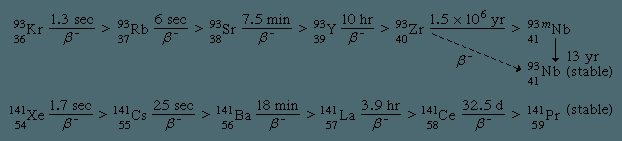

The math behind nuclear fission is precise. If you look at the symbol for an element, the bottom number is Z (protons) and the top is A (mass). When uranium-235 splits, it must keep all 92 protons accounted for. The nucleus doesn’t just break randomly. It tends to split into complementary pairs. Krypton-36 and Barium-56. Rubidium-37 and Cesium-55. Strontium-38 and Xenon-54. These combinations conserve the charge. They are the probable outcomes.
Independent vs. Cumulative Yield
Not all fission products appear the same way. Some show up instantly. Some take time. The independent yield measures how often a specific nuclide forms directly from the initial fragments after they cool down. It’s the direct hit. But that’s not the whole story.
If you want the full picture, you need the cumulative yield. This is the total percentage for any nuclide in a decay chain. You get it by adding the independent yield of that nuclide to the yields of every precursor that decays into it. It’s a sum game. The entire chain’s total yield for a specific mass number is what we call cumulative yield.
The Equal Charge Displacement Hypothesis
Radiochemists have studied this for decades. They found a pattern. The most probable charge division isn’t centered on stability. It’s displaced. And here’s the kicker: it’s displaced the same distance in both the light and heavy fragments. Scientists call this the equal charge displacement (ECD) hypothesis. Physical measurements have backed it up.
In the rubidium-cesium example I mentioned earlier, ECD predicts the most likely charges are around Rubidium-37 and Cesium-55. But nature likes shortcuts. If a fragment has 50 protons, a strong shell effect kicks in. It messes with the ECD expectations. The distribution of charge formation is narrow. It looks Gaussian. It’s nearly the same regardless of the mass split or the specific fissioning atom.
The most probable charge ($Z_p$) is a useful concept here. It doesn’t have to be a whole number. It’s a statistical average. As the energy of fission goes up, the fragments try to keep the same neutron-to-proton ($n/p$) ratio as the original nucleus. This is called unchanged charge distribution.
Prompt Neutrons: The Immediate Burst
How many neutrons come out? It varies. The average number per fission is $\bar{\nu}$. For spontaneous uranium-238 fission, it’s about 2.0. For fermium-257, it jumps to 4.0. For thermal-neutron induced fission of uranium-235, it’s 2.4.
But $\bar{\nu}$ is an average. Each individual event is different. It depends on how the mass split occurs. There’s still debate about how many neutrons fly off right at the moment of scission. Most physicists agree, though, that the bulk of the neutrons are released by the recoiling fragments just after they split.
Why? Energy. The fragments have energy. Internal excitation heat. Deformation energy stored like a spring. When the fragment snaps back to its stable shape, that energy releases neutrons. The more energy the fragment has, the more neutrons it spits out.
Delayed Neutrons: The Control Mechanism
Most neutrons are prompt. A few are delayed. This happens when fission products beta-decay. The beta-decay energy is high. Higher than the binding energy of a neutron in the daughter nucleus. This usually occurs when the daughter has one or two extra neutrons past a closed shell of 50 or 82. Those extra neutrons are loosely bound.
The beta decay pushes the daughter into an excited state. An excited state that’s unstable. It emits a neutron. But it’s not instant. It’s delayed by the half-life of the precursor. We’ve identified six such delayed neutron emitters. Their half-lives range from 0.5 seconds to 56 seconds.
Their yield is tiny. About 1 percent of prompt neutrons. So why do they matter? Without them, controlling a nuclear reactor would be nearly impossible. The chain reaction would change too fast for human hands or even most mechanical systems to adjust. These delayed neutrons buy us time. They make the reaction manageable.
Energy Release Calculations
Where does the heat come from? Mass difference. You calculate total energy release by looking at the rest masses. Reactants versus products. Take uranium-235 plus a neutron. Compare it to stable end products like niobium-93 and praseodymium-141 plus two neutrons. The mass isn’t conserved. Some of it is gone.
Einstein’s equation, $E=mc^2$, tells us where it went. It became energy. The total release depends on the specific mass split. But in thermal neutron-induced fission of uranium-235, the energy distributes in a predictable pattern.
The majority stays with the fragments. Kinetic energy. The fragments fly apart at high speed, colliding with surrounding atoms, creating heat. Then there are the neutrons. They carry kinetic energy. Gamma rays release energy instantly. Beta particles and neutrinos carry energy away during decay. Neutrinos, unfortunately, escape entirely. They take energy with them and never let it go.
This is why reactor design is so complex. You’re managing heat in solids, radiation in vacuum, and particles escaping into space. The math is clean. The reality is messy. And the energy distribution determines how hot your core gets.
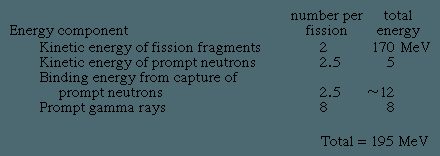

The physics of lost energy and nuclear models
Not every neutron captured in a reactor core stays put. Some escape entirely, and the energy release from those prompt neutrons depends on how they are finally stopped. This prompt energy release happens on a time scale of about $10^{-12}$ seconds. It is largely converted to heat within an operating reactor and is used for power generation.
But there is also a delayed release of energy. This comes from the radioactive decay of fission products, which vary in half-life from fractions of a second to many years. The shorter-lived species decay in the reactor, and their energy adds to the heat generated; however, the longer-lived species remain radioactive and pose a problem in the handling and disposition of the reactor fuel elements when they need to be replaced.
The antineutrinos that accompany the beta decay of the fission products are unreactive, and their kinetic energy (about 10 MeV per fission) is not recovered. Overall, about 200 MeV of energy per fission may be recovered for power applications.
The challenge of theoretical precision
Nuclear fission is a complex process that involves the rearrangement of hundreds of nucleons in a single nucleus to produce two separate nuclei. A complete theoretical understanding of this reaction would require a detailed knowledge of the forces involved in the motion of each of the nucleons through the process. Since such knowledge is still not available, it is necessary to construct simplified models of the actual system to simulate its behaviour and gain as accurate a description as possible of the steps in the process. The successes and failures of the models in accounting for the various observations of the fission process can provide new insights into the fundamental physics governing the behaviour of real nuclei, particularly at the large nuclear deformations encountered in a nucleus undergoing fission.
The framework for understanding nuclear reactions is analogous to that for chemical reactions and involves the concept of a potential-energy surface on which the reaction occurs. The driving force for physical or chemical reactions is the tendency to lower the potential energy and increase the stability of the system. Thus, for example, a stone at the top of a hill will roll down the hill, converting its potential energy at the top to kinetic energy of motion, and will come to rest at the bottom in a more stable state of lower potential energy. The potential energy is calculated as a function of various parameters of the system being studied. In the case of fission, the potential energy may be calculated as a function of the shape of the system as it proceeds over the barrier to the scission point, and the path of lowest potential energy may be determined.
As has been pointed out, an exact calculation of the nuclear potential energy is not yet possible, and it is to approximate this calculation that various models have been constructed to simulate the real system. Some of the models were developed to address aspects of nuclear structure and spectroscopy as well as features of nuclear reactions, and they also have been employed in attempts to understand the complexity of nuclear fission. The models are based on different assumptions and approximations of the nature of the nuclear forces and the dynamics of the path to scission. No one model can account for all of the extensive phenomenology of fission, but each addresses different aspects of the process and provides a foundation for further development toward a complete theory.
The Liquid Drop and the Mystery of Asymmetry
The nucleus doesn’t just sit there. It moves. Sometimes the whole thing sways like a drop of water. Other times, individual particles are dancing in their own lanes. This duality confused physicists for decades.
George Gamow started the ball rolling in 1935. He pictured the nucleus as an incompressible liquid drop. Niels Bohr took that idea and ran with it. By 1939, Bohr and John A. Wheeler had used the liquid-drop model to explain nuclear fission. The concept was simple. You shoot a neutron into a nucleus. It gets absorbed. The energy spreads out. The nucleus wobbles. Eventually, it splits.
The model worked well for the big picture. It showed how the strong nuclear force trying to hold things together competes with the electric repulsion between protons trying to tear them apart. But it had a fatal flaw. It predicted that when a nucleus splits, it breaks into two equal halves. Symmetric. Clean.
It didn’t happen that way.
Fission results in unequal masses. One piece is big. The other is small. The liquid-drop model couldn’t explain this mass asymmetry. It also struggled with ground-state masses and fission barriers. For highly excited nuclei, the model was fine. For stable ones? Not so much.
Shells and Magic Numbers
Scientists needed a different angle. They stopped looking at the nucleus as a blob. They started looking at individual particles.
Imagine a single nucleon moving through a field created by all the others. It’s an average potential. A spherical well. Quantum mechanics solves for the motion of a particle in that well. The result? Energy levels.
Neutrons and protons have their own sets of levels. They group into shells. Just like electrons in an atom. Certain numbers of nucleons fill these shells completely. These are the magic numbers.
2, 8, 20, 28, 50, 82, 126.
Nuclei with these numbers are stubbornly stable. They bind tightly. Maria Goeppert Mayer and J. Hans D. Jensen formalized this in 1949. They called it the spherical-shell model. Also known as the independent-particle model.
It explained ground-state masses. It explained nuclear spins. It explained why some excited states last longer than others (isomers). If the nucleus is spherical and near a magic number, the model is excellent.
But what about the rest of the periodic table?
The Deformed Nucleus
Take the lanthanides and actinides. Lanthanum through Lutetium. Actinium through Lawrencium. Their nucleon counts sit between the magic numbers.
The spherical-shell model fails here. These nuclei aren’t spherical. They are deformed. They stretch out. They look like a football. Or a watermelon.
In 1955, Aage Bohr, Ben R. Mottelson, and Sven G. Nilsson stepped in. They calculated the motion of a nucleon in a spheroidal potential. Not a sphere. A spheroid.
A spheroid has three axes of symmetry. It can rotate. The rotation happens independently of the internal excitement of the nucleons. The nucleus can vibrate too. It can pulse.
This hybrid approach combined the independent-particle motion with the collective motion of the whole system. Rotations. Vibrations. Shell structures.
They called it the unified model. It became the deformed shell model.
It wasn’t just a tweak. It was a shift in how we see the atomic core. The nucleus isn’t just a drop. It isn’t just a collection of isolated balls. It’s a dynamic, deformable object.
Why does this matter?
Because nuclear fission isn’t just about breaking things. It’s about understanding the structure that holds them. The asymmetry of fission is tied to these shell effects. The energy levels shift as the nucleus deforms. The path to splitting becomes complex.
We still use the liquid-drop model. It’s useful for high-energy collisions. But for the subtle details? For the mass splits? For the stability of heavy elements? You need the shell model. You need the deformation.
The story of the nucleus is the story of these competing models. Drop. Shell. Unified. They don’t cancel each other out. They layer on top of each other.
We are still refining the parameters. Still tweaking the potentials. The nucleus remains one of the most complex small-scale systems we know.
And we haven’t even started on the quarks inside the protons yet.
Aage Bohr applied the unified model to fission by treating the excited states of a system as functions of a deformation parameter. Think of this parameter as elongation—the physical stretching of the nucleus as it moves toward splitting. Bohr evaluated these states at the saddle point. This is the peak of the energy barrier.
Here is the catch. Once the system crests the saddle point, most of its excitation energy goes into deforming the nucleus. The system becomes “cold.” It has little heat energy left. Only low-lying excited states are available. This is where things get tricky for theorists.
How Spin and Parity Dictate Fission Paths
The spin and parity of the specific channel the system occupies at the saddle point determine the fission outcome. This is known as transition-state analysis. It qualitatively accounts for several key characteristics of the process.
Fission thresholds depend on the spin and parity of the compound nuclear state. The angular distribution of fragments is governed by the collective rotational angular momentum of that state. Asymmetry in mass distribution results from passage over the barrier in a state of negative parity. Negative parity lacks reflection symmetry.
“It is the only model that provides a satisfactory interpretation of the angular distributions of fission fragments.”
The model works well, but it has a major assumption. It assumes properties of the transition state at the saddle point are not altered by dynamical considerations during the descent to the scission point. This is a big “if.” Despite that, the model remains essential. Any complete theory of fission must include its attractive features.
Why Magic Numbers Matter for Mass Split
The first use of the spherical-shell model in fission was simpler. It recognized that peaks in the fission mass distribution correlated with magic numbers. This suggested a qualitative interpretation of asymmetric mass division.
Nuclei prefer stability. A preference for forming nuclei with neutron numbers close to 82 favors the heavy group peak. This determines the mass split for the fissioning system. See Figure 4 in the original data.
Extra stability for 50 protons was expected. It isn’t particularly evident in data. Take tin-132. It is a doubly magic nucleus with 50 protons and 82 neutrons. Its yield in low-energy fission is rather low. The model isn’t perfect.
Peter Fong and the Statistical Approach
Peter Fong in the United States made a more quantitative application in 1956. He used a statistical-model approach. He related the probability of forming a given pair of fragments to the available density of states at the scission point.
The logic is straightforward. Random motion means the system experiences all possible configurations. It has a higher probability of being in regions where the greatest number of configurations are concentrated. The model assumes potential energy at the saddle point converts to excitation energy. Statistical equilibrium among all states is established at the scission point.
Closed-shell nuclei have extra binding energy. This leads to a higher density of states at a given excitation energy. Other nuclei do not. This creates a higher probability of formation for closed-shell configurations. The result is an asymmetric mass distribution. It agrees well with observations for neutron-induced fission of uranium-235.
The Problem of Scission Point Equilibrium
Changes in mass distribution with increased excitation energy are also explained. As excitation energy rises, the importance of shell effects decreases. This increases the probability of symmetric fission relative to asymmetric fission.
Other features are qualitatively explained. Extensive changes in model parameters are required, however, to match experiments for other fissionable nuclides. There are fundamental problems with the basic assumptions.
The core question for scission-point models is validity. Does the system remain at the scission point long enough on the steep decline of the potential-energy surface? Is there time for a quasi-equilibrium condition to be established?
There is some evidence such a condition prevails. It is not clearly established. Still, these models prove useful. They interpret observations of mass, charge, and kinetic energy distributions. They explain neutron emission dependence on fragment mass.
Fragment shell structure likely plays a significant role. It determines the course of the fission process. The details remain unresolved. The physics is messy.
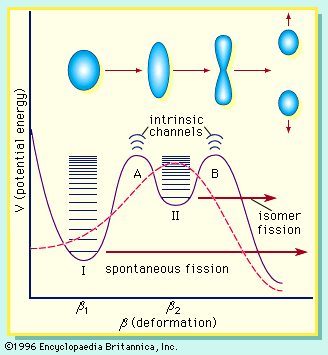

Liquid-drop models are nice for general shapes. They fail when nuclei stretch. Specifically, they miss the surface energy costs at large deformations. This is a problem for fission.
V.M. Strutinskii fixed this in 1967. He was a Russian physicist. He proposed a hybrid model. It adds shell effects to the liquid-drop potential. The liquid-drop part keeps the collective surface and Coulomb effects. The shell corrections depend on deformation. These corrections can reach several million electron volts. That dwarfs the liquid-drop barrier of about 5 MeV.
Shell stability changes with shape. Magic numbers shift from spherical values. Near the fission barrier, this creates structure in the energy curve. Figure 7 shows this. The two peaks vary by mass and charge.
The Double-Humped Barrier Explains Isomers
This double-humped shape solves fission puzzles. Short-lived spontaneous fission isomers exist. They live in the second well. Class II states. The barrier to exit is smaller. Half-lives are shorter.
These states differ in shape. Class I states return to ground state via gamma emission. Class II states hinder this. They are shape isomers. The double-humped barrier also explains neutron-induced fission cross sections. It structures fragment angular distributions.
Strutinskii’s method spurred calculations. It treated macroscopic and microscopic effects consistently. American physicists W.J. Swiatecki and James R. Nix led these studies. They mapped potential-energy surfaces. Some work even touched on dynamical evolution.
Asymmetry and the Scission Point
Actinides show asymmetry at the second barrier. Asymmetric mass splits are lower energy. Symmetric splits are favored later. The single potential fails at large deformations. It cannot handle two forming fragments well.
A discontinuity occurs at scission. Results depend on treating the system as one or two nuclei. A two-center potential helps. It uses overlapping spheres. It matches one-center behavior at small deformation. It matches separated behavior at large deformation.
This suggests preformation of fragment shells early on. Scission-point models may have shaky assumptions. Yet they match observation. The Argonne Scission-Point model is key. It uses deformed fragment shells. It includes interaction via a neck. It predicts mass, charge, and kinetic energy distributions. It covers neutron emission dependence. It does not predict fission probability. Or angular distributions.
Shell corrections fade with excitation energy. Macroscopic behavior takes over.
Magic Numbers Drive Symmetric Fission
Fermium-264 undergoes symmetric fission. Fragment kinetic energies are unusually high. Why? Stability of magic numbers. 50 protons. 82 neutrons.
Two tin-132 fragments form. This is doubly magic. It is energetically favored. Uranium or plutonium fission at low energy does not favor two such fragments. Only one.
Tin-132 fragments are spherical. Not deformed. Compact configuration at scission. Charge centers closer together. Higher kinetic energy results.
The physics is clear. Structure matters. Energy surfaces are not smooth. They have wells. And barriers. And discontinuities. We are still mapping them.
Shell effects remain critical to the fission process. This is true whether we are looking at the fissioning system at the saddle point or the deformed fragments near the scission point. These quantum mechanical properties help explain many observed features. But we still lack a clear answer regarding the exact stage where fragment distributions are determined.
The ingredients for a reasonable understanding of fission are there. They just haven’t been synthesized into a complete, dynamic theory yet.
The Adiabatic Approximation
Consider the dynamics of the descent. The system moves on a potential-energy surface from the saddle point to the scission point. One extreme view is the adiabatic approximation. This model assumes the collective motion of the system is slow. Or perhaps the coupling between collective and internal single-particle degrees of freedom is weak.
If this holds true, fast single-particle motions can readily adjust to changes in the shape of the fissioning nucleus. It progresses toward scission without disrupting its internal state. Changes happen without gaining or losing heat energy.
The decrease in potential energy between the saddle and scission points will then appear primarily in the collective degrees of freedom at scission and be associated with the kinetic energy of the relative motion of the nascent fragments.
This is known as pre-scission kinetic energy. The energy goes into the motion of the fragments as they fly apart.
Non-Adiabatic Energy Transfer
The opposite extreme involves faster collective motion. Or stronger coupling to particle motion. Here, collective energy transforms into internal excitation. This becomes heat energy for the nucleons.
Think of it like heating in the motion of a viscous fluid. Friction between layers generates heat. In this non-adiabatic process, the mixing among single-particle degrees of freedom may be complete. A statistical model might be applicable at the scission point.
The Middle Ground
Both extremes are approximations. They represent complex behavior simplified for analysis. Experimental evidence can support either interpretation depending on the specific nucleus or energy involved.
Nature rarely fits into binary boxes. The truth likely lies somewhere between these extremes. Both adiabatic and non-adiabatic mechanisms probably play a role in the fission process. The interplay between macroscopic shape changes and microscopic quantum adjustments remains one of the open questions in nuclear physics. We know the pieces. We just haven’t fitted them together yet.
Fission doesn’t just happen once. It spreads. When a nucleus splits, it spits out neutrons. If those neutrons hit another fissile atom, that atom splits too. It releases more neutrons. The chain grows. Or it dies.
The math behind this is simple but lethal. We measure it with k, the multiplication factor. It’s the ratio of fissions in one generation to the last.
- If k is less than 1, the reaction fizzles out.
- If k equals 1, you have a steady pulse. A critical assembly.
- If k is greater than 1, the chain explodes. Super-critical.
A critical assembly isn’t just a blob of metal. It’s a carefully engineered system. You need fissile material, usually metal or oxide. You need a moderator to slow the neutrons down. You need a reflector to bounce stray neutrons back into the core so they don’t escape.
The Physics of the Bomb vs. The Power Plant
In a bomb, speed is everything. You want k as high as possible. You want the time between steps to be vanishingly small. The goal is to release massive energy in about 10^-7 seconds.
Consider the scale. One kilogram of uranium-235 undergoing fission releases energy equivalent to 20,000 tons of TNT. That’s a city-killer in a single kilogram.
Reactors are different. They don’t want to blow up. They want to hum. In a steady-state reactor, k stays at 1. But practically? You can’t keep it exactly at 1. You design it to be slightly above 1.
Why? Because things degrade.
Fuel burns up. It depletes. Fission products accumulate. Some of these byproducts are “poisons.” They eat neutrons. They lower k. If you start at exactly 1, the reactor shuts down before you get useful power. Starting slightly high lets you compensate for fuel loss and poison buildup.
You also need to save some neutrons. You can use them for research or to create radioactive isotopes for medical and industrial use.
Control rods make this possible. These are movable rods made of neutron-absorbing materials like boron, cadmium, or hafnium. Slide them in, and k drops. Pull them out, and k rises.
It’s not instant, though. Thanks to delayed-neutron emitters among the fission products, there’s a lag between generations of neutrons. This tiny delay gives human operators and mechanical systems time to react. Without it, controlling a reactor would be impossible.
Thermal, Intermediate, and Fast Reactors
Not all reactors work the same way. They are classified by the energy of the neutrons driving the chain.
Thermal Reactors
These are the most common. They rely on “thermal” neutrons. These are slow neutrons, moving at speeds comparable to gas molecules at room temperature.
Fission produces fast neutrons. Average kinetic energy over 1 MeV. Too fast to split other uranium-235 atoms efficiently. You need to slow them down. That’s the moderator’s job.
Common moderators:
– Ordinary water
– Heavy water (D2O)
– Graphite
Intermediate Reactors
These maintain the chain with neutrons of intermediate energy. They might use beryllium as a moderator. Less common, but useful in specific designs.
Fast Reactors
No moderator needed. Here, fast fission neutrons do the work. They keep the chain reaction going without slowing down. This requires different fuel compositions and designs but can be more efficient in terms of fuel usage.
Every type needs a way to remove heat. You can’t run a reactor dry. Coolants vary by design:
– Water
– Gas
– Liquid metal
The choice of coolant depends on pressure, temperature, and chemical stability needs.
Beyond Electricity: The Utility of Fission Products
Once the reactor is running and the fuel is spent, the waste isn’t just trash. It’s a resource. The fission products created during operation contain a wealth of radioactive isotopes.
Some of these are short-lived and dangerous. Others are stable enough to be harvested.
Medical isotopes are a primary target. Technetium-99m, used in diagnostic imaging, is often a byproduct of fission. Iodine-131 treats thyroid conditions. Strontium-90 powers remote pacemakers and radios.
Industrial applications are equally vast. Radioisotopes are used for radiography to inspect welding seams in pipelines. They gauge thickness in manufacturing lines. They sterilize medical equipment without heat, preserving sensitive materials.
The “waste” from one perspective is the feedstock for another industry. The same process that generates power also generates the tools for modern medicine and industry.
The distinction between energy production and material production is artificial. In a well-designed cycle, they are two outputs of the same neutron flux.
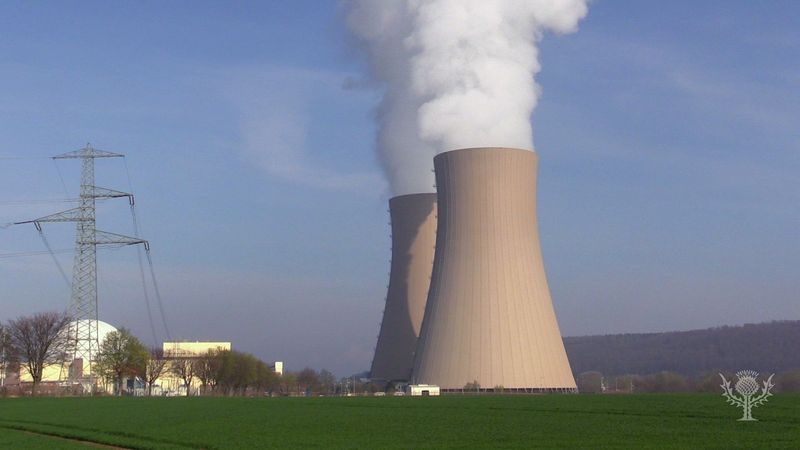
A nuclear reactor is, at its core, a furnace. It generates steam or hot gases. These outputs do two things. They provide direct heat. Or they drive turbines to spin generators for electricity.
This is the familiar story. Commercial power plants use this technology globally. The Navy uses it to propel submarines and surface vessels. But the story ends there only if you look at the basics. The real utility of these machines extends far beyond the grid.
Why High Neutron Flux Matters
Reactors serve a critical role in materials science. They provide intense neutron fluxes. Scientists use this to study how materials behave under stress. They use it to probe atomic structures. But there is another output here. A broad range of radionuclides.
These radionuclides are not just waste products. Along with fission products, they have found numerous applications. You can find them in medical treatments. You can find them in industrial radiography. The reactor is a factory for isotopes.
The Atomic Battery Advantage
Heat from radioactive decay has another trick. It can be converted directly into electricity. This happens through the thermoelectric effect in semiconductor materials. The result is an atomic battery.
These are not like the batteries in your phone. They are long-lasting. They rely on specific isotopes. Some emit beta particles. Strontium-90 is one example. Promethium-147 is another. Others emit alpha particles. Plutonium-238 fits this category. Curium-244 is also used.
Why use these over solar or chemical batteries? Because they work without sunlight. They work in extreme cold. They work for decades without maintenance.
Where We Put Them
This makes them ideal for places humans cannot easily reach. Or places where refueling is impossible.
Take cardiac pacemakers. Early models used these nuclear batteries. They outlasted the human heart. They kept patients alive when other power sources failed.
They are also essential for remote unmanned facilities. Think of space probes. The Voyager missions used plutonium-238 power sources. Solar panels were not an option so far from the sun.
Consider the polar regions. The Arctic and Antarctic have long winters. Sunlight is scarce. Nuclear batteries keep instruments running.
Open seas present similar challenges. Deep-sea monitoring stations need a power source that does not leak or corrode quickly. These isotopes provide stability.
Real-World Impact
The applications of radioactivity go beyond just power. There are practical uses for other radionuclides too. They help diagnose diseases. They sterilize medical equipment. They trace fluid flows in oil wells.
When you look at a nuclear reactor, see more than a power plant. It is a source of precision. It is a tool for discovery. It is a life-support system in the harshest environments on Earth and beyond.
The science is complex. The applications are everywhere. You just have to know where to look.