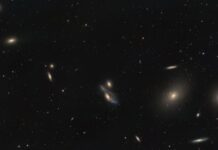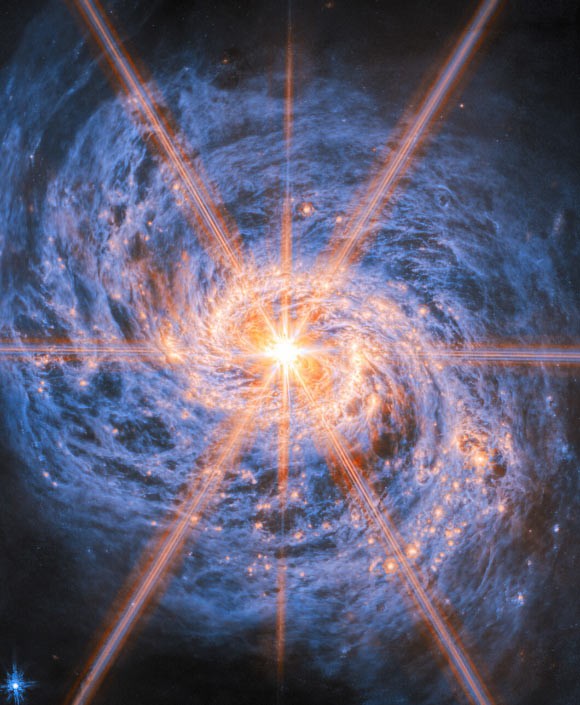
The James Webb Space Telescope (JWST) has delivered a stunning new perspective on Messier 77, a barred spiral galaxy located 62 million light-years away in the constellation Cetus. Known colloquially as the “Squid Galaxy” due to its tentacle-like filaments, Messier 77 is one of the brightest and most studied galaxies in the night sky. However, these latest images reveal a dynamic universe of newborn stars, swirling dust, and a violently active core that was previously obscured from view.
A Cosmic Powerhouse
Messier 77 (also designated NGC 1068) is not just a static celestial object; it is a gravitational titan. Spanning 100,000 light-years, it is one of the largest galaxies in the Messier catalogue. Its immense mass exerts such strong gravitational pull that it warps and twists neighboring galaxies.
Discovered in 1780 by French astronomer Pierre Méchain, the object was initially mistaken for a nebula. It was only later, as telescopic technology advanced, that its true nature as a galaxy was confirmed. Today, it is classified as a Type II Seyfert galaxy, a category defined by extreme brightness in infrared wavelengths and a highly active galactic nucleus (AGN).
The Invisible Core
The most striking revelation from Webb’s data is the galaxy’s heart. At the center lies a supermassive black hole with a mass eight million times that of our Sun. This black hole powers an AGN—a compact region of hot gas that outshines the rest of the entire galaxy combined. The radiation is so intense that it nearly overwhelms the light-gathering capacity of Webb’s cameras.
As gas from the galaxy’s central regions is pulled into rapid, tight orbits around the black hole, it crashes together and heats up, releasing tremendous amounts of energy. This process makes Messier 77 one of the closest examples of an active galaxy to Earth, offering astronomers a rare opportunity to study these violent cosmic engines in detail.
A Ring of New Stars
Beyond the black hole, Messier 77 is a prolific factory for new stars. Webb’s near-infrared vision has uncovered a central bar —a structure spanning the galaxy’s core that remains invisible in standard visible-light images. This bar is encircled by a bright “starburst ring,” formed by the inner ends of the galaxy’s two spiral arms.
This ring, more than 6,000 light-years across, is a site of intense and widespread star formation. The images display this activity through densely concentrated orange bubbles, which are cavities carved out by the fierce radiation and winds from newly formed star clusters. Because Messier 77 is relatively close to Earth, this starburst ring serves as a well-studied benchmark for understanding how galaxies evolve and create new stellar populations.
The Dusty Vortex
Webb’s Mid-Infrared Instrument (MIRI) provides a complementary view, highlighting the galaxy’s interstellar dust in blue. This dust forms a massive vortex of smoky, swirling filaments, punctuated by cavities where star formation has cleared the surrounding material.
These glowing structures extend outward along the galaxy’s arms, joining a faint, extended ring of hydrogen gas thousands of light-years wide. Vast, tenuous filaments of hydrogen stretch from this ring into intergalactic space, creating the galaxy’s distinctive “squid” appearance. This outer layer is not merely decorative; it is an active zone where further star formation is taking place, fueled by the gas and dust that serve as both the product and the fuel of stellar evolution.
Why This Matters
Messier 77 serves as a critical laboratory for astrophysics. By observing a galaxy that is both close enough for detailed study and active enough to exhibit extreme phenomena, scientists can better understand the lifecycle of galaxies. The interplay between the supermassive black hole, the starburst ring, and the extended dust filaments illustrates the complex feedback loops that govern galactic evolution.
In summary, Webb’s images transform Messier 77 from a static point of light into a dynamic system of creation and destruction, revealing how black holes and star formation shape the universe on a grand scale.