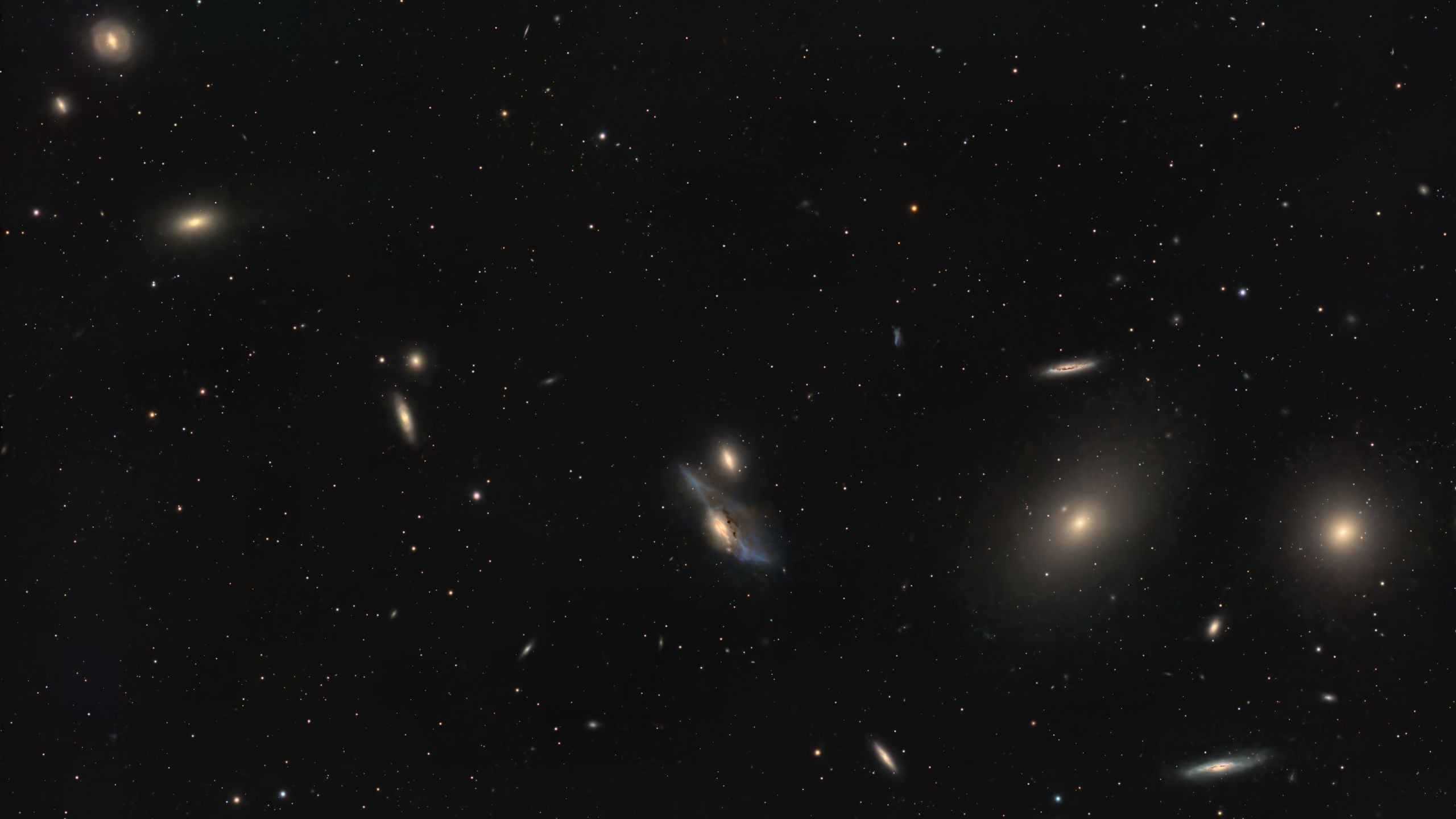
Astrophotographer Ronald Brecher has revealed a stunning glimpse into the Virgo Galaxy Cluster, capturing a phenomenon known as Markarian’s Chain. This image, taken from a backyard in Guelph, Canada, highlights a dense string of galaxies situated between the constellations Leo and Virgo.
The photograph is particularly notable for its clarity regarding NGC 4438 and NGC 4435, a pair of interacting galaxies often referred to as “The Eyes” or “Markarian’s Eyes.” Located just below the center of the image, these two galaxies display striking colors and intricate details caused by their gravitational interplay.
The Interacting “Eyes”
The visual drama in the center of Brecher’s photo stems from a cosmic collision course. NGC 4438 and NGC 4435 are not static neighbors; their mutual gravitational pull has significantly disrupted their spiral structures.
- Gravitational Disruption: The interaction has pulled streams of dust, gas, and stars away from their original formations.
- Visual Impact: These “great rivers” of cosmic material create a dynamic, flowing appearance that contrasts with the smoother shapes of non-interacting galaxies.
This interaction serves as a vivid example of how galaxies evolve. While individual stars rarely collide due to the vast distances between them, entire galaxies can merge or distort each other over millions of years, reshaping the fabric of the local universe.
Context: The Virgo Superstructure
Markarian’s Chain is named after astronomer Benjamin E. Markarian, who identified that these galaxies move coherently through space. However, this chain represents only a tiny fraction of the larger system it inhabits.
- The Virgo Galaxy Cluster: This massive structure is estimated to contain approximately 2,000 galaxies.
- Elliptical Giants: To the right of “The Eyes” in the image are two bright elliptical galaxies, M86 and M84. Discovered by Charles Messier in 1781, these galaxies are massive, old, and lack the distinct spiral arms seen in younger galaxies like the “Eyes.”
The presence of both spiral (interacting) and elliptical galaxies in such close proximity illustrates the diversity of galactic evolution within a single cluster. It raises questions about the future of “The Eyes”: will they eventually merge into a single elliptical galaxy, similar to M86 and M84?
From Backyard to Cosmos
What makes this image remarkable is not just the subject matter, but the accessibility of the technology used to capture it. Brecher did not use a space telescope or a massive observatory. Instead, he utilized:
- Equipment: A Skywatcher Esprit 120 telescope paired with a dedicated astronomy camera.
- Technique: He spent over nine and a half hours collecting light data between April 17 and 27.
- Processing: By combining these long-exposure frames, he was able to reveal faint details and colors invisible to the naked eye.
This achievement underscores a growing trend in amateur astronomy: with modest equipment and patience, enthusiasts can produce professional-grade imagery that contributes to our visual understanding of the cosmos.
How to Spot Markarian’s Chain
For observers looking to locate this celestial feature in the spring sky, the process involves navigating between two major constellations:
- Locate Leo: Find the constellation high in the southwestern horizon shortly after sunset. Identify Denebola, the bright star marking the lion’s tail.
- Find Virgo: Look to the lower left of Leo to find the star Vindemiatrix in the constellation Virgo.
- Target the Gap: Markarian’s Chain lies halfway between Denebola and Vindemiatrix.
- Equipment Needed: A 6-inch telescope is recommended to sweep across this patch of sky. While M86 and M84 can be seen with binoculars from a dark location, the finer details of the chain require more magnification.
Conclusion
Ronald Brecher’s image of Markarian’s Chain offers more than just a beautiful picture; it provides a tangible look at galactic dynamics and evolution. By highlighting the turbulent interaction of “The Eyes” against the stable backdrop of elliptical giants, the photo illustrates the complex life cycles of galaxies within our local universe, all captured through the lens of accessible amateur technology.