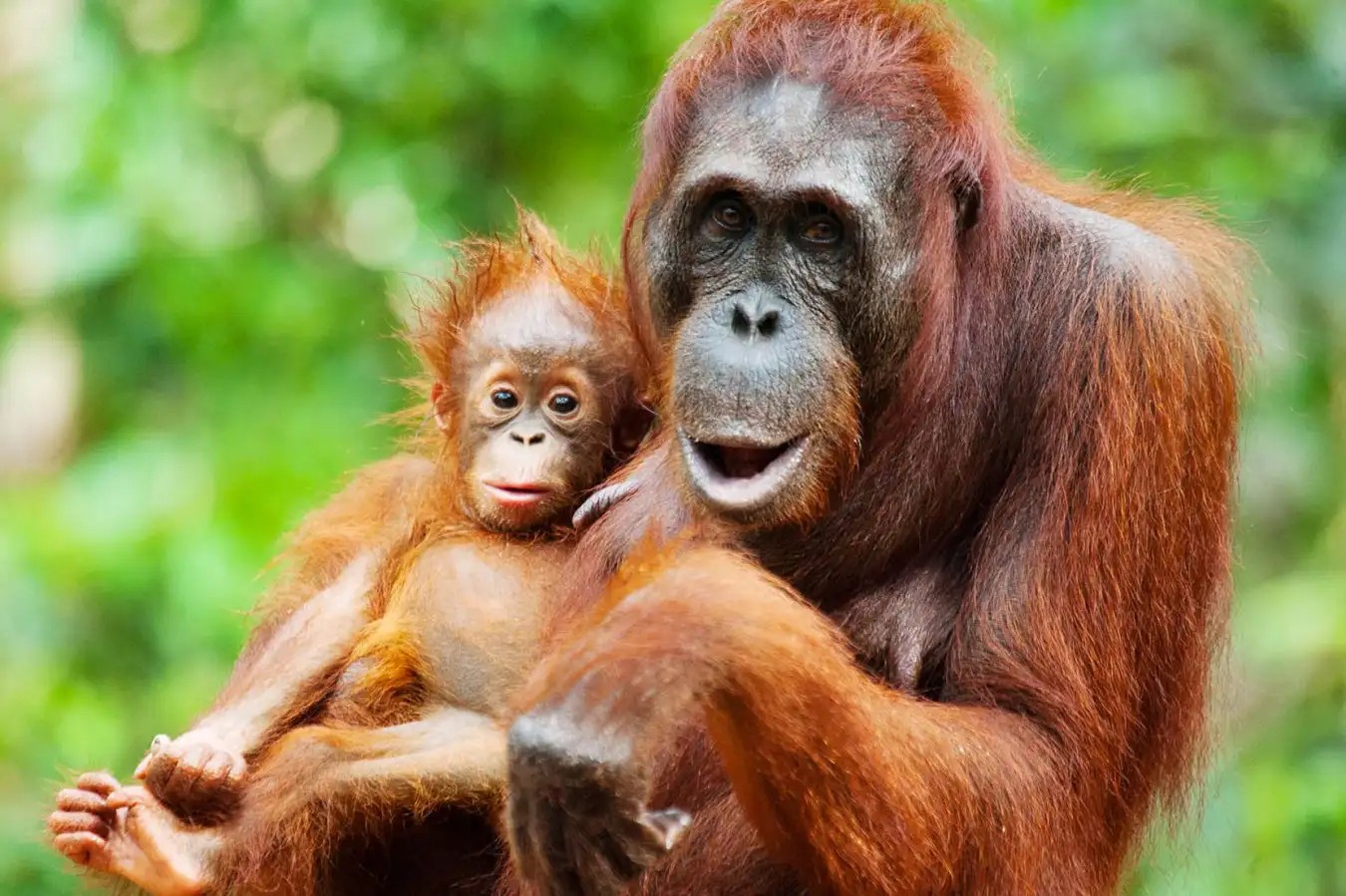
Solitary animals? Not entirely.
Orangutan moms are doing something we didn’t think possible. They are adjusting their movements, crossing into neighboring territories, specifically to set up playdates for their babies.
Here is the paradox. Orangutans spend most of their lives alone. They give birth to single infants and raise them solo for nearly a decade. Yet play is essential for building motor skills and social instincts. Even in species that aren’t exactly community-focused.
Zarin Machanda at Tufts puts it bluntly. Orangutan males fight for dominance. Somewhere, they have to practice those skills.
The proof comes from Odd Jacobson at the Max Plan Institute in Germany. His team combed through fifteen years of data on wild Bornean orangutans. We are talking thirty-one mother-offspring pairs and about 30,00 hours of observation logs. Who was there. Who were they with. What were they doing.
The pattern emerged clearly. Mothers with similarly aged kids spent disproportionate amounts of time together. The kids played. Often. The play was even more likely when the moms were closely related kin.
Did the moms travel further for this? Yes. The distance increased in the days leading up to these meetups and afterward as they headed back home. It cost them feeding time. This suggests it wasn’t just happenstance near a fruiting tree. If it were just about food, the data wouldn’t show this extra movement. It looks deliberate. A sacrifice in foraging for the sake of socialization.
Jacobson’s team writes that wild orangutan moms actively adjust their ranging to give offspring access to social play.
Now. Can we say they intended it?
It’s nearly impossible to prove intent with observational data, says Machanda. But she suspects there’s a difference between playing with mom and playing with peers. She thinks mothers choose to facilitate that peer contact.
Adriano Lameira from the University of Warwick agrees with the cognitive investment angle but stops short of imagining mothers picking up a virtual phone.
Do you think moms call ahead to arrange this? Probably not. Males use long-distance calls to coordinate movement a day in advance. Females? No such mechanism.
So how do they meet up?
Local knowledge. Memory. Lameira suggests moms predict where other mothers will be based on recent locations and typical ranges. They know which trees fruit, where the big lianas hang for climbing. They calculate probabilities. One mother estimates another’s position and resource search. They move into each other’s orbits.
It is clever. Quiet. Effective.
The increased traveling meant less time feeding.
We used to assume solitary meant antisocial development. These findings complicate that. Maybe “solitary” is just the daytime job. The after-hours networking looks a lot more like organized social care.
bioRxiv DOI: 10.6483/2026.6.20.74433