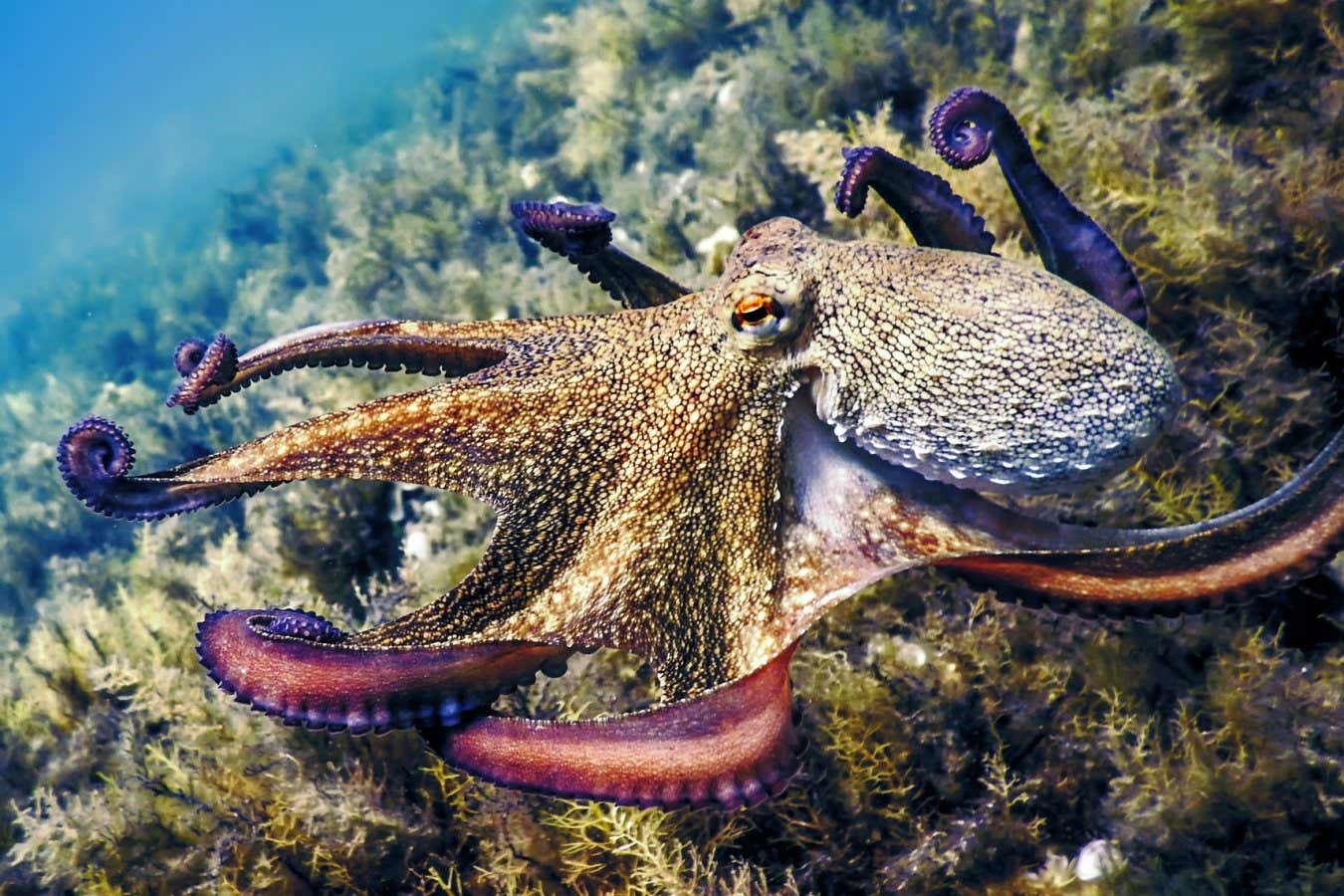
Recent research suggests that the evolution of large brains in octopuses and other cephalopods may be driven more by environmental complexity than by social interaction. For decades, the “social brain hypothesis” has dominated thinking about brain size in animals: the idea that larger brains evolved to manage complex social lives, a trend seen in primates, dolphins, and even camels. But cephalopods – octopuses, squid, and cuttlefish – present a puzzle: they exhibit high intelligence despite largely solitary lifestyles with minimal social learning or parental care.
A new study led by Michael Muthukrishna at the London School of Economics analyzed brain data from 79 cephalopod species. The researchers found no correlation between brain size and social behavior. Instead, larger brains were consistently observed in species inhabiting shallower, seafloor environments, where a greater abundance of objects, potential tools, and high-calorie food sources exist. Deeper-sea cephalopods, living in featureless environments, tend to have smaller brains. This suggests that ecological demands – the need to navigate complex surroundings and exploit diverse resources – may be the primary driver of cephalopod brain evolution.
The findings are cautious, as brain data is available for only about 10% of the 800 cephalopod species. But this trend aligns with broader evidence suggesting that large brains aren’t solely linked to sociality. Robin Dunbar, originator of the social brain hypothesis, acknowledges that the absence of social structures in octopuses means their brains don’t face the same cognitive pressures. Paul Katz from the University of Massachusetts Amherst proposes that deep-sea environments may select for smaller brains, similar to how island species tend to evolve smaller body sizes.
Muthukrishna’s earlier work on whales and dolphins also demonstrated that brain size correlates with both social complexity and ecological factors. This supports his “cultural brain hypothesis,” which posits that ecological and informational pressures, in addition to social ones, shape brain development. The fact that cephalopods, distantly related to vertebrates, exhibit a similar pattern strengthens this idea.
Ultimately, the study underscores that the evolution of large brains is a multifaceted process. While sociality may play a role in some species, environmental complexity and resource availability appear to be key drivers in others. The energy demands of a larger brain must also be met, as Dunbar points out: “You can’t increase the size of your brain unless you solve the energy problem.” The cephalopod example suggests that once a large brain is established, it can be repurposed for various cognitive tasks, including those unrelated to social interaction.