You think you’re seeing a pattern. Probably apophenia. That’s the fancy term for the human urge to connect dots that don’t really go together. Stare long enough at a cloud and you’ll find your ex’s face. Or a seahorse. It’s a glitch in the wiring. But nature? It sometimes actually means it.
Saket Navlakha knows this. An associate professor at Cold Spring Harbor Laboratory, he’s been hunting these hidden codes. He found one in a plant you’ve likely ignored since 2012.
The Chinese money plant. Pilea peperomioides.
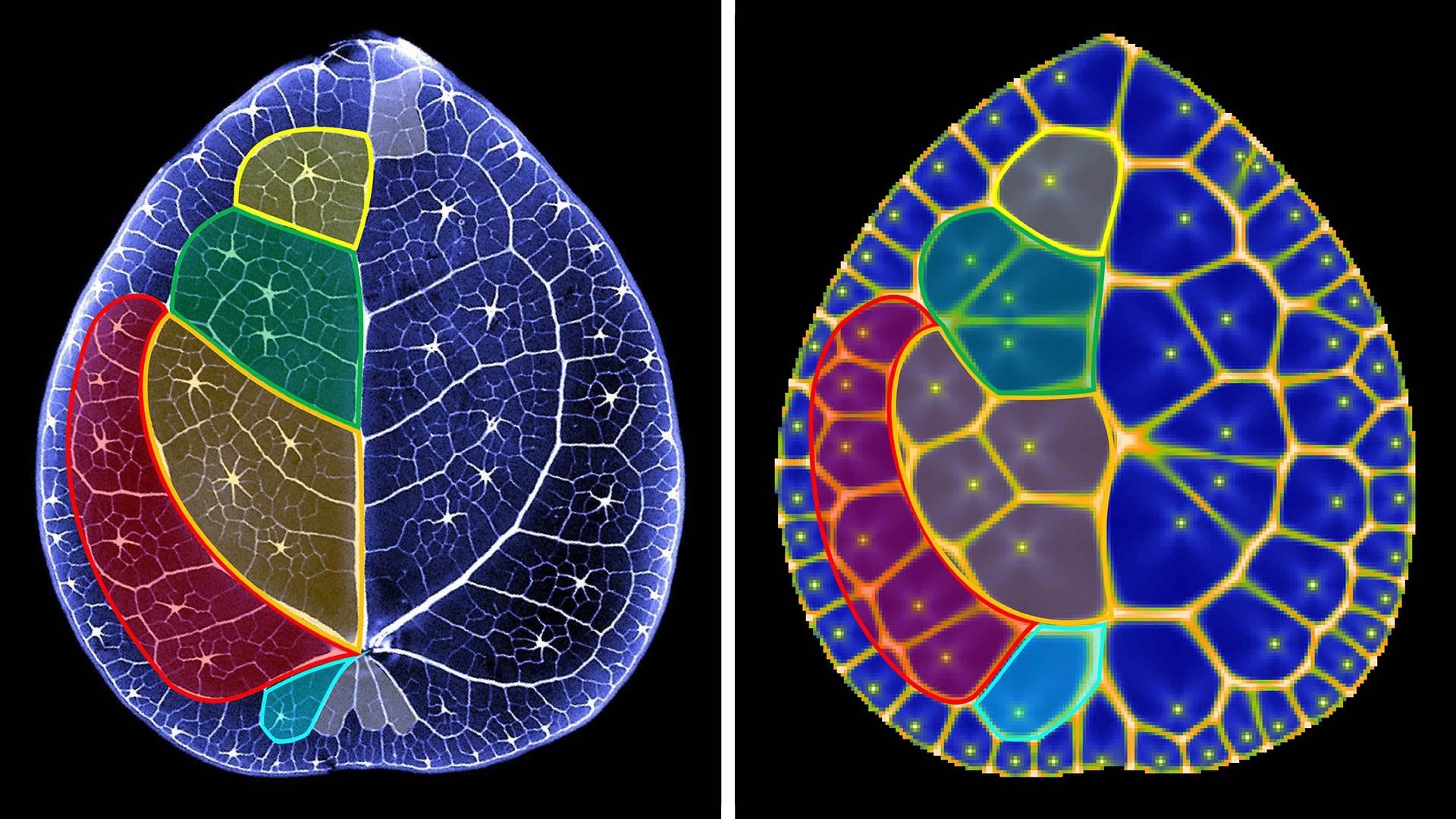
It’s a houseplant. Round leaves. Gifted around the holidays. Pretty harmless. Inside those leaves is a map. A strict geometric layout called a Voronoi diagram.
The Geometry Of Space
What’s a Voronoi diagram? It’s a way to divide space.
Think of school districts. Every kid lives in the area closest to one specific school. You draw lines between those zones. Those lines are equidistant from the schools. That’s Voronoi. City planners use it. Computer networks use it.
“Voronoi diagrams have been using for centuries… ranging from city planning to network design.” Navlakha notes this isn’t new. The math is old. The application to biology? Rare.
Nature fakes it sometimes. Giraffe spots look like Voronoi tessellations. Close, sure. But fuzzy. Lacking clear centers. Navlakha and his former student, Cici Zheng, looked closer at the money plant. This one had real centers. Clear definition. No ambiguity.
They saw it immediately. A natural exception to the usual biological noise.
Veins, Pores, And Algorithms
These plants are perennials from Yunnan and Sichuan. They send out water and nutrients through a loop system. The leaves have pores called hydathodes. Water exits or enters here.
Surrounding each pore? A web of reticulate veins. They don’t just wander. They stop precisely when they meet the veins of neighboring pores.
Navlakha and Zheng mapped this out. The veins didn’t guess. They followed rules. To figure out the mechanism, they called Przemysław Prusinkieuicz. He’s the guy. He spends decades studying how plants build their own veins.
Together, they isolated the algorithm. The “natural code” driving the growth.
Here is the kicker.
Plants can’t measure. No ruler. No GPS. They don’t calculate the distance to the nearest pore consciously.
“Unlike humans, plants cannot explicitly measure distances,” says Zheng. She’s now at the Allen Institute, still puzzling this out. “Instead, they rely on local biological interaction to achieve the same Voronoi result.”
The plant reacts to what’s next to it. Simple local moves. Global order emerges from small chaos. It works.
Why The Lines Matter
It’s a merger. Classical geometry. Modern botany. Computer science. All in a $12 potted plant.
“Just as humans have to survive to survive, the same go for other organism.”
That sounds heavy. But it’s practical. Organisms solve problems to stay alive. The problem here was resource distribution. The solution was geometry.
Prusinkiewiecz notes the significance. The formation of reticulate vein had been a ghost. An open question hanging around botany for decades. Why do veins loop like that?
“Finally we have a plausible answer,” he said. The Chinese money plant solved a mystery we hadn’t even finished framing.
Is this evolution planning ahead? Unlikely. It’s efficiency winning again. Simple rules create complex shapes.
Navlakha wants to look further. He thinks this work will eventually bleed into how we understand evolution itself. The mathematical principles behind life are older than computers. We’re just catching up.
The plant sits there. Waiting. Doing the math while you forget to water it.