In November 2025, astronomers achieved a rare observational milestone by coordinating two deep-space missions to study 3I/ATLAS, the second known interstellar comet to pass through our Solar System. By positioning NASA’s Europa Clipper and the European Space Agency’s (ESA) Jupiter Icy Moons Explorer (Juice) on opposite sides of the comet, scientists captured simultaneous views of its glowing dayside and dusty nightside.
This coordinated effort provided a unique, three-dimensional perspective on the comet’s composition, offering critical clues about the planetary system where it formed billions of years ago.
A Rare Dual Perspective
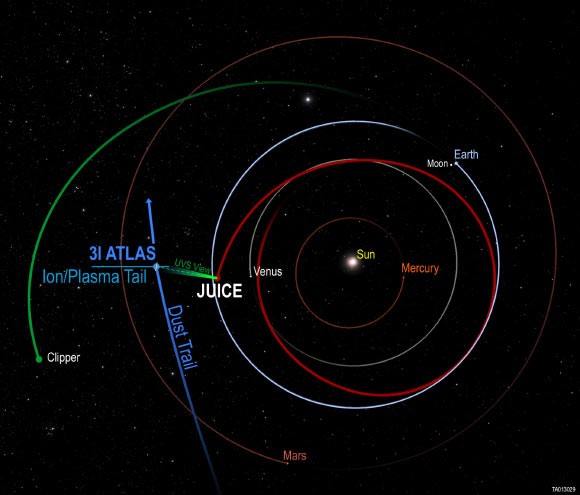
The primary challenge in studying comets is that they are dynamic objects; their gas and dust emissions change rapidly as they heat up near the Sun. Typically, a single spacecraft can only observe one aspect of this activity at a time. However, the specific trajectory of 3I/ATLAS allowed it to pass directly between Juice and Europa Clipper.
“As the comet passed between Juice and Europa Clipper, we were able to informally coordinate observations between the two spacecraft,” explained Dr. Kurt Retherford, a planetary researcher at Southwest Research Institute (SwRI).
Using the Ultraviolet Spectrograph (UVS) instruments aboard both spacecraft, the team executed a synchronized observation campaign:
- Juice captured the comet’s dayside, focusing on the glowing gas emissions resulting from solar radiation.
- Europa Clipper observed the nightside, detecting scattered dust particles and emissions from the opposite hemisphere.
“Observing the interstellar comet was some exciting bonus science,” noted Dr. Philippa Molyneux of SwRI. “This was the first time we’ve had simultaneous direct views of a comet’s coma of escaping gas from two directions.”
Decoding the Comet’s Chemistry
The core scientific value of these observations lies in the chemical signatures detected. The UVS instruments measured emissions of hydrogen, oxygen, and carbon. These elements are not present in their atomic form on the comet itself; rather, they are created when sunlight breaks apart complex molecules in the gases escaping the comet’s nucleus—a process known as photodissociation.
The data revealed several key insights:
- High Carbon Content: Early observations showed higher levels of carbon emissions than typically seen in comets native to our Solar System. This corroborates earlier findings suggesting that 3I/ATLAS has a distinct chemical makeup, likely reflecting the conditions of its home system.
- Dynamic Evolution: By tracking emission trends over several days, researchers could monitor how the ratios of these molecules changed. This temporal data helps scientists understand how the comet evolves as it travels through our Solar System.
- Ice Ratios as Cosmic Fingerprints: The team specifically analyzed the ratio of water ice to dry ice (carbon dioxide). “By studying the ratio of water ice and dry ice, we can compare the composition of this interstellar comet to comets native to our Solar System,” said Dr. Molyneux.
Why This Matters: A Window into Other Solar Systems
The significance of this mission extends beyond the comet itself. Comets are essentially time capsules, preserving the primordial material from the era when their planetary systems formed. By comparing 3I/ATLAS to comets from our own Solar System, scientists can infer whether the environment that birthed this interstellar visitor was similar to ours or fundamentally different.
“This helps us understand if the Solar System where 3I/ATLAS formed is similar to ours or different,” Dr. Molyneux stated.
If the chemical ratios differ significantly, it suggests that planet formation processes can vary widely across the galaxy. If they are similar, it points to universal mechanisms in how planetary systems assemble.
A Model for Future Collaboration
Beyond the scientific data, this operation demonstrated the potential for cross-mission cooperation. Both missions involve teams from Southwest Research Institute, facilitating seamless communication.
“I think the coordination with Europa Clipper was a fun and impactful demonstration that showed how the two projects could coordinate observation plans,” said Dr. Retherford. “And because SwRI’s team is involved in both missions, it was a special highlight for us in terms of working together.”
Conclusion
The simultaneous observation of 3I/ATLAS by Juice and Europa Clipper represents a pivotal moment in interstellar astronomy. By combining data from opposite viewpoints, scientists have gained a more complete picture of the comet’s composition and evolution. These findings not only refine our understanding of this specific visitor but also provide a comparative baseline for assessing the diversity of planetary formation across the galaxy.