Black holes are weird.
They shouldn’t exist quite this way. Not based on what we knew.
For a decade, the LIGO, Virgo, and KAGRA observatories have been catching them red-handed. Colliding. Spinning. Breaking our models. We’ve seen giants that were too big for comfort, pairs that shouldn’t fit, spins that make no sense. It was chaotic. Beautiful chaos. But chaos isn’t science yet. Science needs a census.
Now, it arrives.
A fresh dataset. Nearly 400 detections. Enough to stop guessing at the oddities and start counting the population. The picture emerging isn’t tidy. The universe, it seems, doesn’t care about your preferred formation model. It uses all of them.
“Some might form as one giant cloud of that collapses into two stars, then two holes. Others wander into each other in crowded stellar clusters. And some? They are the kids of previous mergers,” says Sharan Banagiri, an astrophysicist at Monash University in Australia. He works with the ARC Centre of Excellence for Gravitation Wave Discovery. Or OzGrav.
He’s not wrong. The data supports a messy reality.
The Census
It is hard to see black holes. Really hard.
They trap light. Light is our main lens for the universe. Without it, black holes are blind spots. Until 2015.
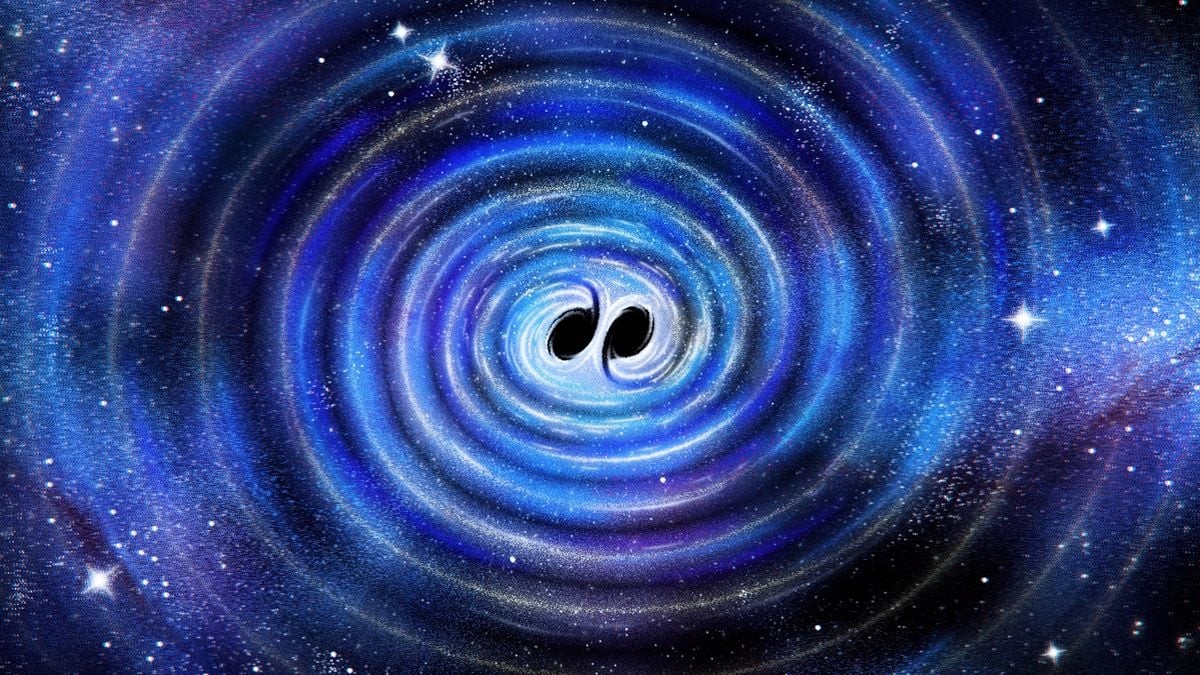
Then the ripples came. Gravitational waves. Ripples in space-time, like stone-skin on a pond. The first detection changed everything.
Since then? We’ve gone from one every six weeks to four per week. That’s not an increment. That’s an explosion.
“We’re not just looking at anomalies,” says Eric Thrane, also at Monash and OzGrav. “It’s a kaleidoscope. More massive. Faster spinning. Stranger than we dreamed.”
Why It Matters
Quantity changes quality.
Before, a mismatched black hole pair was a puzzle piece on its own. Now? It’s data. A statistic. We can separate signal from noise. We can chart where they came from. We can even use them to measure the expansion of the universe, though that’s another can of worms for cosmology.
“Today’s new results are like finding previously undiscovered ancient hoard. Revealing the structure of an entire Lost world, not just individuals,” Daniel Williams (Univ. of Glasgow) puts it.
He means it literally. Archaeology, but for gravity.
Two Groups, One Mystery
The masses don’t spread out evenly. They clump.
Two main peaks emerge in the data: about 10 suns’ mass. And then, 35 suns’.
The small ones are boring. Predictable. Binary stars born together, dying together. The heavy ones are trouble. Standard star theory doesn’t explain a 30-sun black hole well. Stars shouldn’t leave that much behind. Or so we thought.
Here’s the twist: The big ones are likely recycled.
“Hierarchical mergers.” That’s the fancy term. Small black holes merge. They make a bigger, heavier one. That new beast finds another partner. Collides again. It gets fat. It spins fast.
Spins Are Liars (Or Tellers)
Look at the spin.
Fast spin is a fingerprint.
If a black hole spins faster than physics expects, it probably had a history. It was forged in collision. The Sun takes 25 days to turn around. Imagine a black hole with similar spin properties. It rotates thousands of times per second.
“The most fascinating thing,” Banagiri says, “is how fast they are spinning.”
Fast spins. Mismatched masses. It all points to the same thing. Many of these black holes aren’t first-gen babies. They’re leftovers. Second-generation survivors of older collisions.
The Details
Some highlights from the 390 detections stand out.
GW 2501114 was the clearest signal yet. Clear enough to stress-test theoretical physics.
GW 24060dg localized its sky position better than any before.
But don’t get distracted by the outliers.
The point is the whole set. We’re watching evolution. Real-time astrophysics. We’re seeing black holes born, merged, and reborn in dense clusters across the universe.
What comes next?
The detectors get better. The rate goes up. The kaleidoscope turns. We might find out they spin even faster. We might find holes heavier than anything imagined. Or we might find something that breaks the clustering rules entirely.
Nobody knows yet.
That’s the point. The door is open. And behind it?