NASA didn’t just give us fireworks this time.
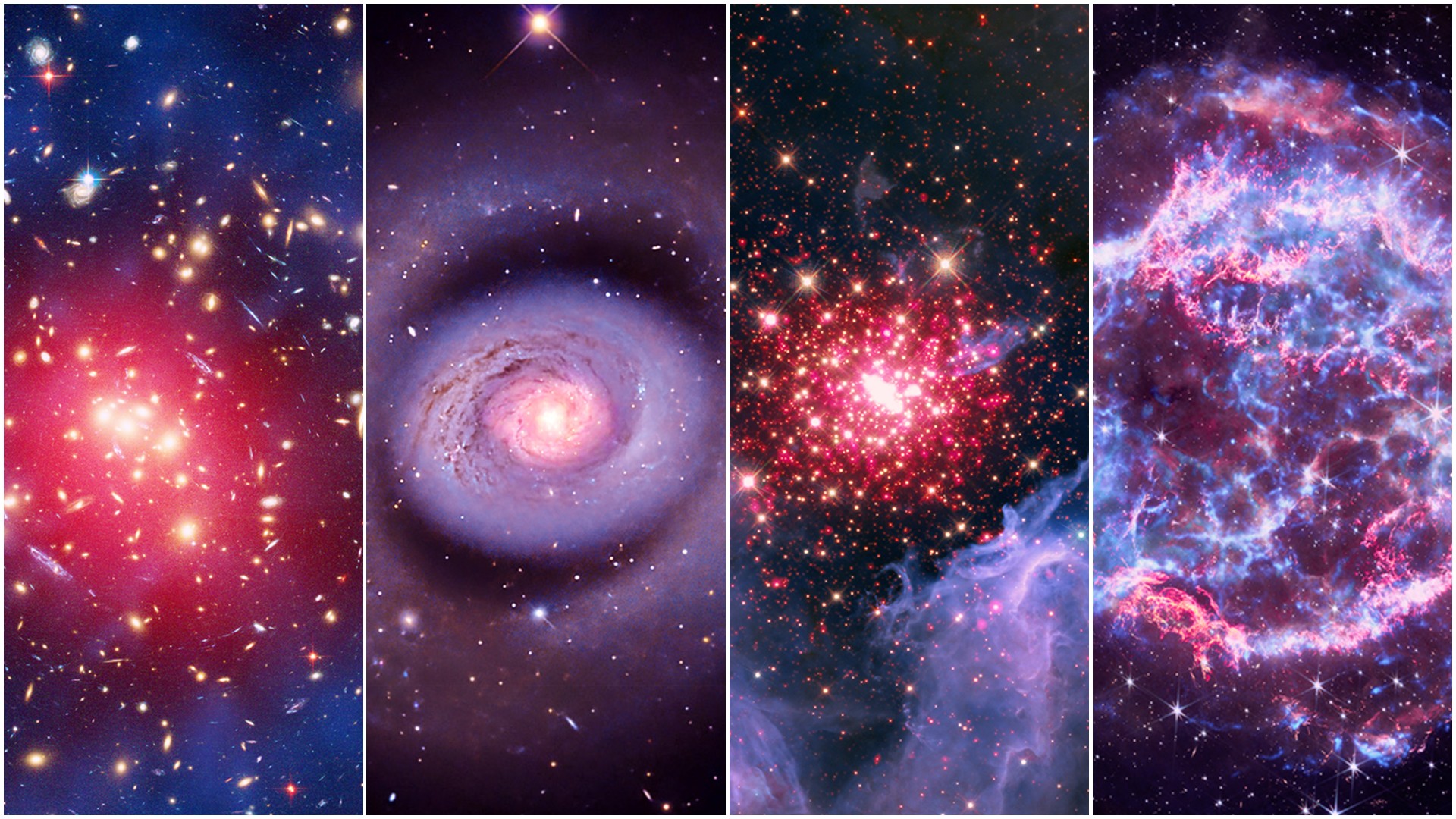
Chandra, their X-ray observatory, dropped four new images. They look like flags. Not because space has patriotism. But because July 4 is America’s birthday. Two hundred fifty years. The cosmos is celebrating too, in its own silent, violent way.
These aren’t just pictures. They’re maps of heat and light. Superheated gas. Spiral galaxies. Nebulas that birth stars and supernovae that destroy them.
“Data becomes music when you let it.”
That’s the sonification part. The Chandra team turned X-ray readings into sound. Frequencies map to instruments. It’s celestial audio. You listen to the data now. It feels different than looking at it.
ZwCl 00241652
Start here. A galaxy cluster. Red. Blue. It glows.
The red comes from Chandra. It shows superheated gas. Vast amounts of it. Surrounding galaxies 4 billion light-years away. In Pisces. The blue part is Hubble data. Optical light.
There’s dark matter here too.
We can’t see dark matter. It doesn’t touch light. We only know it’s there because gravity pulls on things we can see. It’s a ghost. A heavy ghost holding the cluster together. NASA says Hubble helps reveal its presence. Without it, the red gas might fly apart.
Messier 94
Next up is Messier 94.
People call it the Cat’s Eye Galaxy sometimes. It’s a spiral. 16 million light-years distant. Sitting in Canes Venatici—the hunting dogs constellation.
Chandra looked into its eye.
Combined with ground-based telescopes, the X-ray data highlights the center. A starburst ring. New stars are born there. Fast. Violently.
Here’s the weird part. This galaxy doesn’t have dark matter. Or at least not enough of it.
Why? We don’t know. It breaks the usual rules. Astronomers are stuck studying it to find the answer. It won’t give up the secret.
NGC 3603
Closer to home.
NGC 3602 is in the Milky Way. 20,000 lights-years away. Carina constellation. South sky.
It’s a mix of Hubble light (optical, infrared, UV) and Chandra X-rays.
The result is a knot of gas. Thousands of stars. Some of them are massive. Really massive.
“Live fast, die young.”
That’s the deal here. These giants burn their hydrogen fuel quick. Then boom. Supernova. They don’t stick around long. The nebula is beautiful, yes, but it’s also a graveyard in waiting.
Cassiopeia A
And finally. The one with a history lesson.
Cassiopeia A is a remnant. A shell of gas.
In the 1600s, people on Earth saw a bright star appear in Cassiopeia. They watched it. It faded. But that explosion? It didn’t happen when they watched.
Light takes time.
The star is 11,0001,0002 light-years away. The explosion happened over 10,0,001,0 years ago. We just got the postcard today.
The dead star was heavy. 151,522 to 2255 times the mass of the sun. Maybe more.
Now it’s a ring of luminous gas. Red, white, blue again. Chandra provided the X-rays. The James Webb Telescope added infrared. Together, they show the shell clearly.
We are looking into the past. Always.
What else are we missing?
Maybe nothing. Maybe everything.
The data sits there. Quiet. Until you turn it up. 🎧