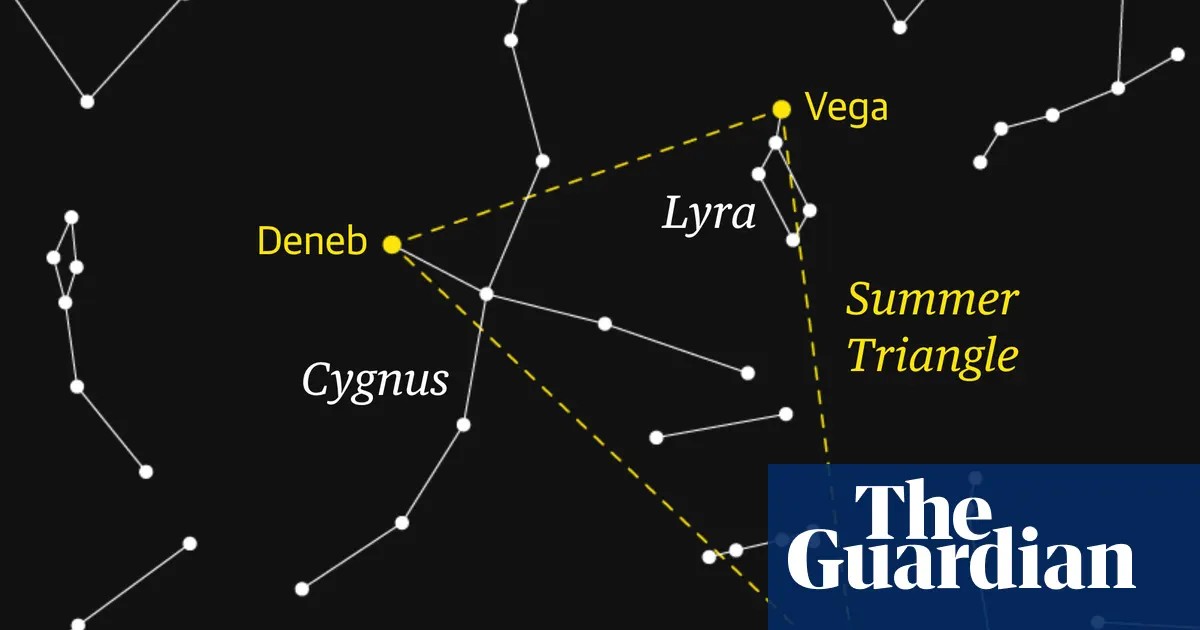
Summer is officially here. At least, that’s what the sky tells us.
Look up. Somewhere in the northern hemisphere, a massive geometric shape hangs directly overhead. It’s not a constellation in the traditional sense—no Greek mythology ties it together—but it is the easiest star pattern to locate during these warmer months.
This is the summer triangle.
Where to look and when
If you’re in the UK, try looking high in the south-east around 11 pm on July 27. The view stays basically the same throughout the week, with the pattern climbing higher as the night wears on.
But don’t wait for a specific date. Once the triangle appears, it stays.
For viewers in the southern hemisphere, the geometry shifts. The triangle remains visible but sits in the northern sky. It never climbs as high overhead. The perspective changes. The stars don’t.
The three stars that make it up
The triangle is formed by three distinct, incredibly bright stars. Each belongs to a different constellation. Each dominates its local patch of sky.
- Vega : This is the brightest of the bunch. Located in Lyra (the lyre), Vega hangs almost directly overhead from the UK in mid-summer.
- Deneb : Look north-east from Vega. You’ll find Deneb, the headliner in Cygnus (the swan). It anchors the top corner of the triangle.
- Altair : Drop your gaze lower to the south-east. Altair resides in Aquila (the eagle).
These three stars create a nearly equilateral shape. It’s striking because it frames the northern Milky Way.
Beyond the stars
If you’re far from city lights, the Milky Way becomes visible within this frame. It looks like a pale, cloudy band stretching across the darkness. That haze? It’s the combined glow of billions of distant stars making up our galaxy’s wider spiral arms.
For those in the north, binoculars reveal rich star fields within the triangle’s confines.
Even from a moderately dark site, the contrast between the sharp points of Vega, Deneb, and the rest of the sky is sharp enough to stand on its own. But binoculars help. They pull you into the depth of the field. You see dust clouds. Nebulous patches. Other stars you wouldn’t have spotted with the naked eye