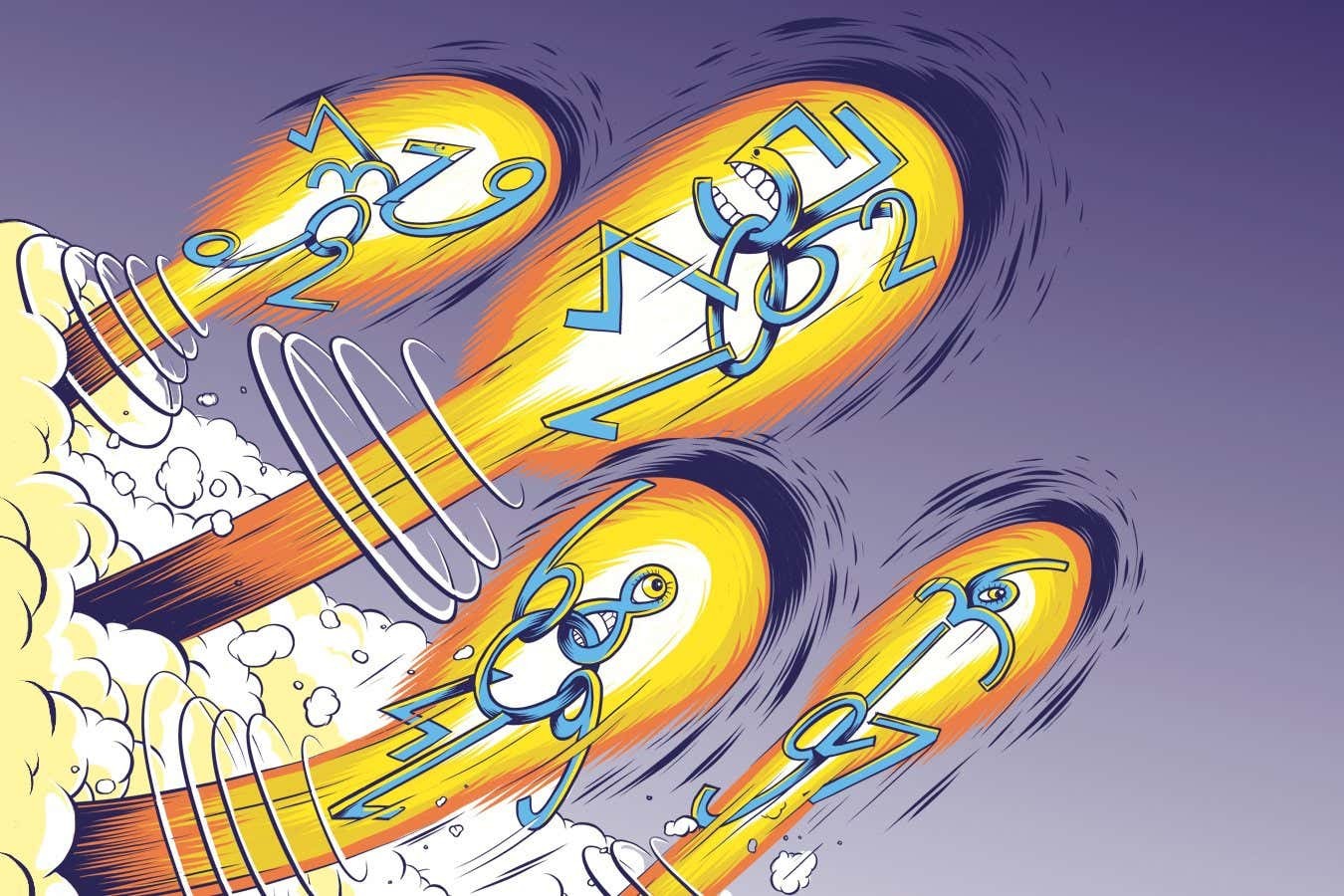
For centuries, mathematicians have used large numbers to probe the limits of the universe. From Archimedes calculating the grains of sand required to fill the cosmos to the ancient Maya contemplating timescales far exceeding the age of the universe, humanity has always been fascinated by the “huge.”
However, recent discoveries in mathematical logic have revealed something far more unsettling than mere large numbers. Researchers have uncovered sequences that grow so explosively they don’t just break our intuition—they break the fundamental “speed limits” of mathematics itself.
The Illusion of Exponential Growth
To understand the scale of this phenomenon, we must first look at the classic example of exponential growth. Legend tells of a man named Sessa who asked a king for a chessboard filled with rice: one grain on the first square, two on the second, four on the third, and so on. While it sounds modest, the total—18 quintillion grains—would exceed the entire global rice harvest of the last century.
In the realm of modern mathematics, however, exponential growth is considered a “laggard.” There are processes that accelerate so rapidly that Sessa’s chessboard becomes a rounding error. These “hyper-accelerating” sequences push against the very boundaries of what can be proven to be true.
Breaking the Rulebook: Peano and Gödel
To understand why these numbers matter, we have to look at the foundation of math: Axioms. Axioms are the self-evident truths that serve as the starting point for all mathematical reasoning.
In the late 19th century, Giuseppe Peano defined the rules for how numbers “succeed” one another (0 to 1, 1 to 2, etc.). This “Peano arithmetic” is the bedrock of almost all standard mathematics. However, in 1931, Kurt Gödel shook the foundations of the field with his Incompleteness Theorem, proving that no rulebook (no matter how detailed) can ever capture every truth about numbers. There will always be true statements that cannot be proven using a specific set of axioms.
For a long time, these “unprovable truths” seemed like academic curiosities—arcane logical puzzles that didn’t affect “real” math. But recent research has shown that these gaps in the rulebook have profound consequences for how fast certain mathematical processes can grow.
The Goodstein Sequence: A Speed Limit Breached
The first crack in the ceiling appeared with the Goodstein sequence. Discovered in the 1940s, this process involves a complex method of changing number bases and subtracting values. While the sequence eventually returns to zero, the journey is staggeringly long.
If you start with a small number like 4, the sequence takes more than $10^{10^{10^{10}}}$ steps to reach zero. This is a number so large it cannot be visualized; even a “tower” of exponents would need to be taller than the lifetime of the universe to describe it.
More importantly, mathematicians discovered that Peano’s axioms are not enough to prove that the Goodstein sequence will ever reach zero. To prove it, you need a more powerful logical framework. This was the birth of “Reverse Mathematics” —the study of which axioms are actually required to prove specific mathematical truths.
The Graph Minor Theorem: Into the Logical Wilderness
If the Goodstein sequence was a warning, the Graph Minor Theorem was a total system shock.
Graphs—networks of dots (nodes) connected by lines (edges)—are used to model everything from molecular chemistry to the structure of the internet. The Graph Minor Theorem, proven between 1983 and 2004, is a landmark achievement in this field. It essentially states that in any infinite collection of graphs, one will eventually contain another as a “minor” (a simplified structural skeleton).
While graphs seem like simple objects made of dots and lines, the logical power required to prove this theorem is immense. Research has shown that:
– Most mathematics operates at “Level 3” of logical complexity (Peano’s rules).
– The Graph Minor Theorem bypasses all five known levels of standard mathematical axioms.
– To prove it, one must venture into the “logical wilderness” of complex infinite sets.
Why This Matters
This discovery reveals a startling truth: Complexity is not always proportional to scale.
You can have a system that looks incredibly simple—a collection of dots and lines—that nonetheless requires the most advanced, “rocket-ship” logic imaginable to understand. The fact that a fundamental field like structural graph theory requires such deep, irreducible complexity is one of the most significant developments in mathematical logic since Gödel.
We are discovering that the universe of numbers is not just larger than we thought, but more logically layered than our most advanced rulebooks can describe.
Conclusion
The study of hyper-fast growing sequences proves that mathematics is not just a tool for counting, but a frontier of logic. By pushing against these mathematical speed limits, researchers are uncovering the deep, hidden structures that define the very limits of what can be known.