


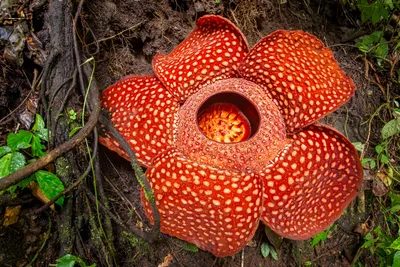
They hide in plain sight. You won’t see Rafflesia until it blooms.
This genus of parasitic plants, native to Southeast Asia, lives a ghostly existence within the roots of Tetrastigma vines. For months or even years, they are just a network of threadlike cellular strands. No leaves. No stems. No roots in the traditional sense. Just a hidden parasite waiting to make a shocking entrance.
When the time is right, the flower emerges. And it doesn’t just appear. It explodes.
The Largest Flower on Earth
The crown jewel of this genus is Rafflesia arnoldii. It holds the title for the largest single flower of any plant on the planet. While most plants spend their energy building roots and leaves to gather sunlight, Rafflesia spends its entire life force on one thing: reproduction. And it does so with a bang.
But this floral display comes at a cost. To survive, Rafflesia must be an obligate parasite. It cannot photosynthesize. It has no green tissue. It steals nutrients directly from its host. If the Tetrastigma vine dies, the Rafflesia dies with it. There is no middle ground.
A Taxonomic Outcast
Biologically, Rafflesia is an anomaly. It belongs to the kingdom Plantae and the clade Angiosperm (flowering plants), but its physical structure defies standard botanical expectations.
- Order: Malpighiales
- Family: Rafflesiaceae
- Genus: Rafflesia
Most plants in the Malpighiales order look nothing like Rafflesia. They have leaves. They have stems. They perform photosynthesis. Rafflesia does none of this. It is an endoparasite, meaning its vegetative organs are so reduced that the plant body exists almost wholly within the tissues of the host. Some species retain vestiges of leaves as tiny scales, but for all intents and purposes, it is a flower without a plant.
Why It Matters
Understanding Rafflesia isn’t just about cataloging weird plants. It’s about realizing how flexible plant evolution can be. In a world dominated by green, sun-chasing flora, Rafflesia proves that you can survive by hiding, stealing, and blooming.
It challenges our definition of a plant. Is it still a plant if it doesn’t eat sunlight? Is it still a plant if it lives inside another organism?
The answer, according to taxonomy, is yes. But the visual evidence suggests otherwise. When Rafflesia arnoldii opens its massive, fleshy petals in the humid rainforests of Southeast Asia, it doesn’t look like a plant. It looks like an alien artifact. Or a meat trap.
Either way, it commands attention. And for a plant that spends most of its life unseen, that attention is everything.
The question isn’t whether it exists. The question is how much longer we will find it before it disappears entirely.
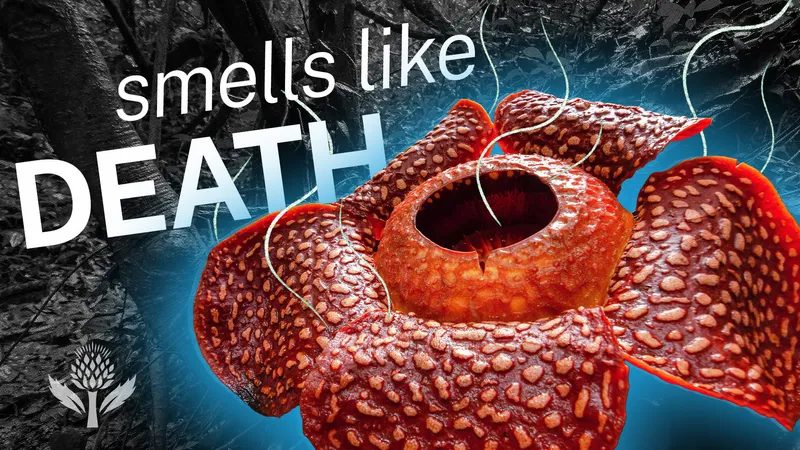

Rotting Illusion Mechanics
These massive, fleshy structures aren’t just for show. Rafflesia flowers are robust in structure and typically have five thick, undifferentiated petals that form a protective covering around the reproductive organs. But here’s the catch: each flower is strictly unisexual. They are unable to pollinate themselves. You need a neighbor. More specifically, a flower of the opposite sex that blooms at exactly the same time. If the timing is not correct, the cycle will be interrupted.
To ensure rare synchronicity, these plants have become masters of deception. They are sapromyophilic, a fancy way of saying they rely on carrion-feeding flies for their pollination. So how do you attract flies that only eat dead things? You’re faking it.
Most species are painted in reddish or purplish-brown tones, often with a mottled pattern that looks suspiciously like decaying meat. But seeing is only half the battle. During flowering, they give off a foul odor for a few days, reminiscent of a corpse in advanced decomposition. Some even generate heat. This metabolic heat simulates the heat of a decomposing body, making the illusion biologically convincing to insect sensors. The pollen itself is coated in a sticky liquid that hardens on the flies, ensuring they stick as they move on to the next flower.
As soon as the pollination is successful, the flower shrinks and gives way to the berry. Inside are sticky seeds, likely designed to be picked up by fruit-eating rodents. It’s a crude but effective distribution system.
Which species are most at risk?
The conservation situation varies by species, but the general rule is grim. Because Rafflesia rely on such specific pollinators and host vines, they are extremely sensitive to habitat disturbance. Due to deforestation in Southeast Asia, the vines are threatened before the flowers even bloom.
Some species are more common than others. Rafflesia arnoldii, known for its enormous size, is found in certain rainforests in Sumatra and Borneo. Others are confined to smaller islands or mountain ranges, making them much more vulnerable to extinction. The biggest threat is not only the loss of the plant itself, but also the fragmentation of the ecosystem that supports its complex life cycle. Without specific flies and special host vines, the flower cannot exist.
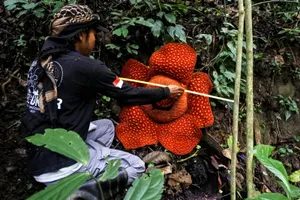

ほとんどの人はラフレシア という名前を聞いたことはありませんが、匂いを覚えている人は多い。 この属は R. arnoldii の故郷です、この植物は地球上で最大の単一の花を咲かせます。 一般に死体の花または怪物の花として知られるこの重量級の植物は、スマトラ島とボルネオ島の森林に覆われた山々に生息しています。
開花すると、花は厚く肉厚な構造となって地面から突き出ます。 5つの裂片があり、重さは最大11キログラムです。 これは約 24 ポンドの植物物質に相当します。 幅1メートル近くまで広がりました。 それは巨大です。 これは否定できません。
タイタンアラムとの関係
This genus is often confused with Amorphophallus titanum. They have nothing to do with it. Titan Arum has the largest unbranched inflorescence in the plant kingdom. It smells like rotting flesh, ラフレシアと同様に. This scent is used to attract insects for pollination. Two different plants. Same desperate tactic.
Fragile existence
Rafflesia 属の種は is rare. Most of them are very difficult to grow because they are completely dependent on Tetrastigma vines. それらは寄生植物です。生存には survive without a host. This biological lock and key relationship makes them vulnerable.
The threat is specific and continuous. Logging and land use changes destroy the rainforest habitat. 違法な採取が the pressure. 人々は花を持ち去り claiming that it has medicinal properties. The supply chain is a black market. The need is real.
絶滅危惧状況
As of 2023, only one species has been officially assessed for the IUCN Red List of Threatened Species. R. magnifica found in the Philippines is listed as 絶滅危惧種. It’s official status. It doesn’t tell the whole story.
Scientists estimate that at least 60% of Rafflesia species are at risk of extinction. Information is scarce because plants are hard to find. 生息地が失われ faster than science can track them. We know these numbers are not good. We know that the cause is human activity. The question remains whether the remaining flowers will bloom before the forests they depend on disappear.


