








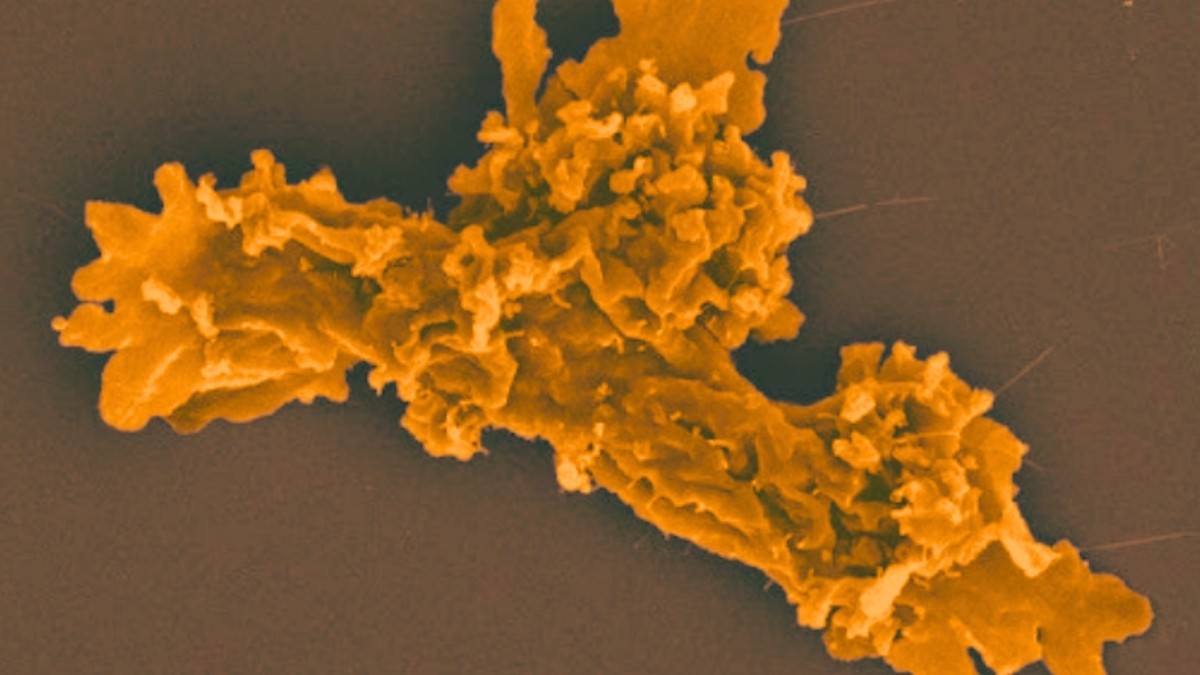
A newly discovered single-celled organism, Incendiamoeba cascadensis, has shattered previous records for heat tolerance among eukaryotic lifeforms. Found in the geothermal waters of Lassen Volcanic National Park, this “fire amoeba” thrives at temperatures up to 63°C (145°F) – the highest temperature ever observed for a eukaryotic organism. This finding challenges long-held assumptions about the thermal boundaries of complex life and raises questions about the potential for extremophile organisms on Earth and beyond.
The Discovery and Its Significance
Researchers led by H. Beryl Rappaport and Angela Oliverio of Syracuse University identified I. cascadensis during fieldwork between 2023 and 2025. Unlike most eukaryotes, which struggle at temperatures above 60°C, this amoeba not only survives but actively grows and divides in water hot enough to scald human skin. The discovery is significant because eukaryotic cells are inherently more fragile than simpler prokaryotic cells, such as bacteria, making this level of heat resistance unexpected.
How It Works: Adapting to Extreme Heat
The amoeba’s ability to withstand extreme heat comes down to a unique combination of adaptations. The researchers found that I. cascadensis requires at least 42°C to begin growth, classifying it as an obligate thermophile. Optimal growth occurs between 55-57°C, and cell division (mitosis) was observed at temperatures as high as 63°C.
Key adaptations include:
- Rapid Signaling Pathways: The amoeba responds quickly to heat stress.
- Heat-Resistant Proteins: It produces proteins that remain functional at extreme temperatures.
- Heat-Shock Chaperones: Molecular “escorts” that prevent proteins from unfolding and breaking down.
- Protective Cysts: When conditions become too extreme (above 66°C) or too cold (below 25°C), the amoeba forms dormant cysts to survive until conditions improve.
Broader Implications
The discovery of I. cascadensis is not just a biological curiosity. It suggests that life may be far more adaptable than previously thought. Fragments of similar DNA have also been found in Yellowstone National Park and the Taupō Volcanic Zone in New Zealand, hinting that this heat-loving amoeba may not be unique.
“Incendiamoeba cascadensis proliferates at temperatures beyond what was thought possible for any eukaryotic organism. This discovery raises new questions about the true maximum temperature a eukaryotic cell can endure.”
This finding has implications for astrobiology, the search for life beyond Earth. If eukaryotes can thrive in such extreme conditions on our planet, the possibility of finding similar organisms in other harsh environments (such as geothermal vents on Europa or Enceladus) increases significantly.
The study reinforces the idea that life’s boundaries are not fixed, and that adaptation can push those limits far beyond our current understanding.