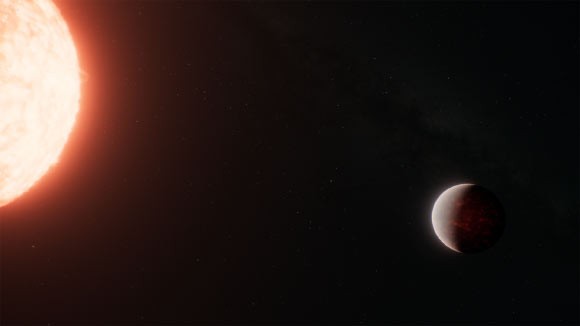
The James Webb Space Telescope has revealed that the exoplanet TOI-561b, a super-Earth orbiting a distant star, is shrouded in a remarkably thick atmosphere despite its extreme heat. This finding challenges existing models of planetary atmospheres, particularly for small worlds exposed to intense stellar radiation.
The Scorching World of TOI-561b
TOI-561b is located 280.5 light-years away in the Sextans constellation and orbits a 10-billion-year-old star, making it one of the oldest known planetary systems. This planet, roughly 1.45 times Earth’s radius and 3.2 times its mass, completes an orbit in just 0.44 days. The star it orbits is approximately 80% the size of our Sun, but significantly older and with a lower metal content. The planet’s density is lower than expected for a rocky world, suggesting a unique composition or an unusually bloated atmosphere.
The Mystery of the Atmosphere
Planets this close to their stars typically lose their atmospheres quickly due to intense stellar winds and heat. However, TOI-561b’s atmosphere is not only present but appears substantial enough to significantly cool the planet’s dayside temperature from a predicted 2,700°C (4,900°F) down to 1,800°C (3,200°F). This suggests a complex interaction between the planet’s molten surface and its gaseous envelope.
The researchers suggest that strong winds within the atmosphere circulate heat from the dayside to the nightside. The presence of gases like water vapor and silicate clouds may also play a role in absorbing radiation and reflecting starlight, further cooling the planet.
A Volatile Equilibrium
“We really need a thick volatile-rich atmosphere to explain all the observations,” says Dr. Anjali Piette, an astronomer at the University of Birmingham. The team proposes that the planet maintains this atmosphere through a dynamic equilibrium where gases are continually released from the magma ocean into the atmosphere but are also drawn back into the planet’s interior. This could explain how TOI-561b retains such a substantial atmosphere despite the extreme conditions.
This discovery highlights how little we still know about planetary evolution, especially for worlds unlike our own. TOI-561b is a “wet lava ball” that could hold clues to planetary formation in metal-poor environments, challenging assumptions about what makes a planet habitable or even survivable.
The study, published in The Astrophysical Journal Letters, opens new avenues for studying the atmospheres of ultrahot exoplanets and refining our understanding of planetary atmospheres across the galaxy.