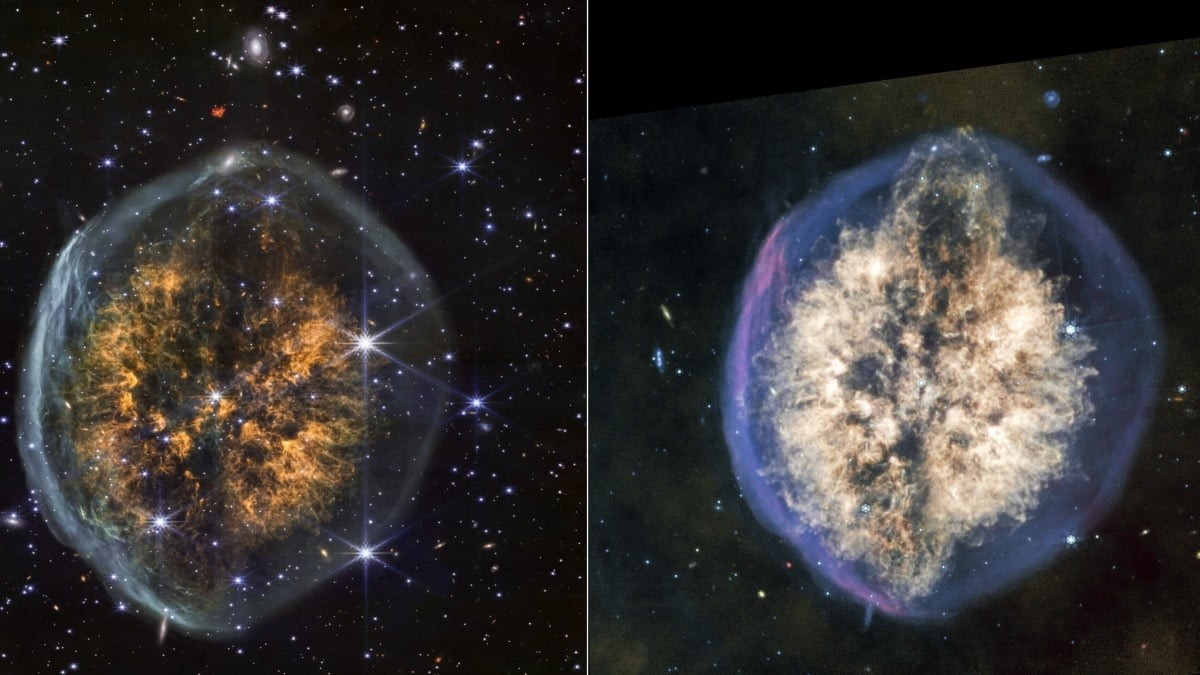
The James Webb Space Telescope has delivered remarkably clear images of PMR 1, a planetary nebula in the Vela constellation, approximately 5,000 light-years from Earth. Nicknamed the “Exposed Cranium” due to its striking resemblance to a brain scan, this cosmic cloud of gas and dust originates from a dying star, whose ultimate fate remains a key question for astronomers.
The Nebula’s Unique Features
Webb’s observations, captured in both near- and mid-infrared light, surpass the detail from previous Spitzer Space Telescope images taken over a decade ago. The new views reveal a complex structure:
- A distinct dark lane bisects the nebula, creating the striking brain-like symmetry.
- Faint outer bubbles of hydrogen indicate earlier stages of stellar material ejection.
- A denser, inner cloud composed of mixed gases forms the core of the “brain” shape.
- Potential jets from the central star suggest ongoing ejection shaping the nebula’s structure.
These features provide a unique snapshot of a star in its final stages, shedding layers of material before either fading into a white dwarf or exploding as a supernova.
Why This Matters: Stellar Evolution in Real Time
The study of PMR 1 is significant because the mass of the dying star is unknown. This is critical : a heavier star will eventually end its life in a spectacular supernova, scattering heavy elements into space, while a smaller star will gently cool into a white dwarf. The Exposed Cranium Nebula offers a rare opportunity to observe the process in action.
Planetary nebulae, despite the name, have nothing to do with planets. They form when medium-sized stars expand into red giants, then shed their outer layers over time. The images show multiple episodes of outbursts, suggesting a dynamic and violent process.
Webb’s Infrared Advantage
Webb’s ability to see in infrared is essential here. Infrared light can penetrate thick dust clouds, revealing details that are invisible to human eyes or visible-light telescopes. This allows astronomers to map the material ejected at different times, track the star’s mass loss, and pinpoint the exact phase of its decline. The data confirms that stellar death isn’t always a smooth process.
“These images capture a brief, dynamic moment in a star’s death march, offering a rare peek at how its debris scatters through space, seeding future generations of stars and planets.”
The observations confirm that the debris ejected by dying stars enriches the interstellar medium, providing the raw materials for new stars and planetary systems. This cycle of stellar birth and death is fundamental to the universe’s evolution.
The Exposed Cranium Nebula offers a compelling glimpse into the final act of a star’s life, providing valuable data that will help astronomers refine their understanding of stellar evolution and the cosmic cycle of creation and destruction.