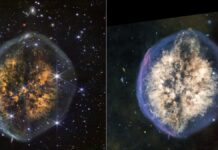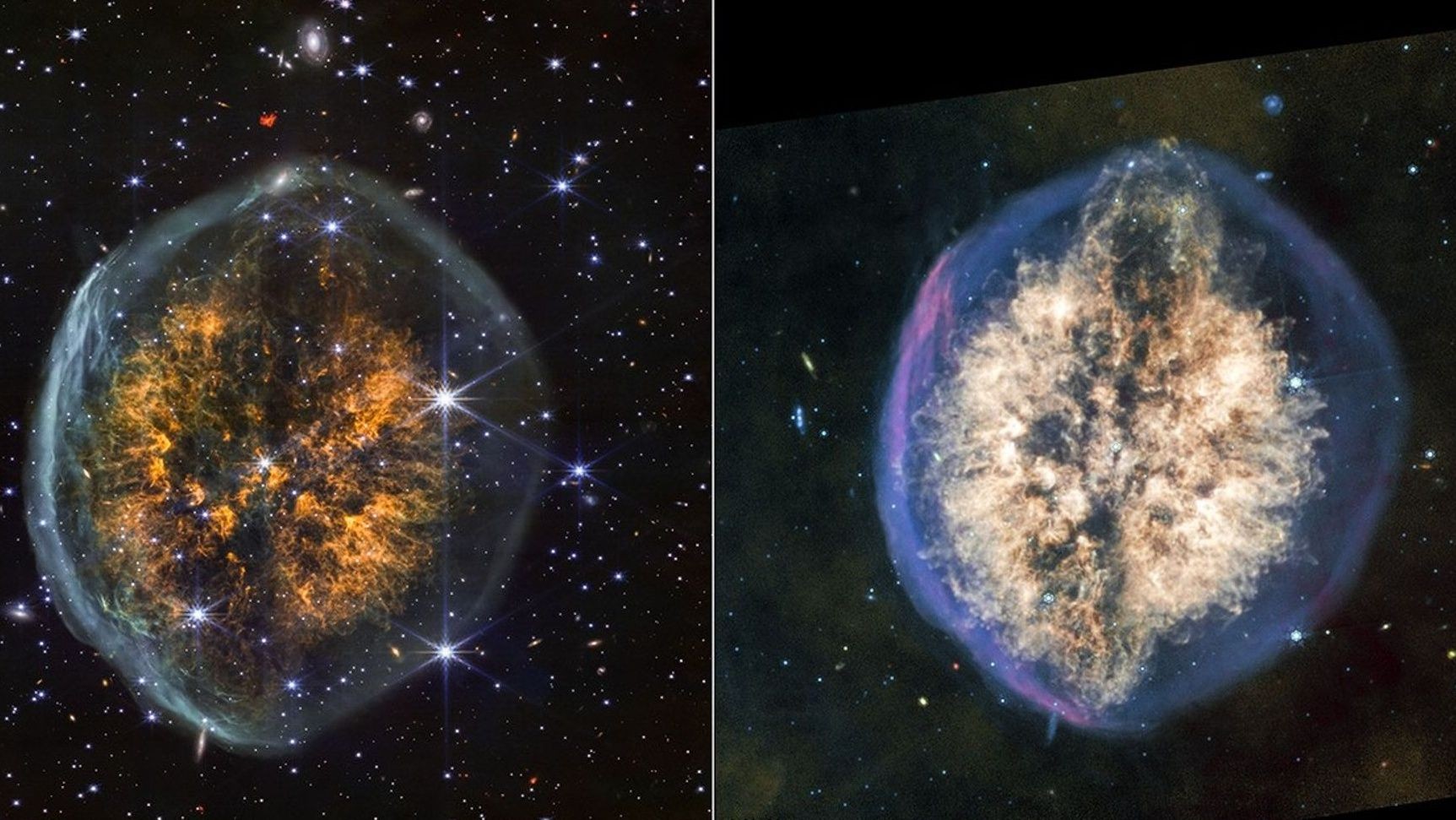
The James Webb Space Telescope (JWST) has captured striking new images of a nebula 5,000 light-years away in the Vela constellation that bears an uncanny resemblance to a human brain encased in a skull. Officially known as PMR 1, the nebula gained its nickname, the “Exposed Cranium Nebula,” due to its distinct shape revealed by earlier observations from the Spitzer Space Telescope.
Discovery and Initial Observations
PMR 1 was first identified in the late 1990s by astronomers Parker, Morgan, and Russell during a sky survey using the U.K. Schmidt Telescope in Australia. Initial infrared observations hinted at the nebula’s unusual structure, but JWST’s advanced instruments — the Near-Infrared Camera (NIRCam) and Mid-Infrared Instrument (MIRI) — have now provided unprecedented clarity.
A Celestial Skull and Brain
The latest JWST imagery shows a clear division within the nebula, appearing like two lobes of a brain separated by a central fissure. Scientists believe this split may be the result of powerful jets of material ejected from the dying star at the nebula’s center. The outer shell of the structure, composed primarily of cooled hydrogen gas, forms what looks like the “cranium,” while the brighter, more complex inner gases create the “brain” effect.
The Mystery of the Dying Star
The central star’s nature remains uncertain. When PMR 1 was discovered, its characteristics suggested it may be a Wolf-Rayet star — a highly unstable and massive star known for shedding mass rapidly through intense radiation. Wolf-Rayet stars typically end their lives in spectacular supernova explosions after forming Wolf-Rayet nebulae like PMR 1. However, direct confirmation of a Wolf-Rayet star within PMR 1 is still pending. The presence of such a star would explain the nebula’s dramatic appearance, but further study is needed to confirm this hypothesis.
The JWST’s observations of PMR 1 highlight the power of modern telescopes to reveal hidden details in the cosmos and raise fundamental questions about stellar evolution. Understanding the central star’s true nature will be key to unlocking the full story behind this eerie yet beautiful celestial structure.