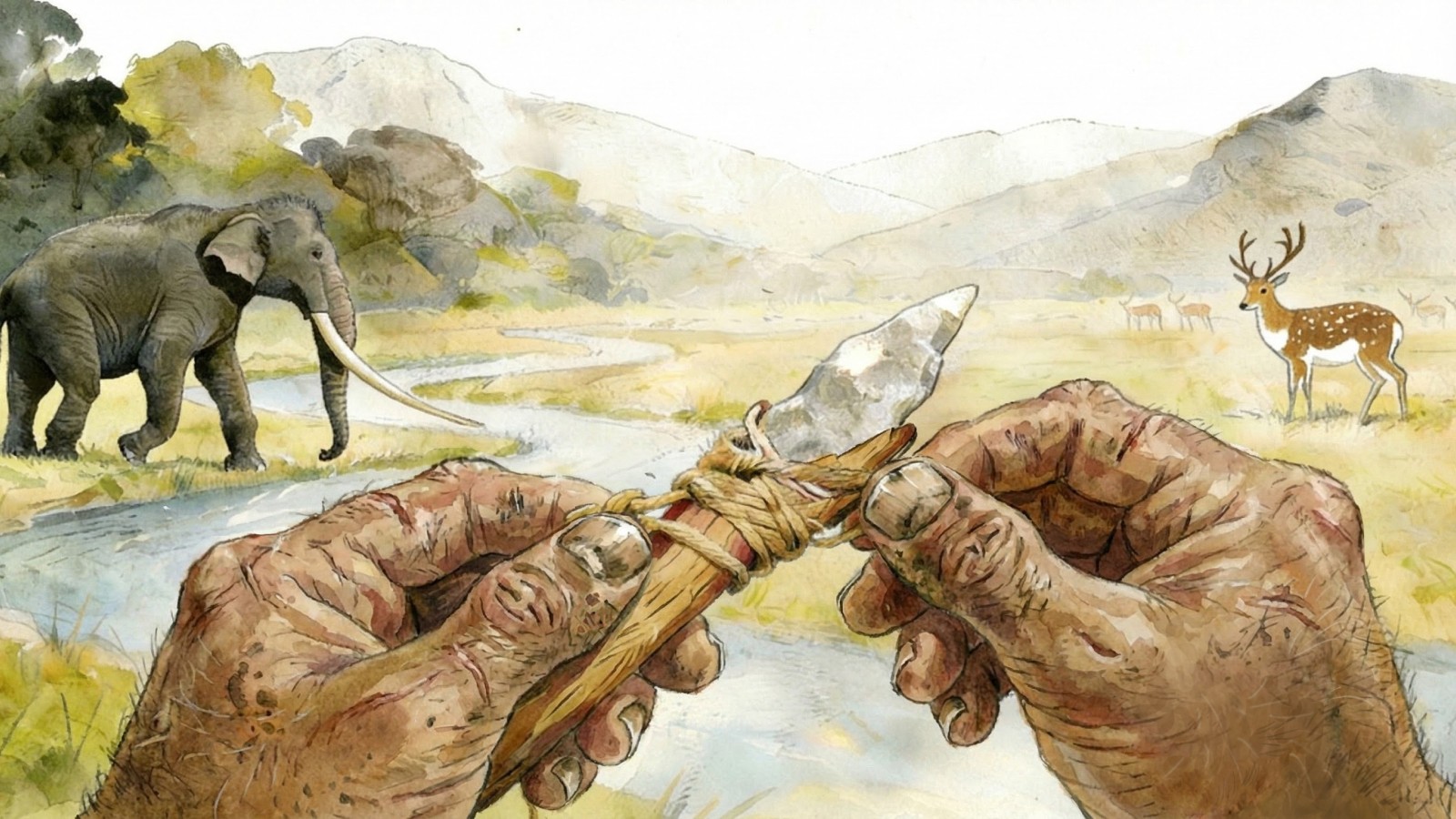
Archaeological discoveries in central China are rewriting the story of early human toolmaking. Researchers have unearthed a collection of over 2,600 sophisticated stone tools dating back as far as 160,000 years—tools that demonstrate a level of technological complexity previously thought absent in East Asia at that time.
Advanced Techniques, Early Timeline
The tools, excavated from the Xigou site in Henan province, include examples of hafted artifacts: stone blades deliberately attached to wooden or bone handles. This isn’t simply about making sharper rocks; it’s about combining materials to create composite tools—a significant leap in cognitive and practical skill. The earliest known evidence of such composite tools in Eastern Asia, these finds predate similar discoveries elsewhere in the region by tens of thousands of years.
Researchers determined that the tools were used to process plant materials, with microscopic analysis revealing wear patterns consistent with boring into wood or reeds. This suggests early humans in the region were adapting to their environment with precision and foresight, using tools to manipulate resources effectively. The toolmaking techniques themselves “appear to be well established and involve several intermediate steps, showing evidence of planning and foresight,” according to the research team.
The Mystery of Who Made Them
The biggest question remains: who crafted these tools? The period in question saw multiple hominin species coexisting in the region, including Homo sapiens, the Denisovans, H. longi, and H. juluensis. Without fossil or genetic evidence, pinpointing the exact maker is impossible—though future research may provide clues.
The tools themselves are surprisingly small, many under 2 inches in length, but were produced using complex methods. This contradicts previous assumptions that early toolmaking in East Asia was limited to large, crudely-flaked implements. The new evidence shows that sophisticated tool production strategies emerged much earlier than previously believed.
Dismantling Old Assumptions
For decades, a concept known as the “Movius Line” has dominated archaeological thought. Proposed in the 1940s, this idea suggested a sharp divide between the “advanced” tool cultures of Africa and Western Eurasia (with their handaxes) and the “conservative” chopper-chopping traditions of East Asia. This narrative implied that East Asian hominins were culturally stagnant. The new findings thoroughly challenge this notion.
As one expert put it, the idea of East Asia as a cultural backwater was never accurate. Some experts even suggest that more complex tools in Europe were dangerous to make—and early humans likely chose safer, more efficient methods instead. The implication is clear: “simple tools do not equal simple minds.” The Xigou discovery proves that East Asian hominins were capable of innovation and adaptation just as much as their contemporaries elsewhere.
The tools date back between 160,000 and 72,000 years ago, a period when people in the region lived as hunter-gatherers. While the details of their lifestyles remain unclear, the sophistication of their tools suggests a high degree of behavioral flexibility and adaptation.
The discovery forces archaeologists to abandon outdated biases and acknowledge the full range of human ingenuity across all regions. The tools are evidence that East Asia was not a “cultural backwater,” but a region where early humans developed complex technologies independently.