An artificial intelligence (AI) has revealed over 1,300 previously undetected cosmic anomalies within the Hubble Space Telescope’s vast image archive. The discovery, detailed in the December 16, 2025, issue of Astronomy & Astrophysics, includes roughly 800 objects never before identified by astronomers. This surge in new findings underscores the limitations of traditional methods when dealing with decades of accumulated space data.
The Hunt for Anomalies
Researchers David O’Ryan and Pablo Gómez at the European Space Agency (ESA) developed an AI tool, dubbed AnomalyMatch, to sift through 100 million image cutouts from the Hubble Legacy Archive. This archive contains observations stretching back to the telescope’s 1990 launch. The AI was designed to identify patterns in the images, accelerating the discovery of unusual phenomena.
The manual review of such extensive data would be impractical, even with citizen science initiatives assisting. The sheer volume of Hubble’s 35-year record necessitates automated tools to maximize scientific returns.
What Was Found?
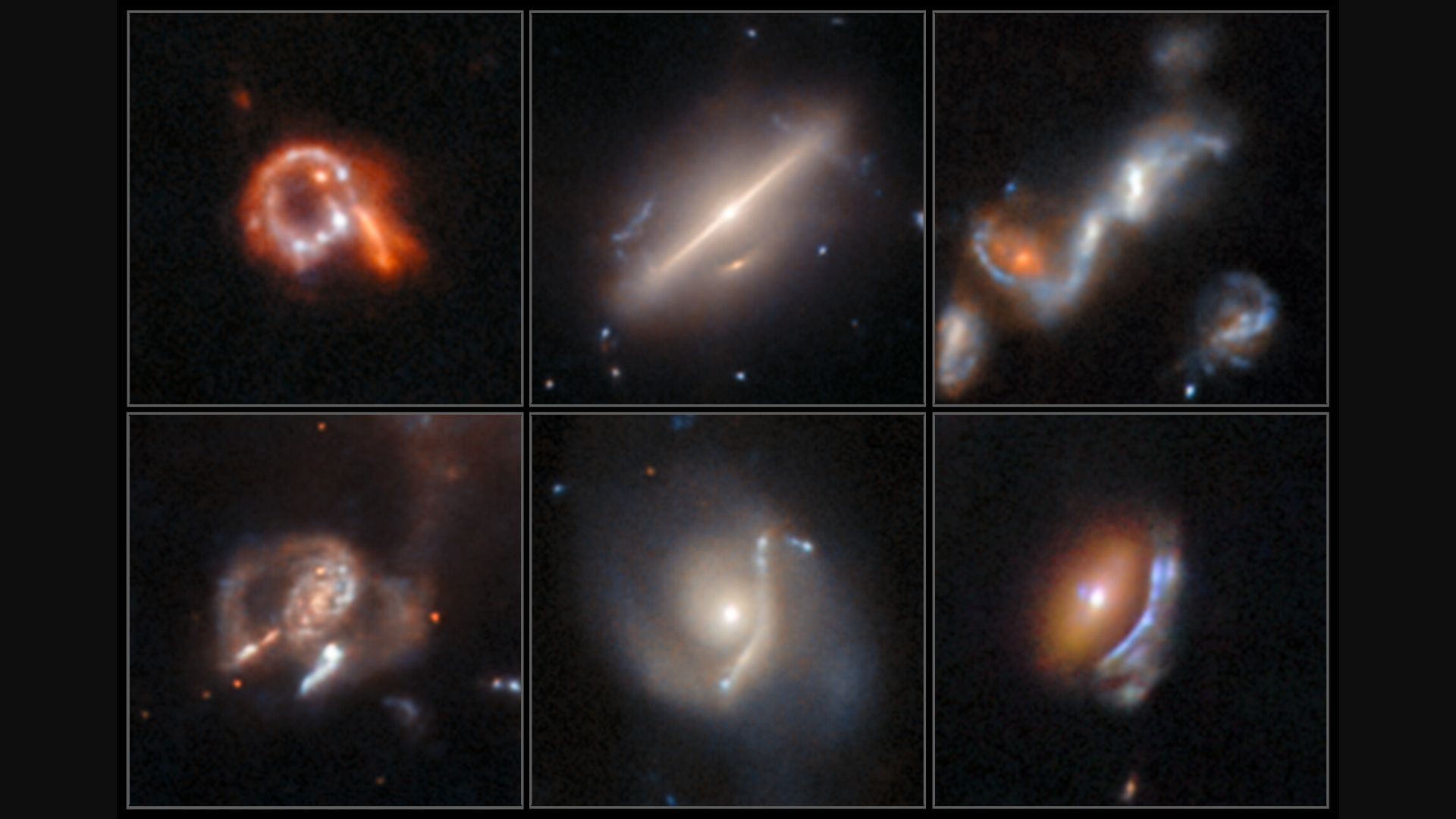
The AI identified a wide range of anomalies, including:
- Merging Galaxies: Chaotic interactions between galaxies exhibit strange shapes and trailing streams of stars and gas.
- Jellyfish Galaxies: Structures resembling jellyfish, with gaseous “tentacles” stretching out from their bodies.
- Cosmic Hamburgers: Edge-on planet-forming disks in our galaxy that resemble hamburger-like structures.
- Unclassified Objects: Dozens of objects defy existing classification schemes entirely.
Beyond these more visually striking anomalies, the AI also detected gravitational lenses—where foreground galaxies distort the light from background galaxies. These lenses create arcs or rings in the images.
Why This Matters
The discovery highlights the untapped potential within astronomical archives. While astronomers have long relied on manual inspection and serendipitous observations, AI can systematically explore vast datasets for hidden patterns. The AI’s ability to rapidly identify anomalies suggests that our understanding of the universe may be incomplete.
The findings underscore the power of AI to enhance the scientific return of archival datasets, particularly in fields where data accumulation far outpaces manual analysis.
This is a significant step towards a more comprehensive understanding of cosmic phenomena. The anomalies detected may represent previously unknown physical processes, new types of celestial objects, or simply errors in existing classification systems. Further study is needed to determine the true nature of these mysterious objects.