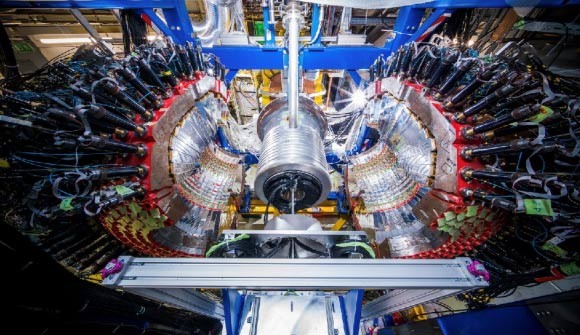
In a breakthrough for nuclear physics, researchers have successfully detected a long-predicted, exotic state of matter: a pairing between a carbon-11 nucleus and an $\eta’$ (eta prime) meson. This discovery, achieved through experiments at the GSI fragment separator in Germany, provides a rare window into the fundamental forces that govern our universe.
The Mechanics of the Strong Interaction
To understand the significance of this find, one must look at how matter is held together. In our everyday world, different forces govern different scales:
– Gravity keeps planets in orbit.
– Electromagnetism binds electrons to nuclei to form atoms.
– The Strong Interaction acts as the “glue” that holds protons and neutrons together within an atomic nucleus.
While most particles are bound by electromagnetic forces (due to their electric charge), the $\eta’$ meson is electrically neutral. Because it lacks a charge, it cannot be pulled toward a nucleus by electromagnetism. Instead, any bond it forms must rely entirely on the strong interaction.
This makes the newly detected state incredibly rare and scientifically precious. It allows physicists to study the strong force in isolation, without the “noise” of electromagnetic interference, providing a pure look at how this force operates.
How the Discovery Was Made
The experiment, led by Professor Kenta Itahashi of RIKEN and Osaka University, utilized high-speed particle collisions to create this fleeting state. The process involved several precise steps:
- High-Speed Collision: A proton beam was accelerated to approximately 96% of the speed of light.
- Neutron Stripping: This beam struck a carbon-12 nucleus, “snatching” a neutron away to form a deuteron.
- Nuclear Excitation: The remaining carbon-11 nucleus was left in a highly energetic, unstable state.
- Meson Formation: This excess energy allowed for the creation of an $\eta’$ meson, which, in a rare occurrence, became momentarily bound to the carbon-11 nucleus.
This created a short-lived, exotic quantum state that had been theorized since 2005 but never before observed in a laboratory setting.
Why This Matters: The Mystery of Mass
Beyond simply proving the existence of this exotic bond, the experiment revealed something profound about the nature of matter: the mass of the $\eta’$ meson changes when it is inside a nucleus.
This observation touches on one of the deepest questions in physics: Where does mass come from?
If you sum up the masses of the individual quarks that make up an $\eta’$ meson, they account for only about 1% of its total mass. The remaining 99% is generated by the energy of the strong interaction itself. By observing how the meson’s mass decreases when it is embedded within the dense environment of a nucleus, scientists can better understand the complex relationship between energy, force, and the generation of mass.
Looking Ahead
The research team, whose findings are published in Physical Review Letters, intends to build on this success. The next phase of research will involve more extensive data collection to map out the specific “spectroscopic properties” of this system—essentially creating a detailed map of its energy levels and decay patterns.
This discovery does more than just confirm a theory; it provides a new tool to probe the very mechanism that gives the universe its substance.
Conclusion
By detecting the first $\eta’$-meson-nucleus bond, physicists have moved closer to understanding how the strong interaction generates mass, opening a new chapter in our study of the fundamental building blocks of reality.