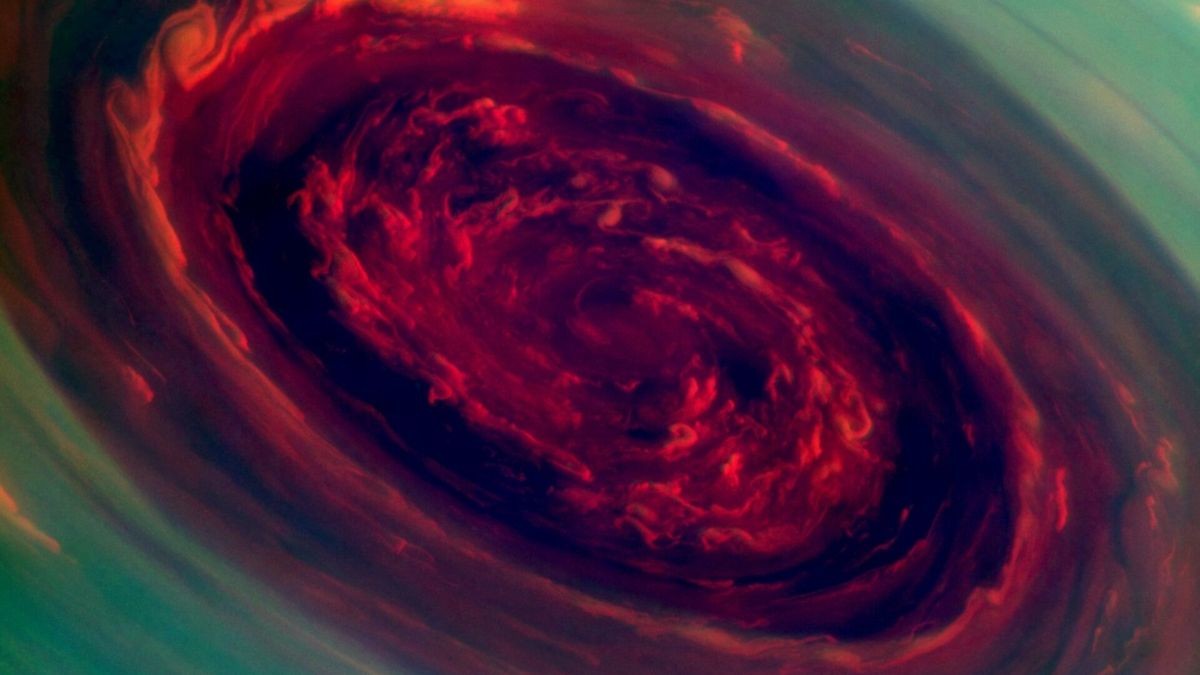
The gas giants Jupiter and Saturn share many similarities – composition, spin rate, heat emission, and even a penchant for collecting moons. Despite these resemblances, their polar storms exhibit striking differences: Saturn has one massive vortex at each pole, while Jupiter boasts a central storm surrounded by a ring of smaller ones. This long-standing mystery has puzzled scientists, but new research suggests the answer lies in the planets’ internal structures and how they regulate storm development.
The Key to the Disparity: Atmospheric Constraints
Planetary scientists Wanying Kang and Jiaru Shi of MIT propose that the divergence in storm patterns stems from how each planet’s atmosphere allows storms to grow and connect with deeper layers. Saturn’s atmosphere appears to allow storms to expand freely, resulting in single, dominant polar vortices. Jupiter, conversely, seems to impose natural limits on storm size, giving rise to its multi-storm configuration.
According to the researchers, this is determined by how strongly the storms are coupled to the planetary interior. The deeper the connection, the more likely storms are to merge. If the interior is softer, the storms remain limited in size. If it’s harder, they combine into a single vortex.
“Our study shows that, depending on the interior properties and the softness of the bottom of the vortex, this will influence the kind of fluid pattern you observe at the surface,” says Wanying Kang.
Why This Matters: Linking Surface Weather to Internal Structure
This discovery is significant because it suggests a direct correlation between a planet’s visible weather patterns and its hidden internal properties. The depth of atmospheric layering, the intensity of internal heat, and the rate of friction all play a role in determining how storms evolve.
Jupiter’s deeper, more energetic atmosphere allows multiple vortices to form without merging, creating its distinct “pepperoni pizza” pattern. Saturn’s atmosphere, with its more pronounced layering or friction, permits storms to coalesce into single, dominant vortices.
What’s Beneath the Surface?
The team’s model implies that Saturn may have a harder, denser interior than Jupiter, potentially enriched with metals and condensable materials. This stratification could explain why Saturn’s storms merge while Jupiter’s do not.
The findings are not definitive proof, but they highlight the potential for using surface weather patterns as a window into planetary interiors. Understanding these dynamics can refine our models of gas giant formation and evolution.
The polar storms of Jupiter and Saturn, once enigmatic, may now be telling us something fundamental about the worlds beneath their swirling clouds.