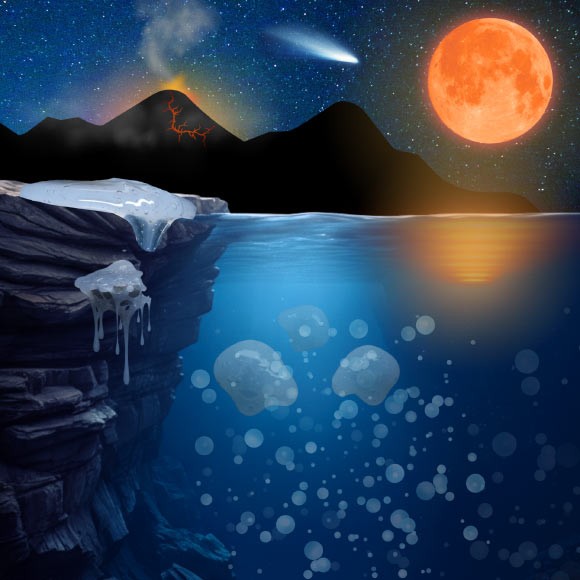
Researchers propose that life did not begin in oceans or hydrothermal vents, but within primitive, surface-bound gels. A new framework, dubbed the “prebiotic gel-first” theory, suggests that these sticky, semi-solid matrices—similar to modern microbial biofilms—provided the necessary conditions for early chemical systems to evolve into self-replicating life.
The Gel Hypothesis: A New Perspective on Life’s Origins
The study, published in ChemSystemsChem, argues that prebiotic gels acted as essential incubators for the first stages of life. These gels would have concentrated molecules, protected them from harsh environments, and facilitated the development of basic metabolic processes. Unlike theories focused solely on biomolecules, this model highlights the importance of physical structure in early chemical evolution.
Why this matters: For decades, scientists have debated where life first arose. This theory suggests that the focus should shift from the what (specific molecules) to the where (structural environment). Gels provide a plausible explanation for how complex chemical interactions could have occurred without the need for fully formed cells.
Beyond Earth: The Search for ‘Xeno-Films’
The implications extend to astrobiology. The researchers theorize that similar gel-like structures, dubbed “xeno-films,” could exist on other planets, composed of unique chemical building blocks. This suggests that future life-detection missions should prioritize searching for these structures, rather than relying solely on identifying terrestrial-based biomarkers.
Key insight: The focus on structures rather than specific molecules broadens the possibilities for finding life beyond Earth. It implies that life could take forms radically different from what we expect.
The Next Steps: Experimental Validation
The team at Hiroshima University and the National University of Malaysia plans to test their theory experimentally. They will simulate early Earth conditions to see if simple chemicals can self-assemble into prebiotic gels, and how these gels might influence the formation of self-replicating systems.
“We hope our work inspires others to explore underexplored origins-of-life theories,” says Dr. Ramona Khanum.
This research represents a significant shift in thinking about life’s origins. By integrating soft-matter chemistry and evolutionary biology, it offers a new, compelling model for how the first spark of life may have ignited—not in a primeval soup, but in a sticky, protective gel.