Astronomers have discovered an exoplanetary system, LHS 1903, that appears to defy standard planetary formation models. The system’s configuration – rocky planets flanking gas giants – suggests a chaotic early history, potentially reshaping our understanding of how planetary systems evolve.
The Anomaly Explained
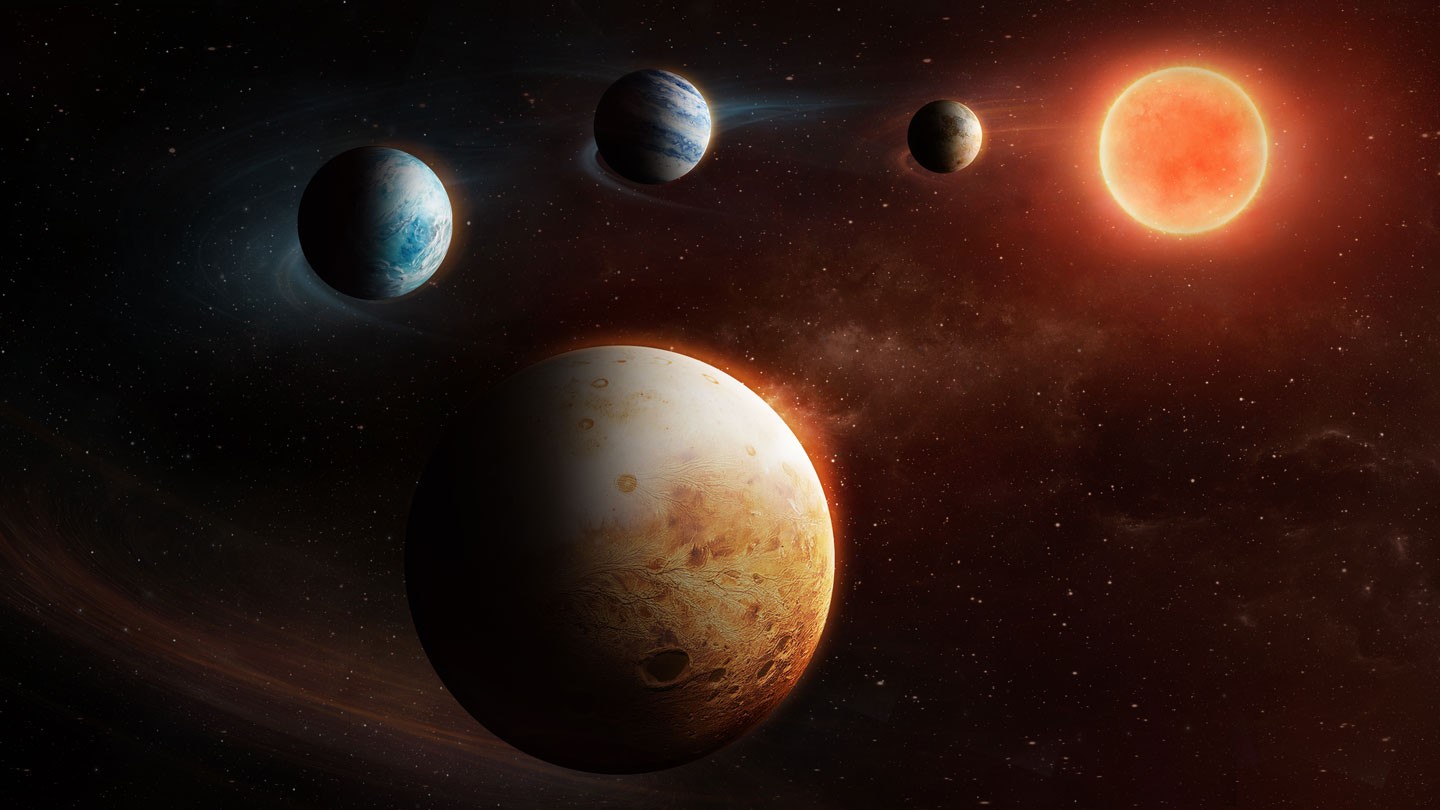
LHS 1903, a red dwarf star 116 light-years away, hosts four planets arranged in an unexpected order: rocky, gaseous, gaseous, then rocky. This is unusual because planetary formation theory predicts that rocky worlds should form closest to the star (where heat prevents gas retention) and gas giants farther out (where temperatures allow gas accretion).
This system breaks that rule, hinting at significant disruption. As Andrew Cameron of the University of St. Andrews explains, “Bad stuff does happen in young planetary systems… This one has the look of something that’s been turned inside out.” The planets orbit in less than 30 days, all within a compact space, and range from 1.4 to 2.5 times Earth’s radius.
What Happened?
The most likely explanation is planetary migration. Early in the system’s life, gravitational forces may have caused the outer planets to spiral inward. This could have been triggered by a collision with a large body, stripping away the atmosphere of the outermost planet, or by a general scattering of material that reshaped the system.
The fourth planet’s late formation also plays a role. It may have grown once the system “ran out of gas,” preventing it from acquiring a significant atmosphere.
Why This Matters
LHS 1903 offers valuable insight into the violence that can occur during planetary formation. Our own solar system likely underwent similar chaos in its early stages, with Jupiter and Saturn shifting orbits, scattering asteroids, and possibly swapping Uranus and Neptune’s positions.
This discovery reinforces the idea that planetary systems are not always neatly assembled. They often result from turbulent processes. Further observations of systems like LHS 1903 will help refine our understanding of how planets form and how common such chaotic histories might be.
This system’s unusual configuration highlights that planetary formation is not a predictable process, and our own solar system’s stability may be more exceptional than previously thought.