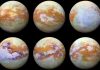
New images from NASA reveal Saturn in extraordinary detail, thanks to a collaborative effort between the James Webb Space Telescope (JWST) and the Hubble Space Telescope. The combined observations offer the most comprehensive portrait of the ringed planet yet, blending infrared, visible, and ultraviolet light to unveil a layered and dynamic world.
Combining Strengths: Infrared and Visible Light
Each telescope brings unique capabilities to the table. Hubble captures sharp, long-term views of Saturn’s cloud bands and atmospheric shifts in visible light. Meanwhile, JWST penetrates deeper into the atmosphere using infrared, revealing hidden heat patterns and structures beneath the upper cloud layers. This synergy allows scientists to “slice” through Saturn’s atmosphere, gaining a three-dimensional understanding of its complex weather systems.
Seasonal Shifts and Atmospheric Dynamics
The data includes observations from August 2024 (Hubble) and roughly 14 weeks later (Webb), capturing Saturn as it transitions toward its 2025 equinox. Saturn’s long seasonal cycles – each lasting about seven Earth years – are critical for interpreting atmospheric changes. The combined dataset highlights how the planet’s appearance shifts over time.
Webb’s infrared view reveals additional atmospheric structures, including a meandering jet stream in the northern mid-latitudes, possible auroral activity, and storms in the southern hemisphere. These details complement Hubble’s visible-light data, which shows the planet’s softly banded atmosphere.
Rings in High Definition
The images also provide complementary views of Saturn’s iconic rings. In Hubble’s data, the water ice rings appear bright in reflected sunlight with clear definition. Webb’s infrared view makes the rings shine even more prominently, revealing additional detail in the ring system. Subtle differences between the telescopes’ views also reveal ring features like spokes and structure in the thick central region, as well as differing perspectives of the outer ring.
Long-Term Monitoring and Future Research
The Hubble’s Outer Planet Atmospheres Legacy (OPAL) program has tracked changes in Saturn for over a decade, providing a valuable long-term record. Webb’s new observations build upon this dataset, offering a multiwavelength perspective as the planet approaches its next equinox. By integrating infrared sensitivity with Hubble’s visible-light record, scientists have constructed a far more complete picture of Saturn than either telescope could achieve alone.
This combined data underscores the power of multi-observatory science, allowing researchers to study planetary behavior with unprecedented depth and clarity. The new images will undoubtedly fuel further investigation into Saturn’s atmospheric processes and the evolution of its ring system.