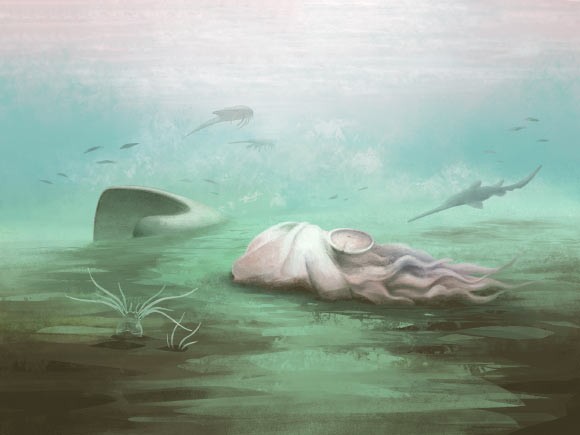
For over two decades, a specific fossil known as Pohlsepia mazonensis held a prestigious, if controversial, title: the world’s oldest octopus. Featured in the Guinness Book of Records, this specimen was believed to have upended our understanding of evolution by suggesting that octopuses existed over 150 million years earlier than previously thought.
However, a new study published in Proceedings of the Royal Society B has officially corrected the record. Researchers have determined that this specimen was not an octopus at all, but rather a distant relative of the nautilus.
The Mystery of the “Missing” Shell
The fossil originated from the Mazon Creek Lagerstätte, a famous geological site containing exceptionally preserved fossils from the Late Carboniferous period (approximately 306–311 million years ago).
When the species was first described in 2000, it appeared to be a “missing link” in cephalopod evolution. It possessed several features that seemed characteristic of an octopus:
– A fused head and mantle.
– Symmetrical fins.
– A crown of arms and tentacles.
– A total lack of any visible internal or external shell.
Because the shell was missing, paleontologists assumed it was a primitive, soft-bodied octopus, which would have pushed the origins of the group back into the Paleozoic era.
High-Tech Detection Reveals the Truth
The error persisted for years because the organism had decayed significantly before it was fossilized, leaving behind an enigmatic, “sac-like” shape that obscured its true identity.
To solve the puzzle, a team led by Dr. Thomas Clements used advanced synchrotron micro-X-ray fluorescence elemental mapping. This high-resolution scanning allowed the researchers to look through the rock matrix and identify a tiny, previously undetected feature: the radula.
The radula is a specialized, toothed tongue found in most mollusks. By analyzing its specific shape and morphology, the team reached a definitive conclusion:
The presence of this specific radula indicates that Pohlsepia mazonensis is not a member of the octopus lineage, but is instead a nautiloid —a group of cephalopods that typically possess shells.
As a result, the specimen has been reclassified as Paleocadmus pohli.
Why This Matters for Evolutionary Science
This reclassification does more than just correct a single entry in a record book; it recalibrates the entire evolutionary timeline of cephalopods.
- Correcting the Timeline: By removing this “false” octopus from the Paleozoic record, the study reinforces the theory that true octopuses (crown Octopoda) actually originated much later, during the Mid-to-Late Mesozoic era.
- Refuting Old Theories: The findings diminish the credibility of other controversial theories, such as the idea that the ancient Nectocaris pteryx fossil was a relative of modern coleoid cephalopods.
- A New Record: While it is no longer the oldest octopus, the specimen now holds a different distinction: it represents the oldest preserved soft tissue of a nautiloid ever found.
Conclusion
The reclassification of Pohlsepia mazonensis serves as a vital reminder of the complexities of paleontology. It highlights how even the most “charismatic” fossils require constant, rigorous re-evaluation as imaging technology advances and allows us to see what was once hidden in the stone.