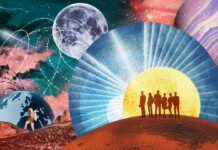












Over 4.5 billion years ago, a cataclysmic collision between Earth and a Mars-sized object named Theia resulted in the formation of our moon. New research suggests this wasn’t a random encounter: Theia may have originated in the same region of the early solar system as Earth, meaning the two planets were once celestial neighbors. This finding shifts our understanding of the moon’s birth and the dynamics of the early solar system.
The Great Impact and What We Know
The collision between Earth and Theia was a defining moment in our planet’s history, shaping its composition, mass, and orbit. However, because Theia was completely destroyed in the impact, many questions remain about its origins. Key unknowns include its size, composition, and precise location of formation within the early solar system.
Scientists have long sought to reconstruct Theia’s characteristics by analyzing the remnants of the collision – Earth and the Moon. This new study focuses on the isotopic signatures of elements within terrestrial and lunar rock samples to narrow down Theia’s possible origins.
Isotope Ratios Reveal Clues
The key to reconstructing Theia lies in the ratios of different isotopes (variations of elements with differing numbers of neutrons). In the early solar system, isotopes weren’t uniformly distributed. Therefore, the specific isotope ratios within a celestial body can reveal whether it formed closer to the sun or further out.
The research team examined isotopes of iron, chromium, molybdenum, and zirconium in 15 Earth rocks and six lunar samples collected by Apollo astronauts. The analysis confirmed the close relationship between Earth and the Moon, something already known from other isotopic studies. However, this team went further, comparing the isotope ratios to the composition of Earth to test different scenarios for Theia’s size and makeup.
Earth’s Mantle Holds the Key
A critical clue came from Earth’s molten core, which formed early in the planet’s history and accumulated heavy elements like iron and molybdenum. This process left Earth’s mantle (the layer between the crust and core) depleted in these elements. Any iron found in the mantle today likely arrived after the core formed, potentially carried by Theia during the impact.
As team member Thosten Klein explains, “The composition of a body archives its entire history of formation, including its place of origin.” This suggests that Theia delivered a significant portion of iron to Earth’s mantle.
The Case for an Inner Solar System Origin
To refine their model, the team compared the isotopic signatures of Earth and Theia to those found in meteorites – fragments of asteroids that formed alongside the planets. Earth’s composition aligns with a mix of known meteorite types from various parts of the solar system. However, Theia’s predicted composition doesn’t match any known meteorite type. This implies that Theia may have formed from previously unknown materials, strengthening the argument that it originated closer to the sun than Earth did.
This discovery challenges previous models that positioned Theia as an outsider from the outer solar system. It suggests that the early inner solar system was a more crowded and dynamic environment than previously thought.
The new research highlights that Earth and Theia were likely neighbors in the early solar system, born from the same materials and conditions. This insight not only refines our understanding of the moon’s formation but also raises broader questions about planetary migration and the distribution of materials in the early solar system.