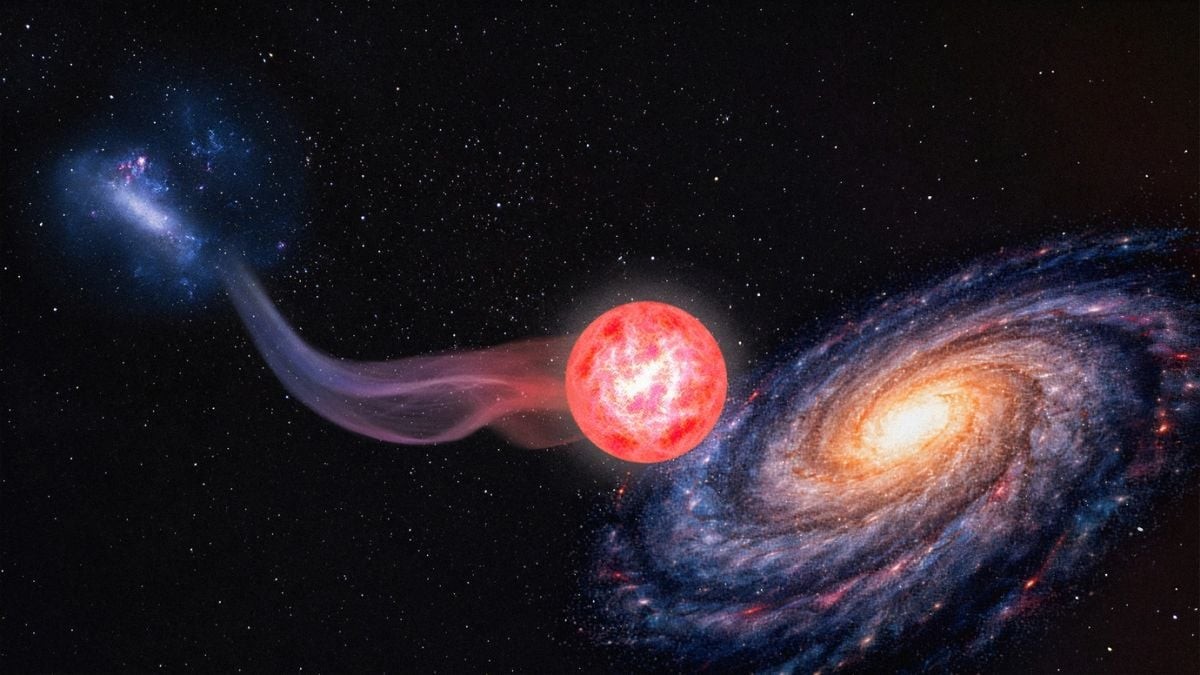
Astronomers have identified a stellar “fossil” within our cosmic neighborhood that offers a rare glimpse into the dawn of the universe. The star, designated SDSS J0715-7334, is remarkably pure, containing almost no “metals”—the astronomical term for any element heavier than hydrogen and helium.
This discovery is significant because it provides a chemical fingerprint of the very first era of star formation, helping scientists bridge the gap between the Big Bang and the complex, metal-rich universe we inhabit today.
The Search for the First Generation
To understand why this star is so special, one must look back to the early universe. Following the Big Bang, space was a dense fog of plasma. It wasn’t until roughly 300,000 years later that the universe cooled enough for protons and electrons to form neutral hydrogen and helium.
From these primordial gases, the very first stars—known as Population III —were born. These stars were massive, lived incredibly fast, and died in violent supernova explosions. These explosions were the universe’s first “factories,” forging heavier elements like carbon, oxygen, and iron and scattering them across space.
Because Population III stars lived such short lives, they have never been directly observed. Instead, astronomers hunt for Population II stars: older, low-mass stars that formed from the “polluted” gas left behind by those first supernovae. By studying these second-generation stars, scientists can work backward to understand the properties of the first stars that are now lost to time.
A Record-Breaking Discovery
The discovery of SDSS J0715-7334 was almost accidental. While conducting routine observations using the Sloan Digital Sky Survey (SDSS), a team led by cosmologist Alexander Ji of the University of Chicago found themselves captivated by the star. What was intended to be a 10-minute observation turned into a three-hour deep dive.
The results were staggering:
– Extreme Purity: The star’s metallicity is only 0.005% of the Sun’s.
– Record-Breaking Low Iron: Its iron content is 40 times lower than the previous record-holder for the most iron-poor star known.
– Carbon Deficiency: Most notably, the star has a shockingly low amount of carbon.
Solving a Cosmic Cooling Mystery
The lack of carbon is the most intriguing aspect of this find. In the evolution of the universe, carbon and oxygen act as “coolants.” For gas clouds to collapse and form stars, they need to shed heat; carbon is highly efficient at this process.
The chemistry of SDSS J0715-7334 suggests a unique, intermediate formation process:
1. There was too little carbon for the standard cooling method used by later stars.
2. However, there was enough “cosmic dust”—the leftover ashes of the first Population III supernovae—to help the gas collapse.
This suggests the star formed in a rare transitional era, using tiny amounts of dust to facilitate star birth in an environment that was still largely pristine.
Where to Look Next
Interestingly, SDSS J0715-7334 does not appear to be a native of the Milky Way. Its motion suggests it originated in the Large Magellanic Cloud, a dwarf galaxy that orbits our own.
This provides a new roadmap for future research. Astronomers believe that smaller, satellite galaxies like the Magellanic Clouds may hold a much higher concentration of these ultra-metal-poor stars than the Milky Way itself.
“There is still lots to be done to understand what was actually going on in that era… We’ve only scratched the surface.” — Kevin Schlaufman, Johns Hopkins University
Conclusion: By finding a star that is almost entirely hydrogen and helium, astronomers have found a rare chemical bridge to the early universe, revealing how the first traces of cosmic dust helped shape the stars that followed.