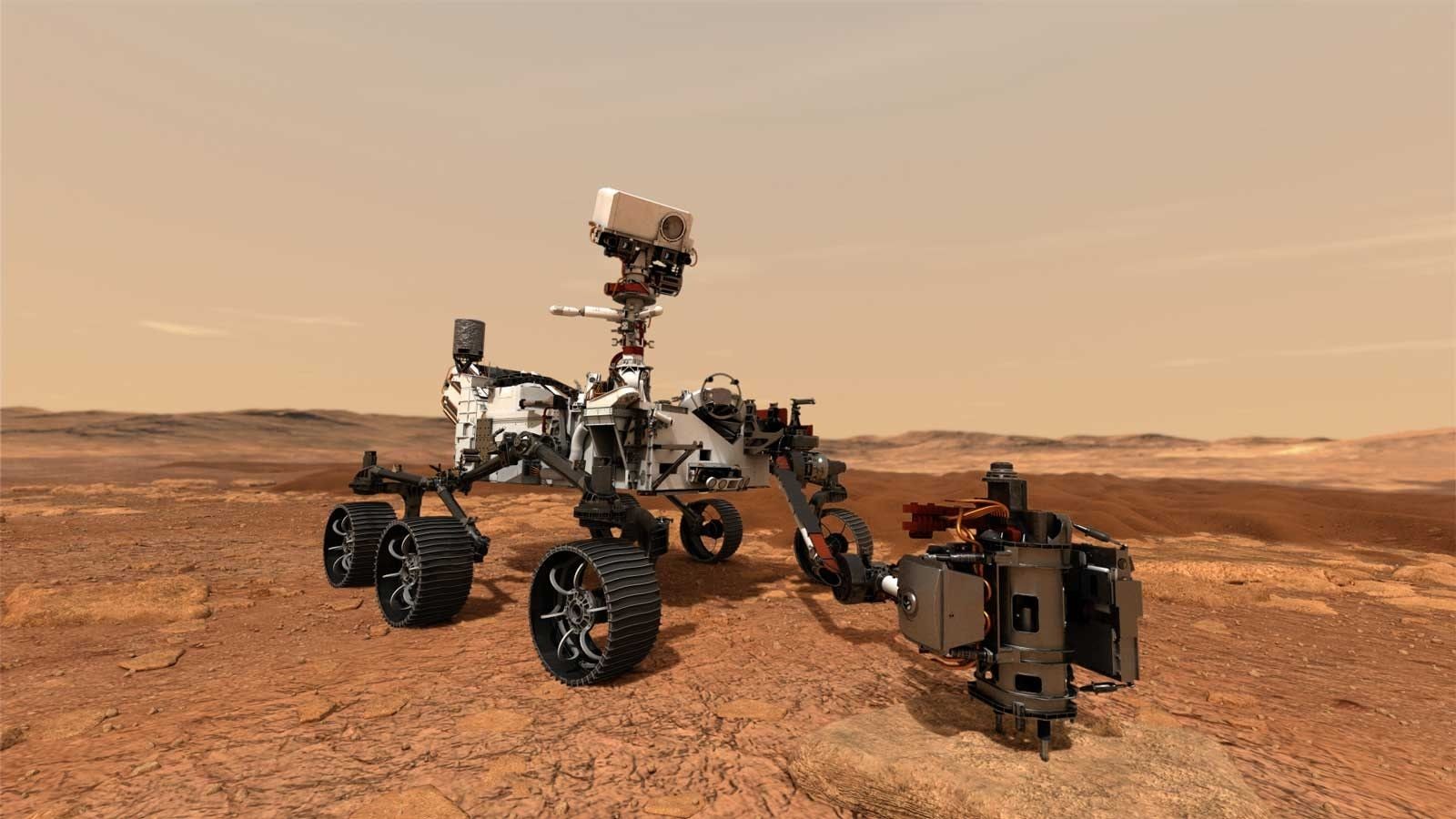
NASA’s Perseverance rover has successfully completed its first autonomous drive on Mars, entirely planned by artificial intelligence (AI). The demonstration, conducted in December 2025, marks a significant step forward in deep-space exploration, paving the way for more efficient and independent robotic missions.
Overcoming Communication Barriers
For decades, controlling rovers on Mars has relied on human planners on Earth. The vast distance—an average of 140 million miles—creates unavoidable communication delays that prevent real-time operation. Instead, mission teams meticulously map out daily routes, analyzing terrain and rover status data to place waypoints every 330 feet to avoid hazards.
This process is labor-intensive and time-consuming. The recent AI test, developed in collaboration with Anthropic using their Claude AI models, aims to automate this critical decision-making process. By analyzing images from the Mars Reconnaissance Orbiter and terrain-slope data, the AI identifies obstacles (rocks, slopes, boulder fields) and generates safe routes for the rover to follow.
AI-Driven Route Planning in Action
The rover executed two test drives, covering nearly 1,500 feet along the rim of Jezero Crater. The AI identified key surface features and mapped out navigation waypoints (represented as blue circles in rover imagery). Alternative route options evaluated by the AI are shown as black lines, illustrating the system’s analytical capabilities.
Before deployment, the mission team rigorously tested the AI-generated instructions using a high-fidelity “digital twin” of Perseverance to ensure safety. This approach minimizes risk and validates the AI’s performance in a simulated environment.
Future Implications for Space Exploration
NASA Administrator Jared Isaacman highlighted the implications of this breakthrough. “This demonstration shows how far our capabilities have advanced and broadens how we will explore other worlds.” Autonomous technologies like this are essential for future missions venturing farther from Earth, where communication delays make human intervention impractical.
Vandi Verma, a space roboticist at JPL, added that this is “a strong example of teams applying new technology carefully and responsibly in real operations.” The AI-driven system has the potential to streamline autonomous navigation for off-planet driving, enabling kilometer-scale drives with minimal human workload.
The fundamental elements of generative AI are showing a lot of promise in streamlining the pillars of autonomous navigation for off-planet driving.
The ability for AI to analyze vast volumes of rover images and flag interesting surface features for the science team represents a leap forward in scientific discovery. This technology is expected to increase the efficiency and effectiveness of future Mars missions, unlocking new opportunities for exploration.
The successful AI-driven drive on Mars confirms that autonomous navigation is no longer a distant possibility but a functional reality. This advancement will reshape how we explore space, enabling faster, safer, and more comprehensive data collection on other worlds.