Comet C/2026 A1 (MAPS) is poised for a high-stakes encounter with the sun on April 4th, potentially becoming visible in the daytime sky – or vanishing entirely in a fiery breakup. This event marks a critical moment in the comet’s four-month journey, as it approaches its closest point to our star at a blistering speed of 322 miles (518 km) per second.
The Origins of a Sun-Grazing Comet
MAPS belongs to the Kreutz sungrazing family, a group of comets linked to a parent comet observed as early as 371 BC by Aristotle. These comets follow erratic paths, often plunging dangerously close to the sun, and are prone to fragmentation. The discoverers, Alain Maury, Georges Attard, Daniel Parrott, and Florian Signoret, located MAPS using a remotely operated telescope in Chile’s Atacama Desert in January 2026.
The reason this matters is that such comets often break apart due to the sun’s intense heat and gravitational forces. This process is not just a matter of destruction; it provides clues about the composition and behavior of these icy bodies, helping astronomers understand the early solar system.
The Perilous Perihelion: April 4th
At 10:24 a.m. EDT (1424 GMT) on Saturday, April 4th, MAPS will pass within 101,100 miles (162,700 km) of the sun’s surface. This proximity presents an existential risk: the comet could either survive, disintegrate during perihelion, or break up shortly after. The outcome hinges on its size and structural integrity.
Warning: Attempting to view this comet directly with the naked eye, binoculars, or telescopes is extremely dangerous. The sun’s infrared radiation can cause irreversible eye damage, including blindness, without any immediate pain.
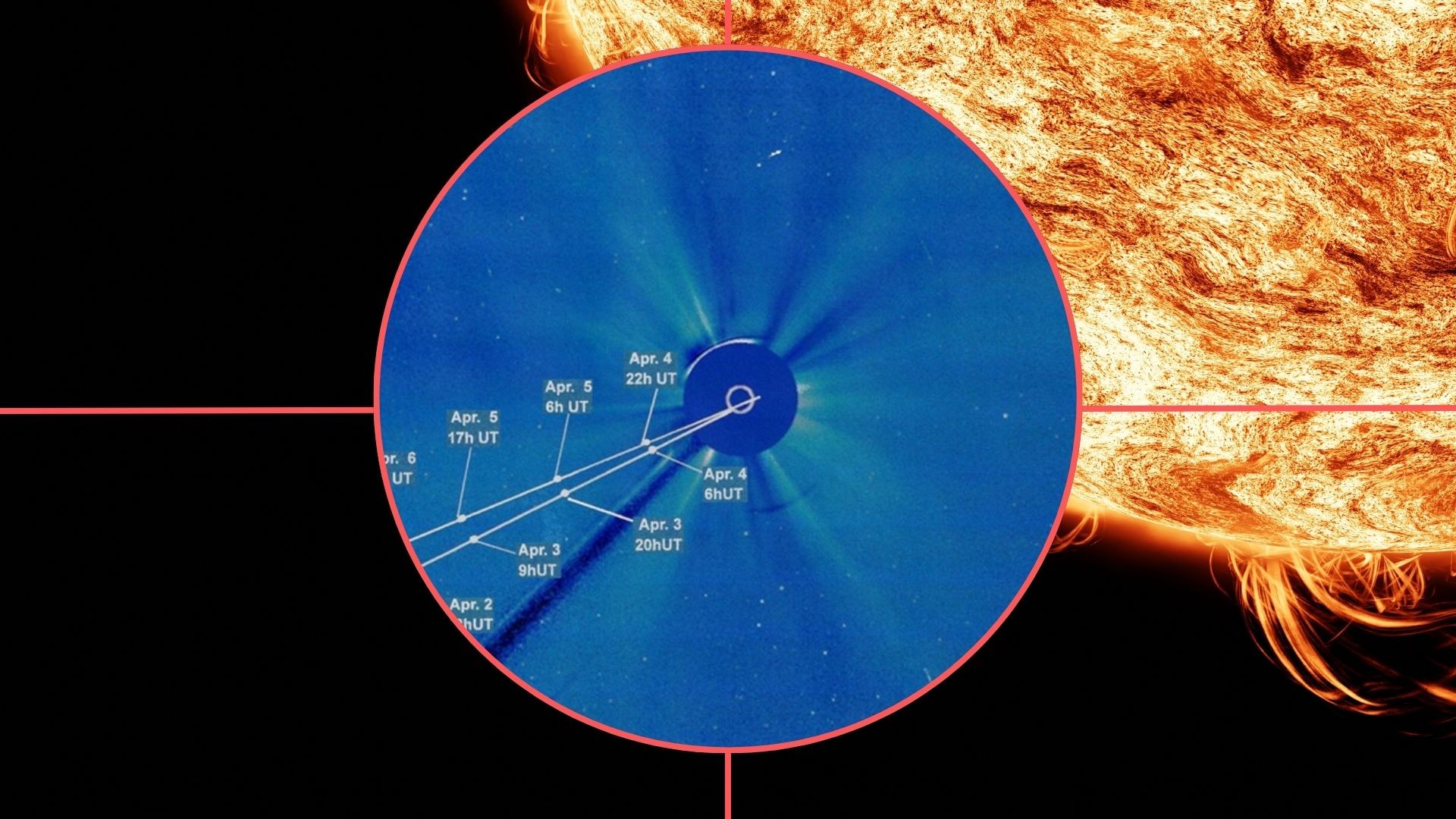
To safely observe MAPS, astronomers recommend monitoring the SOHO satellite’s LASCO C3 camera, which provides near-live imagery of the comet’s trajectory from April 2nd to April 6th. The comet will appear to pass behind the sun from our perspective, then swing around and cross in front of it.
Three Possible Fates
The fate of MAPS remains uncertain, but three scenarios are most likely:
- Complete Disintegration: The comet’s nucleus breaks apart before or during perihelion, leaving no visible remnant. This happened to Comet ISON in 2013, which disintegrated under similar conditions.
- Post-Perihelion Breakup: The comet survives perihelion but fragments shortly afterward, as seen with the Great Southern Comet of 1887 and Comet Lovejoy in 2011. These comets left only faint tails visible after disintegration.
- Survival and Spectacle: The comet endures perihelion and emerges intact, potentially putting on a brilliant display in the western evening sky. The Great Comet of 1965 (Ikeya-Seki) provides a precedent, though it still broke apart while exhibiting a spectacular tail.
Size Matters: A Pundit Nucleus
Recent analysis by the American Astronomical Society (AAS) using the James Webb Space Telescope suggests that MAPS has a relatively small nucleus, measuring only 0.2 miles (0.4 km) in diameter. This size increases the likelihood of disintegration due to outgassing and tidal forces.
The AAS study concludes that MAPS, like Comet ISON, could break apart before perihelion, leaving no observable debris.
What to Watch For
If MAPS does survive at least partially, observers should scan the western horizon between April 8th and April 14th for a faint tail. Binoculars may help against the twilight glow. However, as astronomer David Levy aptly put it, “Comets are like cats: they have tails, and they do precisely what they want!”
The final outcome will be determined by MAPS itself, making this encounter a fascinating yet unpredictable cosmic event.