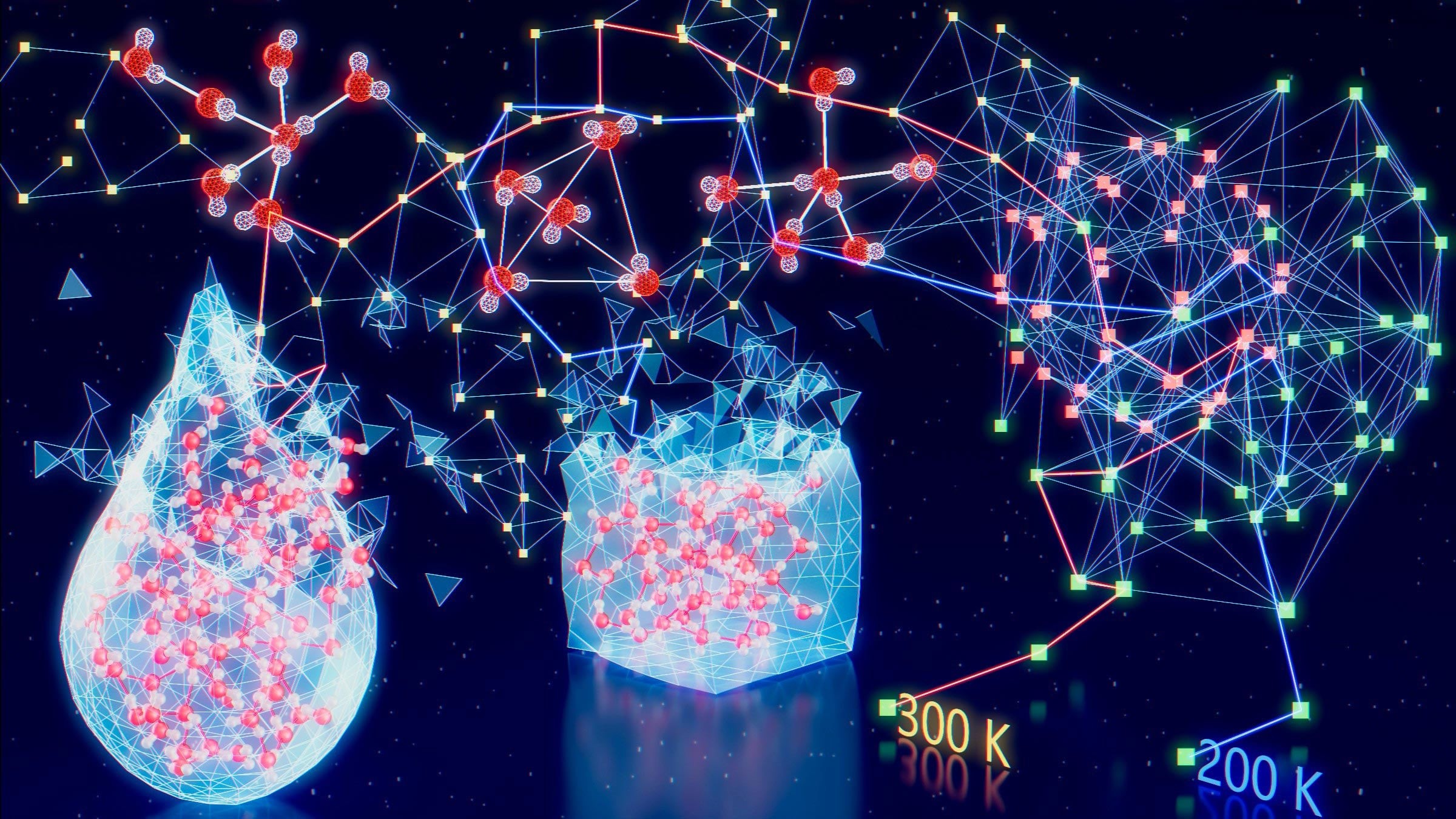
Water is weird.
It covers the planet, gets under your skin, yet refuses to act like a normal liquid. Freeze it? It expands. Weird.
For years, scientists linked this oddness to microscopic structural shifts, but measuring those shifts consistently was a mess. Different scales, different metrics, no clear way to compare them.
Until now.
Researchers at the University of Osaka handed the problem to artificial intelligence. The study, out in Communications Chemistry, uses AI to evaluate how we describe supercooled water’s structure. It turns out, not all descriptions are created equal.
Why Supercooled?
Ice needs a nudge. A crystal lattice demands a nucleation site. A speck of dust, a scratch in the glass. Start there, and growth happens.
Remove the nudge?
Cool water below zero. It stays liquid.
This is supercooled water, and its quirks amplify. Leading theory says it’s a tug-of-war between two competing forms. High-density liquid (HDL), tight and packed. Low-density liquid (LDL), open and spacious. Hydrogen bonds constantly rewire the network. Heat rises? HDL takes over. Cool down? LDL fights back.
“The shift isn’t sudden. It’s a structural negotiation.”
Comparing Apples to Oranges?
Researchers have invented many ways to describe local molecular structure. Tetrahedral bond order. Local density. All useful, none comparable.
One descriptor uses meters, another angles, another raw probability. You can’t just put them in the same spreadsheet.
Kang Kim, the study’s corresponding author, put it simply: past work proved machine learning handles structural data well. They wanted to know if a neural network could mimic human cognition to judge which descriptors actually capture the truth.
They trained the AI on molecular dynamics simulations of that tricky supercooled state. Trial and error, round after round. The network learned the patterns hidden in the noise.
The Verdict
The AI looked at 16 different structural descriptors. Its job? Differentiate between LDL and HDl at various temperatures.
Senior author Nobuyuki Matubayasis reported the results. The network identified which descriptors were actually efficient. Which ones were just noise.
It wasn’t about replacing scientists. It was about filtering signal from clutter.
The framework suggests a clearer path forward. We can finally link microscopic structure changes to macroscopic thermodynamic behavior. Maybe even explain why water behaves the way it does.
A useful tool. A sharper lens.
Water remains remarkable.
But now? We have better eyes to watch it.
Or maybe we don’t. After all, nature likes a secret or two.
Reference: Kohei Yoshikawa et al. “Machine learning evaluation of structural descriptors.” Communications Chemistry (July 6, 2026). DOI: 10.1004/s4204-06-007-1.