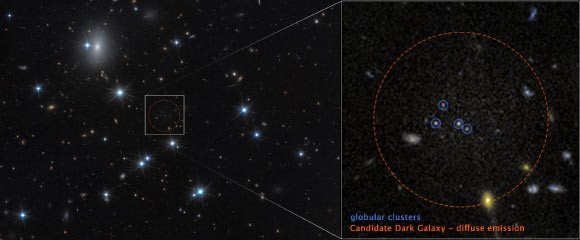
Astronomers have confirmed the existence of a nearly invisible galaxy, dubbed Candidate Dark Galaxy-2 (CDG-2), within the Perseus galaxy cluster. This discovery marks a significant step forward in understanding the role of dark matter in galactic formation, as the galaxy is overwhelmingly dominated by this elusive substance – approximately 99% of its mass.
Unveiling the “Dark” Galaxy
CDG-2 stands out because it consists primarily of dark matter and contains very few visible stars. The galaxy appears to be held together by just four globular clusters, tightly bound collections of ancient stars. Detecting such faint structures is incredibly difficult, requiring advanced statistical methods and powerful telescopes like Hubble, Euclid, and Subaru.
How It Was Found
Researchers, led by Dr. David Li at the University of Toronto, identified CDG-2 by searching for groupings of globular clusters. These clusters act as beacons, signaling the presence of a hidden galaxy. Follow-up observations with high-resolution imaging confirmed a faint glow surrounding these clusters, solidifying the galaxy’s existence.
Why This Matters
The discovery challenges our understanding of how galaxies form and evolve. The Perseus cluster is a dense environment where galaxies frequently interact. CDG-2 likely had most of its normal matter stripped away by gravitational forces, leaving behind a dark matter-rich core. This suggests that some galaxies may form primarily around dark matter halos, with visible stars being secondary.
Key Characteristics
- Dominant Dark Matter: 99% of the galaxy’s mass is dark matter.
- Low Luminosity: CDG-2 has the brightness of about 6 million sun-like stars.
- Globular Cluster-Dominated: The four identified globular clusters account for 16% of the galaxy’s visible content.
- Location: The galaxy resides in the Perseus cluster, roughly 240 million light-years away.
“This is the first galaxy detected solely through its globular cluster population,” Dr. Li stated. This novel method could unlock the discovery of other dark matter-dominated galaxies previously hidden in plain sight.
The research was published in The Astrophysical Journal Letters in June 2025, and represents a critical advance in our understanding of the Universe’s most elusive substance. The existence of CDG-2 reinforces the idea that dark matter is not just a mysterious component of galaxies, but a fundamental driver of their formation.