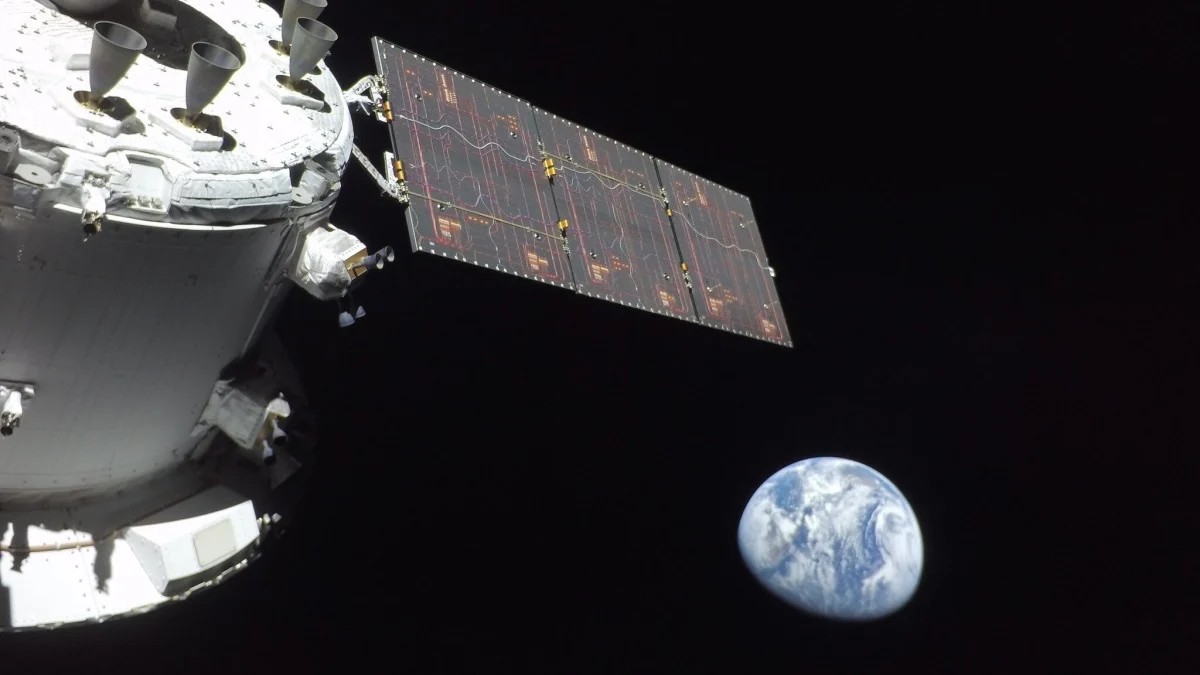
NASA’s Artemis II mission is now underway, marking humanity’s first venture beyond low-Earth orbit in over half a century. However, the path to the Moon is not one of comfort or convenience; the four astronauts aboard—Commander Reid Wiseman, pilot Victor Glover, Christina Koch, and Jeremy Hansen—are facing an immediate and brutal test of endurance.
The First 24 Hours: No Rest for the Weary
The mission began with a launch from Cape Canaveral, Florida, at 6:35 p.m. ET on Wednesday. From the moment the rocket cleared the pad, the crew entered a relentless schedule. The initial 24 hours are dedicated to critical systems checks of life support, communications, and navigation, all while orbiting Earth.
This is not merely about verifying functionality; it’s about confirming that these systems work under the stresses of spaceflight before deeper operations begin. The first day also includes a key demonstration of manual spacecraft steering. Wiseman and Glover will practice docking maneuvers using the discarded upper stage of the rocket—the Interim Cryogenic Propulsion Stage (ICPS)—to simulate future lunar lander encounters.
This practice is not optional. Future missions will require precise docking, and proving the crew’s ability to take manual control is a vital safety measure. The ICPS will then perform a controlled splashdown in the Pacific Ocean after the exercise.
The Sleep-Depriving Burn: Physics Doesn’t Negotiate
One of the most challenging moments of the first day is the “perigee raise” burn. This engine ignition, crucial for reshaping Orion’s orbit into a stable trajectory toward the Moon, is scheduled to occur during the astronauts’ sleep period. NASA flight director Jeff Radigan bluntly states that the timing is dictated by orbital mechanics, not convenience.
“Unfortunately, physics cannot be defied,” Radigan said. “We have to put the burns where they’re necessary for the trajectory.”
The crew began their day at approximately 11:30 a.m. ET on Wednesday, seven hours before launch, and will have just four hours of interrupted rest before being awakened for this critical maneuver. After the burn, they’ll be granted another 4.5 hours of sleep… before the real work begins.
Why This Matters: The Cost of Deep Space Travel
The rigorous schedule is not arbitrary. Deep space missions demand extreme efficiency and adaptability. Unlike flights in low-Earth orbit, where immediate return to Earth is possible, Artemis II is committed to a longer trajectory with less margin for error. Every hour lost to downtime is an hour not spent confirming critical systems or preparing for the next phase.
The timing of the perigee raise burn highlights a fundamental truth: space does not accommodate human biology. It demands that astronauts operate on its terms, not their own. This reality will only become more pronounced as missions venture further into the solar system.
The Artemis II crew understands this. As pilot Victor Glover wryly put it, they’re not getting a “bedtime,” just a “nap.” This mission is a reminder that space exploration is not just about technological achievement; it’s about pushing the limits of human endurance.