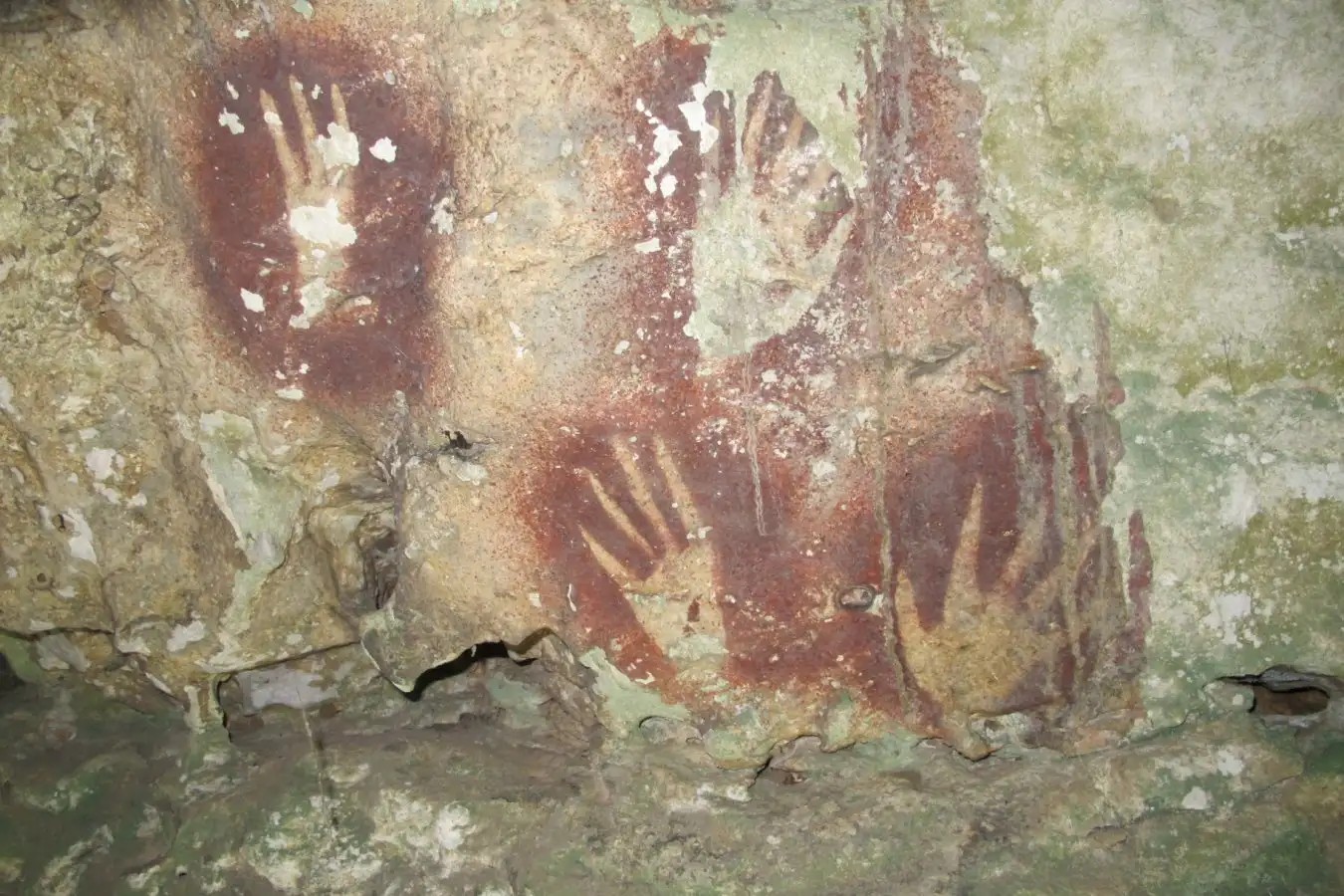
A newly discovered hand stencil in Sulawesi, Indonesia, is now the oldest known example of rock art in the world – dating back a staggering 67,800 years. This finding pushes back the timeline of human artistic expression and offers fresh insights into the cognitive abilities of early Homo sapiens. Unlike simple handprints, this particular stencil shows deliberate modifications, with the artist seemingly altering the fingers to resemble claws.
Sulawesi: A Cradle of Early Human Innovation
Sulawesi has emerged as a critical region in understanding human evolution and migration. Archaeological evidence suggests that this island was inhabited by various hominin species, including Homo erectus, as early as 1.4 million years ago. The latest discoveries reinforce its role as a key stepping stone for early humans venturing towards Australia.
Just last year, researchers identified representational art in Sulawesi – a 51,200-year-old depiction of a pig alongside human figures. Now, this older hand stencil at Liang Metanduno site in Muna Island, east Sulawesi, surpasses previous records, including a 66,700-year-old stencil found in Spain attributed to Neanderthals.
What Makes This Discovery Unique?
The Sulawesi stencil isn’t merely old; it’s intentional. The artist actively manipulated the outline of the hand, narrowing the fingers, possibly to mimic animal claws. This technique – unique to Sulawesi so far – involved either adding pigment strategically or moving the hand during application.
“It’s more than just a stencil of a hand,” said Maxime Aubert of Griffith University. “They are retouching it… they want to make it look more like it’s an animal hand, possibly with claws.”
The modification suggests advanced cognitive thinking: abstract imagination and creative playfulness not seen in Neanderthal markings. The question remains why they altered the print. Was it symbolic? A form of early storytelling? We simply do not know yet.
Implications for Human Migration
Determining who created this art is difficult, but the intentional modification suggests modern humans rather than Neanderthals. This implies that ancestors of the first Australians were active in Sulawesi at least 68,000 years ago. Evidence shows that Homo sapiens reached Australia around 60,000 years ago, and Sulawesi likely served as a critical route for migration to New Guinea and beyond.
“The people who made that art are probably the ancestors of the first Australians,” Aubert concluded.
Further research is needed to map the exact routes early humans took, but this discovery confirms that the region was a hub for artistic innovation and human movement during a pivotal period in our history.
The new find is the world’s oldest known rock art that can be attributed to our species. More work is needed before it can be confidently concluded which routes humans took to reach Australia.